Summer can make exercise feel like a chore. Heat, humidity and long days can leave even motivated people looking for an excuse to stay inside. Then fall arrives and suddenly moving feels easier.
That is why I think fall is a great time to rebuild a fitness routine after 50. You do not need to start with something extreme. You need a routine you can repeat.
Use the weather to your advantage
Cooler mornings can make walking and other outdoor activity much more comfortable. If heat has kept you inactive, fall removes one of the biggest excuses.
Start with walking
Walking is not glamorous, but it is practical. Start with a time and distance that feels manageable and gradually add more. The important part is creating the habit of getting up and moving.
Keep strength training in the mix
After 50, fitness should not be only about burning calories. Strength work matters because maintaining muscle and strength supports everyday activities such as getting up from a chair, carrying groceries and climbing stairs.
You can use machines, free weights, resistance bands or simple bodyweight exercises. The equipment matters less than learning good form and progressing gradually.
Do not make your first week your hardest week
Many people feel motivated, do too much, get extremely sore and then disappear for two weeks. A better approach is to finish a workout feeling like you could have done a little more. Consistency beats enthusiasm when enthusiasm burns out.
Make fall activity enjoyable
Walk somewhere with changing leaves. Listen to music or a podcast. Meet a friend. Take the dog. If an activity is enjoyable, you are more likely to keep doing it.
If you have a medical condition, significant pain or have been inactive for a long time, check with your healthcare professional about the right way to restart.
This is a season for building momentum
You do not have to transform your body this fall. You just need to become a person who moves regularly again. Once that habit is established, the rest gets much easier.
Common Questions
Why is fall a good time to get moving again after 50? Cooler temperatures can make outdoor activity more comfortable, and the change of season can provide a fresh starting point.
What exercise should I start with after a break? Start with manageable walking, mobility work, and basic strength exercises that match your current fitness level.
How quickly should I increase exercise after 50? Increase duration or intensity gradually rather than making a large jump all at once.
Can walking help me get back into fitness after 50? Yes. Walking is accessible and can help rebuild regular activity and cardiovascular fitness.
Should I add strength training after 50? Yes. Regular resistance exercise helps maintain muscle and strength and can complement walking.
Do I need to exercise every day? No. The goal is consistent weekly activity with appropriate recovery, not necessarily a hard workout every day.
What if I am starting from zero? Begin with short, comfortable sessions and build from there.
How can I stay motivated through the fall? Set simple goals, schedule workouts, choose activities you enjoy, and track consistency instead of perfection.
Can I exercise outside when it gets cooler? Yes, if conditions are safe and you dress appropriately. Move indoors when weather makes outdoor exercise uncomfortable or unsafe.
What is the simplest fall fitness plan after 50? Walk regularly, add strength training, keep moving during the day, and progress gradually.
Practical takeaway: Keep the ideas from this post simple enough to use consistently. Small, repeatable habits usually work better than trying to change everything at once.
A gentle health note: This post provides general information, not personalized medical advice. If you have persistent, severe, or unusual symptoms, or are making a major change to exercise or health routines, discuss it with a qualified healthcare professional.
Affiliate Disclosure
Affiliate Disclosure: Some links in this post may be affiliate links. If you purchase something through one of these links, Well After 50 may earn a small commission at no extra cost to you. This helps support the site and allows us to continue creating helpful content.
Written by Tom Green, creator of Well After 50
Tom is the creator of Well After 50, focused on practical skincare, wellness, fitness, and healthy-aging ideas after 50.
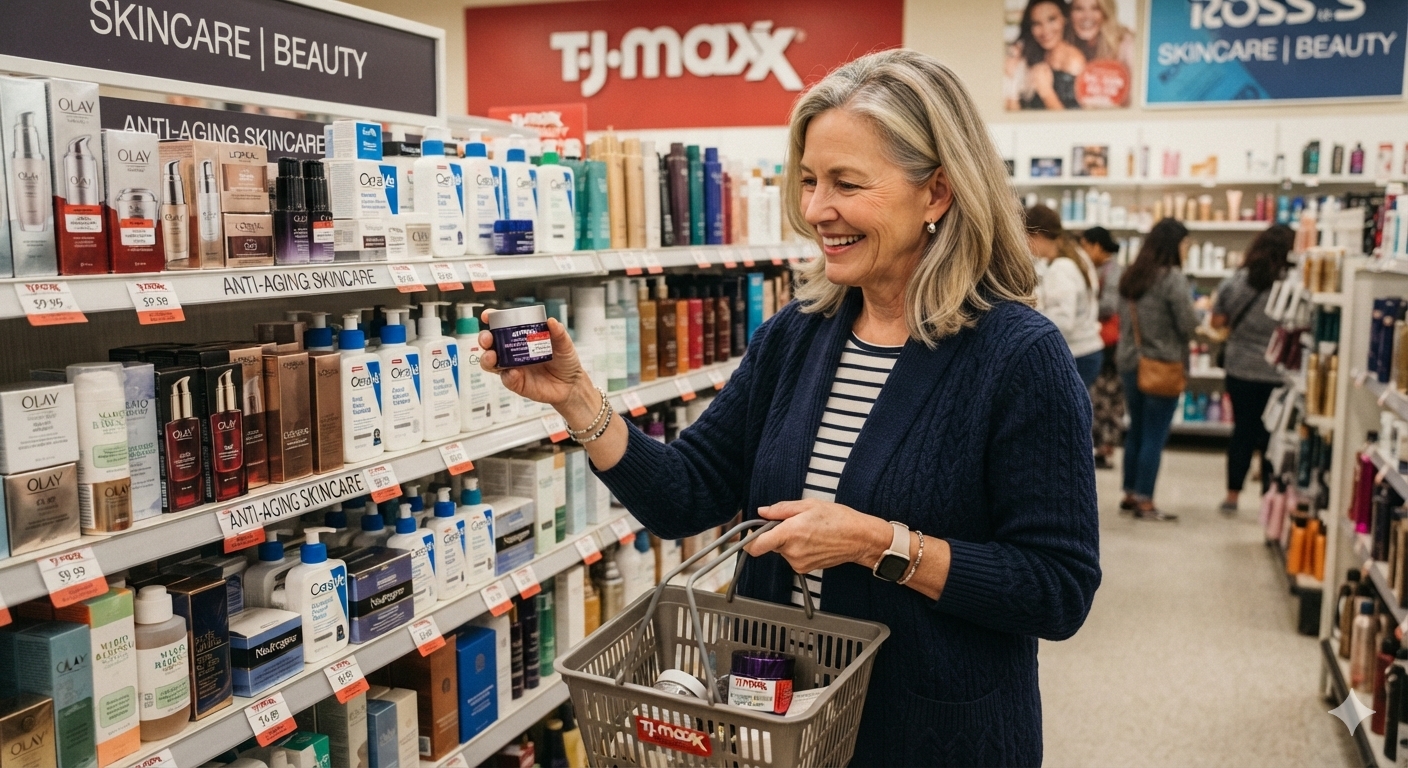
If you like finding good skincare without paying full beauty-store prices, there are three stores worth checking: TJ Maxx, Ross and Marshalls.
I was at TJ Maxx recently and was surprised by how much skincare was on the shelves for fall. There were plenty of products I hadn’t seen before, including a lot of Korean skincare. That made me wonder: Can you actually find good skincare for less at these stores?
Yes—but bargain shopping for skincare takes a little more attention than simply grabbing the prettiest bottle.
Why TJ Maxx, Ross and Marshalls Are Worth Checking
Inventory changes constantly at discount retailers, which is part of what makes shopping there interesting. You may find cleansers, moisturizers, serums, masks, eye products and other skincare at prices well below the comparison prices shown by the retailer.
TJ Maxx currently lists a large selection of skincare, including products made in Korea. Its online selection has included rice serums, ginseng cleansers, ceramide cleansers, hydrogel masks, vitamin C products and other skincare at relatively low prices. Marshalls also currently lists Korean skincare such as hyaluronic acid essence, toner pads, peptide eye patches and snail mucin serum.
That doesn’t mean every bargain is a great bargain. The product still matters more than the price.
Korean Skincare Is One of the Interesting Finds
One of the things that caught my attention was the amount of Korean skincare showing up on these shelves.
Korean skincare often puts a big emphasis on hydration, gentle cleansing, skin-barrier support and lightweight layers. You may see ingredients such as hyaluronic acid, ceramides, niacinamide, centella asiatica, rice extracts, peptides and snail mucin.
For many people 50+, that focus on hydration can be appealing because skin often becomes drier and more easily irritated with age.
But don’t buy a product just because the words Korean skincare are printed on the package. Read the ingredient list and decide whether you actually need it.
What I Would Look For After 50
1. A gentle hydrating cleanser
If your skin feels tight after washing, a gentler cleanser may make more sense than a harsh, squeaky-clean formula. Look for moisturizing ingredients such as glycerin and consider a cleanser designed for dry or sensitive skin if that describes you.
2. A good moisturizer
A moisturizer is one of the places where you don’t necessarily need to spend a fortune. Ingredients such as glycerin, ceramides, hyaluronic acid and squalane are worth recognizing when you read labels.
3. A simple hydrating serum
You don’t need five serums sitting on your bathroom counter. A simple hydrating serum can be enough if dryness is your main concern.
4. Niacinamide
Niacinamide is another ingredient worth knowing. It is used in many skincare formulas and can be found in affordable products. As with any active ingredient, more isn’t automatically better.
5. Sunscreen—but check the date
This is where I would be especially careful with bargain shopping. Sunscreen is regulated as a drug in the United States, unlike ordinary cosmetics, and sunscreen products are required to carry expiration dating. Don’t buy expired sunscreen just because the price looks good.
The Expiration-Date Warning You Shouldn’t Ignore
Here’s something many shoppers don’t realize: ordinary cosmetics are not required by U.S. law to have an expiration date printed on the package. The FDA explains that cosmetic shelf life depends on the product, how it is used and how it is stored.
That makes it especially important to inspect bargain-store skincare before you buy it.
Look for an expiration date when one is provided.
Check that the seal is intact.
Don’t buy a leaking or damaged package.
Look for unusual changes in color or texture.
Smell the product only if it can be safely checked without opening a sealed package.
Be especially careful with products that have been exposed to heat or moisture.
The FDA notes that cosmetics can change in color, texture and smell as they deteriorate, and heat and moisture can make problems worse.
Be Extra Careful With Eye Products
I’m more cautious when bargain shopping for anything that goes around the eyes.
Eye-area cosmetics can have shorter useful lives because applicators can repeatedly introduce microorganisms. The FDA specifically warns that older eye cosmetics can pose infection risks.
If an eye product looks old, damaged or questionable, I would leave it on the shelf.
Don’t Let a $7 Price Tag Talk You Into Buying Everything
This is probably the easiest mistake to make in a discount beauty aisle.
You see a $7 serum. Then an $8 mask. Then a $6 toner. Suddenly you’ve spent $30 on products you never planned to buy.
Instead, ask yourself one question:
What does my skin actually need?
If your skin is dry, start with a gentle cleanser and moisturizer. If your basic routine is already working, maybe add one serum. You don’t need a 10-step routine because the products are inexpensive.
Read the Back Before You Fall in Love With the Front
Beautiful packaging can be tempting, especially when the price is low. But the front of the bottle doesn’t tell you everything you need to know.
Check the ingredient list, directions, warnings, skin-type information and size of the container. And don’t assume words such as “natural” or “hypoallergenic” automatically mean a product is safer or better for you. The FDA recommends reading the complete label.
TJ Maxx, Ross or Marshalls?
I wouldn’t declare one store the winner.
The inventory changes, so one visit may be completely different from the next. You might find the best moisturizer at Marshalls one week and a great Korean cleanser at TJ Maxx the next. Ross can surprise you, too.
Shop the product—not the store.
My 50+ Bargain-Skincare Strategy
Start with what your skin actually needs.
Look at ingredients instead of just the packaging.
Check seals and packaging for damage.
Check expiration dates when applicable.
For sunscreen, always check the expiration date.
Don’t assume a “compare at” price means the product is automatically a bargain.
Buy one or two products and see how your skin responds before building a whole new routine.
The Bottom Line
TJ Maxx, Ross and Marshalls can be worth exploring if you’re looking for budget-friendly skincare after 50.
The growing selection of Korean skincare makes these stores even more interesting. But bargain shopping still requires a little homework.
Don’t assume expensive means better. Don’t assume cheap means bad. And don’t assume a beautiful package means the product is right for your skin.
Read the ingredients. Check the packaging. Watch the dates. And buy for your skin—not simply because the price tag is tempting.
Common Questions
Is TJ Maxx a good place to buy skincare?
It can be. TJ Maxx currently carries a wide range of skincare, including Korean products. Inventory changes frequently, so inspect each product before buying.
Is Korean skincare good for people 50+?
It can be. Many Korean skincare products emphasize hydration and gentle routines, but the best choice depends on your skin and the ingredients in the individual product.
Do skincare products at TJ Maxx expire?
Some products have expiration dates and ordinary cosmetics are not required by U.S. law to display one. That is why it is important to inspect packaging, condition and dates when available.
Should I buy sunscreen at a discount store?
You can, but check the expiration date carefully. Sunscreen is regulated differently from ordinary cosmetics and should not be used after its expiration date.
What’s the best skincare bargain after 50?
There isn’t one product that is best for everyone. A gentle cleanser, moisturizer and daily sunscreen are a sensible starting point for many people, with other products added according to individual needs.
Tom Green is the creator of Well After 50, where he writes about practical skincare, fitness, wellness and healthy-aging ideas for life after 50. His goal is simple: share useful information that can help make getting older feel a little easier—and a lot more manageable.
This article is for general information and isn’t a substitute for professional medical or dermatological advice. If a skincare product causes persistent irritation, burning, swelling or another concerning reaction, stop using it and seek appropriate medical advice.
I like skincare, but I don’t like wasting money. And after 50, it can be especially easy to end up with a bathroom cabinet full of serums that sounded great when we bought them but never became part of a routine.
Serums can be useful. The problem is that more serums do not automatically mean better skin. What matters is knowing what you are trying to improve, choosing an ingredient for a reason, and actually using the product consistently.
Start With One Simple Question
Before buying another serum, ask yourself: What exactly am I trying to improve?
Maybe your skin feels dry. Maybe you are concerned about the appearance of fine lines, uneven tone, dullness or loss of firmness. Those concerns can call for different approaches.
If you cannot explain what you want the product to do, that is a pretty good reason to leave it on the shelf.
Don’t Let Your Bathroom Become a Chemistry Experiment
One of the easiest skincare mistakes is adding product after product without knowing how they work together.
You might have a vitamin C product, a retinoid, an exfoliating acid, a peptide serum and a hydrating serum all competing for a place in the same routine. Then your skin becomes irritated and you have no idea which product caused it.
There is nothing wrong with having more than one targeted product. But I would rather know exactly why each one is there than use five different products simply because they are popular.
Look Past the Bottle
Serum marketing can make almost anything sound revolutionary. Words such as “advanced,” “renewing,” “firming” and “age-defying” can grab your attention, but the ingredient list tells you much more.
For example, hydrating ingredients can be useful when skin feels dry or tight. Retinoids are commonly used for concerns involving fine lines and texture. Vitamin C is commonly used for antioxidant support and uneven-looking tone. Peptides are popular in products aimed at improving the appearance of firmness.
The point isn’t that one ingredient is magically better than everything else. The point is that you should know what you are buying and why you are buying it.
The Basics Still Matter More Than the Hype
This isn’t as exciting as buying a new serum, but a simple foundation matters.
A gentle cleanser, a moisturizer that works for your skin and daytime sun protection can form the backbone of a sensible routine. If those basics are missing, I wouldn’t expect another expensive serum to rescue the whole routine.
And if your skin is already dry, burning, peeling or irritated, adding another active product may be the wrong move. Sometimes the smartest skincare decision is to simplify for a while.
Give New Products a Fair Chance
Another way we waste money is by changing products constantly.
Skincare usually isn’t an overnight project. Some products take time to show noticeable results, and the improvement may be subtle rather than dramatic.
At the same time, “give it time” does not mean you should ignore a bad reaction. If something consistently causes significant irritation, stop and reconsider rather than forcing yourself to keep using it because the bottle was expensive.
I like the idea of making one meaningful change at a time. That way, you have a much better chance of figuring out what is actually helping.
Five Questions Before You Buy Another Serum
What problem am I trying to address?
What ingredient am I buying for?
Am I already using something with a similar purpose?
Will this fit into the routine I already have?
Will I realistically use it consistently?
If you can’t answer those questions, you may not need another serum yet.
Expensive Doesn’t Automatically Mean Better
A higher price does not guarantee that a serum will be a better match for your skin. A less expensive product isn’t automatically a bad product either.
For me, the bigger questions are the formula, the ingredients, how my skin tolerates it and whether I can use it consistently.
I would much rather have a straightforward routine that I actually follow than a shelf full of products that looked exciting when I bought them.
When a Serum Really Can Make Sense
A serum can earn its place when it fills a specific need.
If your basic routine is working and you have a particular concern you want to address, adding one targeted product can make sense. You don’t have to overhaul everything at once.
That is especially important after 50, when skin can become less forgiving of routines that are overly aggressive or complicated.
Common Questions
Do you really need a serum after 50?
No. A serum is optional. A good cleanser, moisturizer, and daily sunscreen can form the foundation of a simple skincare routine.
Are expensive serums worth the money after 50?
Not necessarily. Price doesn’t guarantee better results. Look at the ingredients, your specific skin concern, and how well your skin tolerates the product.
How do you use a serum correctly after 50?
Apply it after cleansing and before moisturizer. In the morning, finish with broad-spectrum sunscreen.
How many serums should you use after 50?
Usually, you don’t need several. One targeted serum that addresses a specific concern can be a better starting point than layering multiple products.
Can using too many serums hurt your skin?
It can. Layering too many active ingredients may cause dryness, redness, peeling, or irritation.
Should you use a different serum for every skin concern?
Not necessarily. Start with the concern that matters most to you and choose one useful product before adding anything else.
What serum ingredients are worth considering after 50?
Depending on your goal, ingredients such as hyaluronic acid, niacinamide, vitamin C, and retinoids may have a place in a mature-skin routine.
How long should you use a serum before judging the results?
Give a product consistent use over time rather than expecting an overnight transformation. Some effects, such as improved hydration, may be noticed sooner than changes in fine lines or texture.
What is the biggest mistake people make with serums after 50?
Buying products because they sound impressive without first deciding what problem they want the serum to address.
What is the simplest way to use serums after 50? Identify one concern → choose one appropriate serum → introduce it gradually → moisturize → use sunscreen in the morning.
Serums aren’t the enemy. Mindless serum shopping is.
Figure out what you want to improve. Choose a product for a reason. Introduce it thoughtfully. Give it a fair chance. And don’t forget the basics while chasing the newest bottle.
Good skincare isn’t about owning the most products. It’s about having products that make sense for you and actually using them.
This is general skincare information based on research and personal experience, not medical advice. Everyone’s skin is different, so consider professional advice for persistent irritation or a specific skin condition.
Affiliate Disclosure: Some links in this post may be affiliate links. If you purchase something through one of these links, Well After 50 may earn a small commission at no extra cost to you. This helps support the site and allows us to continue creating helpful content.
Written by Tom Green, creator of Well After 50
Tom is the creator of Well After 50, focused on practical skincare, wellness, fitness, and healthy-aging ideas after 50.
The Ordinary is one of those skincare brands that can be both exciting and a little dangerous for someone over 50. The prices are approachable, the ingredient names are everywhere, and suddenly it is very easy to imagine that you need six different serums.
But here is the question I think matters more than the price: Can you build a routine with The Ordinary that actually makes sense for mature skin?
Yes—but I would keep it much simpler than the giant lineup of bottles might tempt you to do.
Why The Ordinary Gets So Much Attention
The appeal is easy to understand. The brand focuses heavily on individual ingredients and targeted formulas, rather than making every product sound like a mysterious luxury treatment.
The current lineup includes products built around peptides, retinoids, hyaluronic acid, niacinamide, vitamin C, squalane and other active ingredients. It also has products specifically organized around concerns such as signs of aging, dryness, uneven tone and texture. citeturn0search0turn0search1
For someone who wants to understand what they are putting on their face, that transparency can be appealing.
But Mature Skin Doesn’t Need Everything
This is where I think people can get into trouble.
You see a $10 serum for one concern, another inexpensive serum for something else, and another one that promises brighter or smoother-looking skin. Because each bottle seems affordable, buying several doesn’t feel like a big decision.
Then you have a bathroom shelf full of active ingredients and no idea which one is causing the dryness or irritation.
Older skin can already be more prone to dryness and sensitivity. A routine that looks impressive on paper can be a terrible routine if your skin is constantly irritated.
The Basics Come First
Before adding an active serum, I would get the foundation under control:
Gentle cleanser: Clean your skin without leaving it feeling stripped.
Moisturizer: Use one that leaves your skin comfortable rather than tight.
Sun protection: Protect exposed skin during the day with broad-spectrum sunscreen.
One treatment: Add a targeted active based on your actual concern.
That may sound almost too simple. That’s exactly why I like it.
If Wrinkles and Texture Are Your Main Concern
Retinoids are among the most studied topical ingredients for signs of skin aging. The Ordinary currently offers several retinoid options, including retinol formulas and Retinal 0.2% Emulsion. Its own 2026 guidance emphasizes introducing retinoids carefully and building tolerance rather than jumping straight into an aggressive routine. citeturn0search6
If you are new to retinoids, I would not start by combining one with every other active you own. Start slowly, pay attention to how your skin responds, and give it time.
And because retinoids can increase irritation and sun sensitivity, daytime sun protection remains an important part of the routine. citeturn0search6
If Dryness Is the Bigger Problem
Sometimes the answer isn’t another anti-aging active. Sometimes your skin is simply asking for more support.
The Ordinary currently offers hydrating products such as Hyaluronic Acid 2% + B5 and moisturizers containing ingredients intended to support hydration and the skin barrier. citeturn0search0turn0search3
If your skin feels tight, flaky or uncomfortable, I would rather see you simplify the routine and improve hydration than keep adding stronger treatments.
What About Peptides?
Peptides have become a major part of the mature-skin conversation, and The Ordinary has several peptide products, including Multi-Peptide + HA Serum, Matrixyl 10% + HA and Multi-Peptide + Copper Peptides 1% Serum. citeturn0search0turn0search1
I think peptides can be an interesting option when you want a treatment step without making your routine all about exfoliation or strong retinoids. But I would still judge the product by the formula and how your skin responds—not by the word “peptide” printed on the bottle.
Niacinamide Can Be Useful, Too
Niacinamide is another ingredient that shows up frequently in The Ordinary’s lineup. The brand currently sells Niacinamide 10% + Zinc 1% as a product aimed at smoothing and brightening the look of skin, along with other niacinamide-containing formulas. citeturn0search0turn0search3
But again, stronger is not automatically better. If a high-concentration product irritates your skin, a lower-strength or simpler formula may be a better fit.
The Routine I Would Build First
If I were trying to keep a The Ordinary routine straightforward, I would think in terms of jobs rather than collecting products.
Morning
Gentle cleanse or simply rinse, depending on your skin.
One hydrating or targeted serum if you actually need one.
Moisturizer if needed.
Broad-spectrum sunscreen.
Evening
Cleanse.
Use one treatment product.
Moisturize.
That is enough to start. You can add complexity later if there is a good reason.
Don’t Start Five New Products on the Same Night
This is probably my biggest piece of advice.
If you add a cleanser, acid, retinoid, peptide serum and a new moisturizer all at once, you won’t know what your skin likes or dislikes.
Introduce products one at a time. Give your skin time to adjust. If irritation shows up, you have a much better chance of identifying the culprit.
Be Careful With Acids and Retinoids Together
The Ordinary itself advises using retinoids and direct acids such as glycolic acid on alternate evenings rather than stacking them together, especially while your skin is adjusting. citeturn0search6
That is a good example of why an ingredient-focused brand requires you to pay attention. The fact that two products are individually useful does not mean they belong in the same routine at the same time.
So, Is The Ordinary Worth It?
I think it can be—especially if you like affordable, ingredient-focused skincare and are willing to keep your routine under control.
But I wouldn’t buy The Ordinary simply because the prices make it easy to accumulate products. A $10 serum you never use consistently is not a bargain.
The real value is finding a few formulas that address your actual concerns and fit comfortably into a routine you can stick with.
My Rule for Mature Skin: Don’t Chase More
After 50, I think skincare gets better when you stop treating every line, spot and texture change like a separate emergency.
Choose your biggest concern. Build a solid foundation. Add one active. Watch how your skin responds. Then decide whether you actually need anything else.
The Ordinary gives you plenty of choices. You don’t have to use all of them.
The Ordinary Brighten & Hydrate Skin Care Set, 3-Piece Skincare Collection
Glycolic Acid 7% Exfoliating Toner 3.4 Fl Oz, Hyaluronic Acid 2% + B5 1 Fl Oz, Natural Moisturizing Factors + HA 3.4 Fl Oz Budget friendly set for 28.20 https://amzn.to/4AN7ufs
Common Questions
Is The Ordinary skincare worth it for mature skin after 50? It can be, especially if you want straightforward products focused on specific ingredients without paying for a luxury brand.
Which The Ordinary products are useful for mature skin after 50? Products containing ingredients such as hyaluronic acid, niacinamide, vitamin C, or retinoids may be useful depending on your specific skin concerns.
Can The Ordinary help with dry skin after 50? Yes. Hydrating products can help improve the feel and appearance of dry or dehydrated mature skin.
Can The Ordinary products help with wrinkles after 50? Some ingredients, particularly retinoids, may help improve the appearance of fine lines and skin texture over time. Results vary.
How should you build a The Ordinary routine after 50? Start simple: gentle cleanser → one targeted serum or treatment → moisturizer → sunscreen in the morning.
Can you use several The Ordinary serums together after 50? You don’t need to. Using too many active ingredients at once can increase irritation. Start with one targeted product and add others carefully if needed.
Can you use The Ordinary retinoids after 50? They may be an option, but retinoids can cause dryness and irritation. Start gradually, follow the product directions, and use sunscreen during the day.
Do you need The Ordinary products if you have mature skin? No. The Ordinary is one option, not a requirement. Choose products based on your skin’s needs rather than the brand name.
Is The Ordinary better than expensive skincare after 50? Price alone doesn’t determine whether a skincare product works for you. Ingredient selection, formulation, consistency, and how well your skin tolerates it matter more.
What is the simplest The Ordinary routine after 50? Cleanse → choose one useful treatment → moisturize → sunscreen every morning. Keep the routine simple before adding more products.
Practical takeaway: The Ordinary can be worth considering after 50, but you don’t need a bathroom full of serums. Choose one product for one specific concern and see how your skin responds.
A gentle skincare note: Introduce new active ingredients gradually. If you develop persistent burning, swelling, rash, or significant irritation, stop using the product and consider talking with a dermatologist.
This article reflects my personal perspective and general skincare research. I’m not a dermatologist or healthcare professional, and this isn’t medical advice. If you have a persistent skin problem, significant irritation, or a condition that concerns you, talk with a qualified healthcare professional or dermatologist.
Affiliate Disclosure: Some links in this post may be affiliate links. If you purchase something through one of these links, Well After 50 may earn a small commission at no extra cost to you. This helps support the site and allows us to continue creating helpful content.
About Tom Green
Written by Tom Green, creator of Well After 50. Tom shares practical, straightforward ideas about skincare, fitness, nutrition, wellness and healthy aging after 50.