Are you too old to start over after 50?
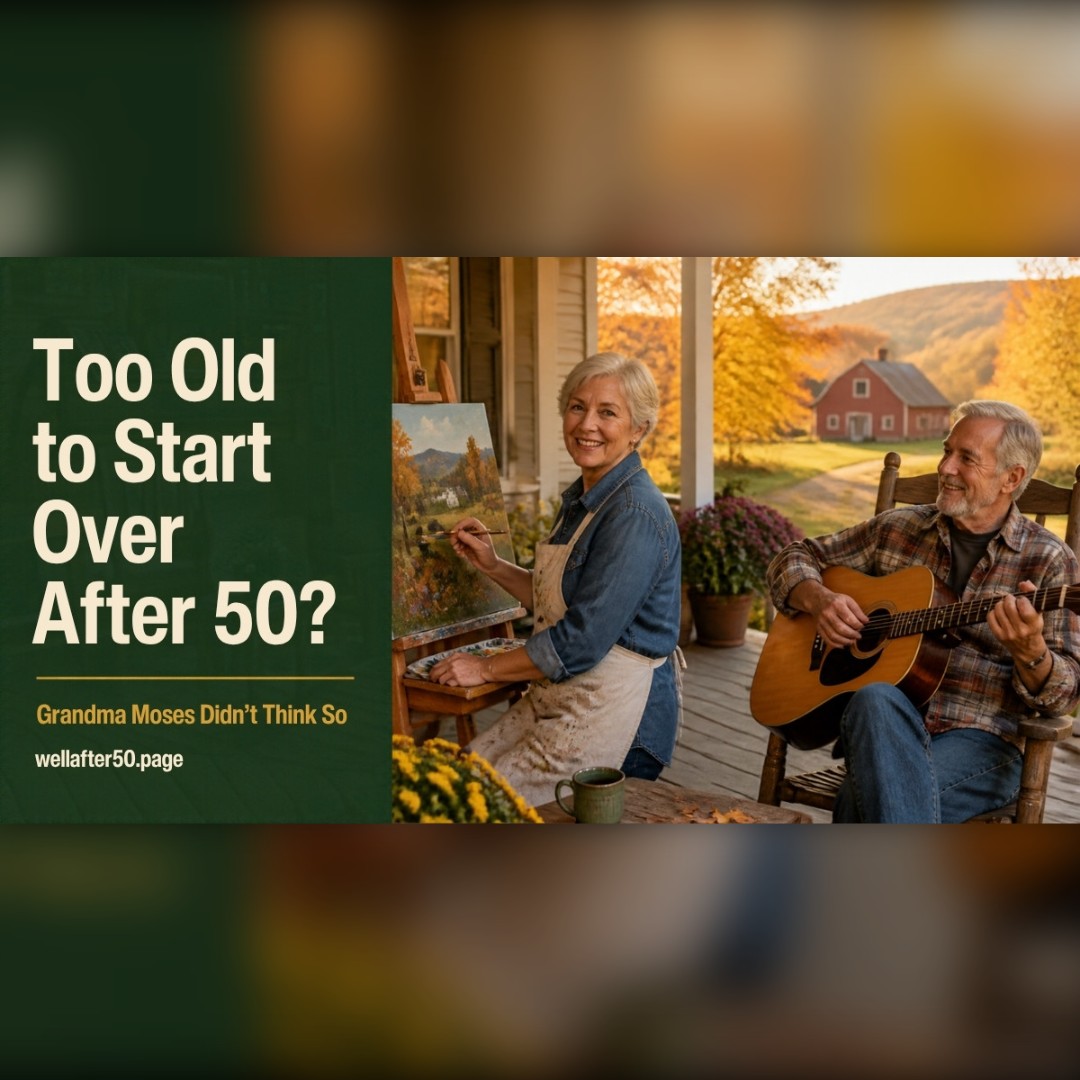
Short answer: No, you’re not too old to start over after 50. Grandma Moses didn’t take up painting seriously until her late 70s and kept painting into her 100s. Laura Ingalls Wilder was in her 60s when her first Little House book came out. Start small, like ten pages, ten minutes or one phone call.
Ever catch yourself thinking, “I’m too old to start over”? Every so often somebody tells me, “I should’ve done this years ago.”
Maybe it’s a trip they never took. A guitar sitting in the closet. A garden they keep meaning to plant. A book they’ve been “fixing to write” since the kids were little.
And then right behind it comes the real question: At my age, what’s the point?
I reckon the point is that you’re still here. The years you’ve already lived don’t disqualify you from the ones still coming.
I Started This Site at 64
I’ll tell you straight: I started Well After 50 at 64. I didn’t know much about websites. I made plenty of mistakes, and some of them I’m still cleaning up. But I’m glad I didn’t wait for the “right time,” because the right time wasn’t coming. It was just going to keep being later.
I’m not telling you that to brag. I’m telling you so you know the fellow writing this is in the same boat as a lot of y’all.
Some Folks Who Didn’t Get Going Until Later
When I start thinking I’m too old for something, I think about these people:
- Grandma Moses (Anna Mary Robertson Moses) didn’t take up painting seriously until she was in her late 70s, after arthritis made her embroidery too hard. She kept painting into her 100s, and her farm scenes ended up in museums. (Wikipedia)
- Frank McCourt taught high school in New York for about 30 years. He published his first book, Angela’s Ashes, at 66, and it won the Pulitzer Prize. (NPR)
- Laura Ingalls Wilder was in her 60s when her first Little House book came out. (United Methodist Communities)
There’s a whole website full of stories like these called Later Bloomer, and it’s worth a look on a day you’re feeling behind. Larry Potter over at Last Best Bite wrote a good piece on this too, “After All, You’re Never Too Old for a First Time.”
None of them knew how it would turn out when they started. They just started.
You’re Not Starting From Scratch
Starting something after 50 feels different because you know how fast time goes. But you also bring something you didn’t have at 20: experience.
You know what matters and what doesn’t. You’ve made mistakes and lived through things you weren’t sure you would. That’s not baggage. That’s the stuff you get to carry into whatever comes next.
Arthur Brooks, a Harvard professor, wrote a whole book about this called From Strength to Strength. His point is that some of our smarts fade as we get older, like quick thinking and raw speed, but another kind keeps growing: the know-how and judgment that come from years of living. That’s the kind that makes you good at teaching, advising and seeing the big picture. In other words, the second half isn’t just leftovers. It’s a different kind of strong.
Being Bad at It Is Part of the Deal
This is where a lot of us quit too soon.
The first painting looks like a kid made it. The first exercise class leaves you sore and a little embarrassed. The first try at anything new feels like everybody else got the instructions but you.
Well, they probably have been at it longer. You’re comparing your first page to their twentieth chapter. That’s not a fair fight, so don’t pick it.
Your first job isn’t to be good. Your first job is to show up.
Try the One-Hour Rule
You don’t need to plan the rest of your life. That’s too much pressure for anybody.
Just ask yourself: What would I enjoy trying for one hour this week?
An hour can be a class at the library, a walk somewhere you’ve never been, a new recipe, a beginner video, or a phone call to somebody who already does the thing you’re curious about.
If you like it, give it another hour. If you don’t, you’ve got your answer, and that’s not failure either. You’re allowed to say, “Tried it. Not for me. What’s next?”
Make It Easy on Yourself
- Make the first step almost silly-small. Ten pages, ten minutes, one phone call.
- Put it on the calendar. If it doesn’t have a day and time, “someday” turns into never.
- Find the beginner version. The intro class, the easy trail, the “for dummies” book. No shame in it.
- Expect it to feel awkward. Awkward doesn’t mean wrong. It means new.
- Give it more than one try. The first time is usually the worst it’ll ever be.
If you want to dig a little deeper, James Clear’s book Atomic Habits is a good one. His whole idea is that tiny changes, done over and over, add up to big results, and that you’ll stick with a new habit a lot longer if you make it easy to start. He calls it the two-minute rule: shrink the new thing down until it takes two minutes or less.
You Don’t Have to Impress Anybody
This may be the best part of getting older. You don’t have to turn your new thing into a business, win a ribbon or post it online. You can paint because you like colors, or walk because you like being outside. You can take a class just to get out of the house and meet somebody new.
Not everything worth doing has to be an accomplishment.
And if the people around you don’t understand why you want to do it? They don’t have to. Like the old saying goes, you can’t plow a field by turning it over in your mind.
Common Questions
Am I too old to start over at 50 or 60?
No. People learn new skills, pick up hobbies and start new work well into their 60s, 70s and beyond. You don’t have to become an expert for it to be worth doing.
Is 60 too old to start a new career?
Not necessarily. Plenty of people switch to part-time work, consulting, teaching or a small business in their 60s. Start by using skills you already have, and test the idea small before you jump in with both feet.
What if I don’t know what I want to try?
Think about what you used to enjoy as a kid, what you catch yourself reading about, or what you’ve always said “I’d like to try that someday” about. Start there.
What if I start and then quit?
Then you learned something about yourself. That still counts.
What if it’s something physical?
Start at a beginner level, and if you’ve got a health concern, check with your doctor first. For a safe place to start on strength, see How to Build Muscle After 60 Without Getting Hurt.
Try This This Week
Grab a piece of paper and write down three things you’re curious about. Not things you should do, but things that make you think, “I’ve always wondered what that’d be like.”
Circle one. Take the smallest first step this week.
If you want more ideas, I put together 9 ways to start a new chapter after 50 and 10 hobbies that don’t cost much.
What Would You Start?
If you could begin one new thing this year, what would it be? Tell me in the comments. Somebody reading might need the nudge.
You’re not behind. Starting at 50, 60, 70 or beyond still counts.
— Tom
I’ve also mapped out some great tools on my new Tech for Independent Living After 50 page.
About Tom Green
Tom Green writes Well After 50. He was born in Pell City, Alabama, in 1962, and he’s a country boy and a true Southerner through and through. He’s just a regular, laid-back 64-year-old who keeps things simple. He shares what he learns about skincare, fitness and getting older, and what’s working for him. He’s also the author of A Practical Guide to Getting Older Without Giving Up on Yourself. Tom isn’t a doctor. He reads up on the research and passes along what’s useful, plain and simple.