Tag: starting over after 50

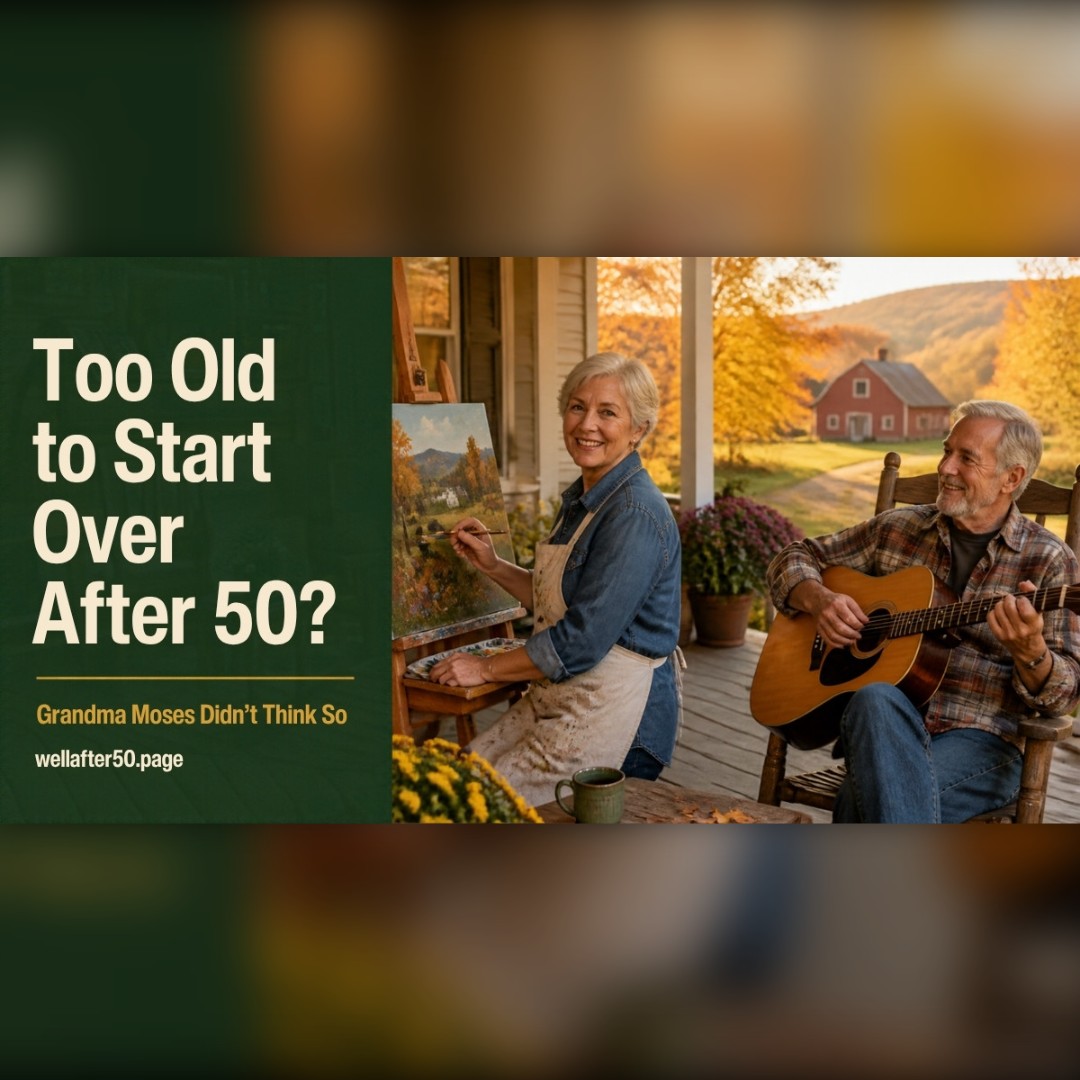
  • Too Old to Start Over After 50? Grandma Moses Didn’t Think So

    Too Old to Start Over After 50? Grandma Moses Didn’t Think So

    Are you too old to start over after 50?

    Short answer: No, you’re not too old to start over after 50. Grandma Moses didn’t take up painting seriously until her late 70s and kept painting into her 100s. Laura Ingalls Wilder was in her 60s when her first Little House book came out. Start small, like ten pages, ten minutes or one phone call.

    Ever catch yourself thinking, “I’m too old to start over”? Every so often somebody tells me, “I should’ve done this years ago.”

    Maybe it’s a trip they never took. A guitar sitting in the closet. A garden they keep meaning to plant. A book they’ve been “fixing to write” since the kids were little.

    And then right behind it comes the real question: At my age, what’s the point?

    I reckon the point is that you’re still here. The years you’ve already lived don’t disqualify you from the ones still coming.

    I Started This Site at 64

    I’ll tell you straight: I started Well After 50 at 64. I didn’t know much about websites. I made plenty of mistakes, and some of them I’m still cleaning up. But I’m glad I didn’t wait for the “right time,” because the right time wasn’t coming. It was just going to keep being later.

    I’m not telling you that to brag. I’m telling you so you know the fellow writing this is in the same boat as a lot of y’all.

    Some Folks Who Didn’t Get Going Until Later

    When I start thinking I’m too old for something, I think about these people:

    • Grandma Moses (Anna Mary Robertson Moses) didn’t take up painting seriously until she was in her late 70s, after arthritis made her embroidery too hard. She kept painting into her 100s, and her farm scenes ended up in museums. (Wikipedia)
    • Frank McCourt taught high school in New York for about 30 years. He published his first book, Angela’s Ashes, at 66, and it won the Pulitzer Prize. (NPR)
    • Laura Ingalls Wilder was in her 60s when her first Little House book came out. (United Methodist Communities)

    There’s a whole website full of stories like these called Later Bloomer, and it’s worth a look on a day you’re feeling behind. Larry Potter over at Last Best Bite wrote a good piece on this too, “After All, You’re Never Too Old for a First Time.”

    None of them knew how it would turn out when they started. They just started.

    You’re Not Starting From Scratch

    Starting something after 50 feels different because you know how fast time goes. But you also bring something you didn’t have at 20: experience.

    You know what matters and what doesn’t. You’ve made mistakes and lived through things you weren’t sure you would. That’s not baggage. That’s the stuff you get to carry into whatever comes next.

    Arthur Brooks, a Harvard professor, wrote a whole book about this called From Strength to Strength. His point is that some of our smarts fade as we get older, like quick thinking and raw speed, but another kind keeps growing: the know-how and judgment that come from years of living. That’s the kind that makes you good at teaching, advising and seeing the big picture. In other words, the second half isn’t just leftovers. It’s a different kind of strong.

    Being Bad at It Is Part of the Deal

    This is where a lot of us quit too soon.

    The first painting looks like a kid made it. The first exercise class leaves you sore and a little embarrassed. The first try at anything new feels like everybody else got the instructions but you.

    Well, they probably have been at it longer. You’re comparing your first page to their twentieth chapter. That’s not a fair fight, so don’t pick it.

    Your first job isn’t to be good. Your first job is to show up.

    Try the One-Hour Rule

    You don’t need to plan the rest of your life. That’s too much pressure for anybody.

    Just ask yourself: What would I enjoy trying for one hour this week?

    An hour can be a class at the library, a walk somewhere you’ve never been, a new recipe, a beginner video, or a phone call to somebody who already does the thing you’re curious about.

    If you like it, give it another hour. If you don’t, you’ve got your answer, and that’s not failure either. You’re allowed to say, “Tried it. Not for me. What’s next?”

    Make It Easy on Yourself

    1. Make the first step almost silly-small. Ten pages, ten minutes, one phone call.
    2. Put it on the calendar. If it doesn’t have a day and time, “someday” turns into never.
    3. Find the beginner version. The intro class, the easy trail, the “for dummies” book. No shame in it.
    4. Expect it to feel awkward. Awkward doesn’t mean wrong. It means new.
    5. Give it more than one try. The first time is usually the worst it’ll ever be.

    If you want to dig a little deeper, James Clear’s book Atomic Habits is a good one. His whole idea is that tiny changes, done over and over, add up to big results, and that you’ll stick with a new habit a lot longer if you make it easy to start. He calls it the two-minute rule: shrink the new thing down until it takes two minutes or less.

    You Don’t Have to Impress Anybody

    This may be the best part of getting older. You don’t have to turn your new thing into a business, win a ribbon or post it online. You can paint because you like colors, or walk because you like being outside. You can take a class just to get out of the house and meet somebody new.

    Not everything worth doing has to be an accomplishment.

    And if the people around you don’t understand why you want to do it? They don’t have to. Like the old saying goes, you can’t plow a field by turning it over in your mind.

    Common Questions

    Am I too old to start over at 50 or 60?

    No. People learn new skills, pick up hobbies and start new work well into their 60s, 70s and beyond. You don’t have to become an expert for it to be worth doing.

    Is 60 too old to start a new career?

    Not necessarily. Plenty of people switch to part-time work, consulting, teaching or a small business in their 60s. Start by using skills you already have, and test the idea small before you jump in with both feet.

    What if I don’t know what I want to try?

    Think about what you used to enjoy as a kid, what you catch yourself reading about, or what you’ve always said “I’d like to try that someday” about. Start there.

    What if I start and then quit?

    Then you learned something about yourself. That still counts.

    What if it’s something physical?

    Start at a beginner level, and if you’ve got a health concern, check with your doctor first. For a safe place to start on strength, see How to Build Muscle After 60 Without Getting Hurt.

    Try This This Week

    Grab a piece of paper and write down three things you’re curious about. Not things you should do, but things that make you think, “I’ve always wondered what that’d be like.”

    Circle one. Take the smallest first step this week.

    If you want more ideas, I put together 9 ways to start a new chapter after 50 and 10 hobbies that don’t cost much.

    What Would You Start?

    If you could begin one new thing this year, what would it be? Tell me in the comments. Somebody reading might need the nudge.

    You’re not behind. Starting at 50, 60, 70 or beyond still counts.

    — Tom

    I’ve also mapped out some great tools on my new Tech for Independent Living After 50 page.

    About Tom Green

    Tom Green writes Well After 50. He was born in Pell City, Alabama, in 1962, and he’s a country boy and a true Southerner through and through. He’s just a regular, laid-back 64-year-old who keeps things simple. He shares what he learns about skincare, fitness and getting older, and what’s working for him. He’s also the author of A Practical Guide to Getting Older Without Giving Up on Yourself. Tom isn’t a doctor. He reads up on the research and passes along what’s useful, plain and simple.
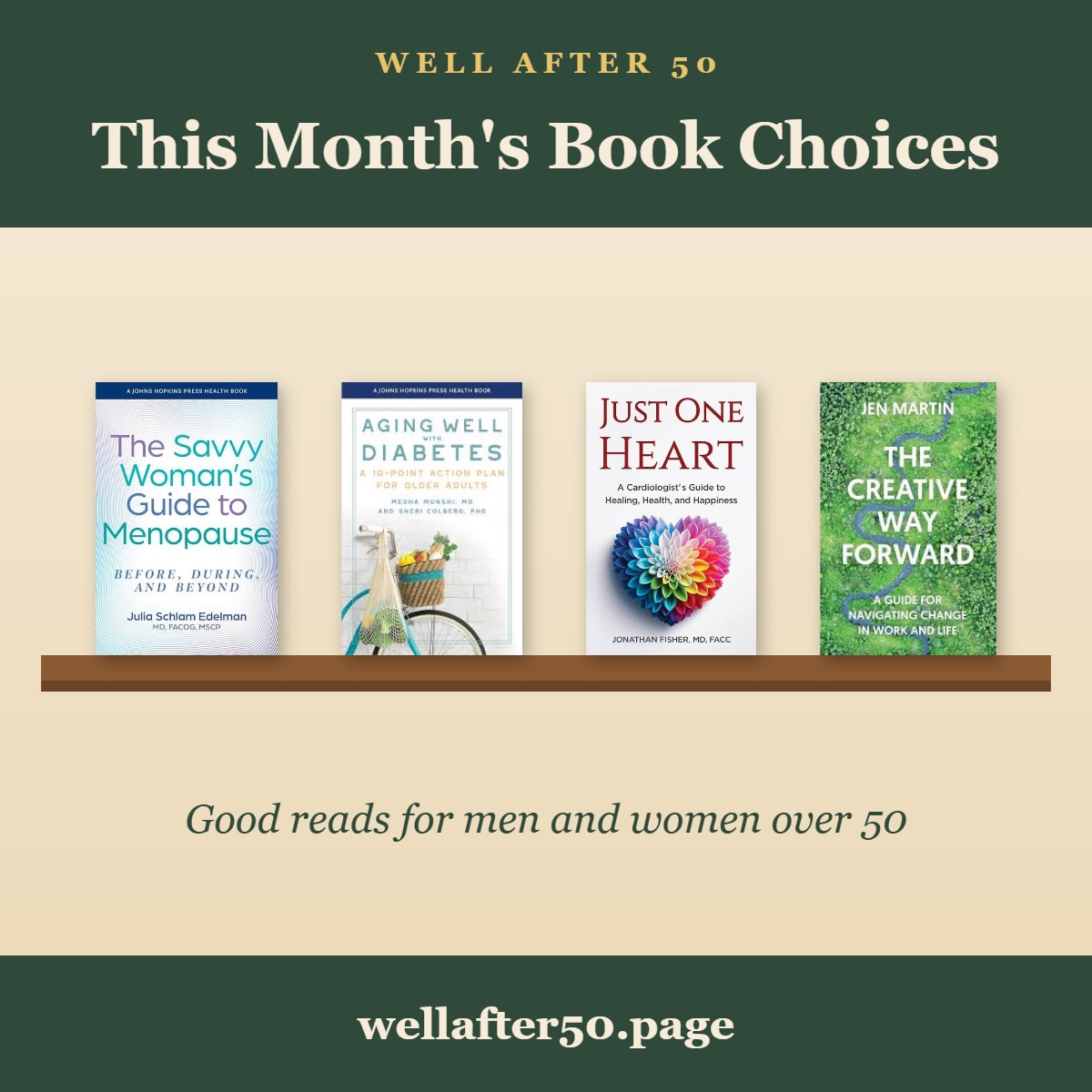
  • 📚 4 Award-Winning Books for Healthy Aging After 50 (This Month’s Book Choices)

    📚 4 Award-Winning Books for Healthy Aging After 50 (This Month’s Book Choices)

    What are the best award-winning books on healthy aging?

    Short answer: This month’s four picks are Savvy Woman’s Guide to Menopause by Dr. Julia Schlam Edelman, a 2026 IBPA Gold winner; Aging Well with Diabetes by Dr. Medha Munshi and Dr. Sheri Colberg, a 2026 IBPA Silver winner; Just One Heart by cardiologist Dr. Jonathan Fisher; and The Creative Way Forward by coach Jen Martin, a 2025 IBPA Gold winner.

    Welcome to our monthly Book Choices post!

    Each month, we’ll share a few books that might be interesting, useful, inspiring, or just enjoyable to read.

    This month, I’d also like to hear from you.

    What are you reading right now — or what book would you recommend to someone 50+?

    Share the title in the comments and tell us a little about why you liked it.

    You never know who might discover their next favorite book because of your recommendation! 📖

    Let’s build our Well After 50 reading list together.

    Savvy Woman's Guide to Menopause book cover, a healthy aging book for women over 50

    Savvy Woman’s Guide to Menopause

    by Julia Schlam Edelman (Author) Format: Paperback

    🏆 2026 IBPA Gold Winner — Health & Fitness Excellent fit for our menopause, wellness, nutrition, and healthy-aging discussions. The book is specifically described as evidence-based and covers lifestyle, hormonal and non-hormonal approaches.

    A practical guide to getting through menopause, before, during and after the change, and doing well on the other side.

    Dr. Julia Schlam Edelman has spent more than 30 years as a gynecologist and menopause doctor. She trained at Yale, Columbia and Harvard, she’s a Menopause Society Certified Practitioner, and she also wrote the earlier book Menopause Matters. In this one she takes all that experience and puts it in plain words for the rest of us.

    She walks you through all three stages, perimenopause, menopause and postmenopause, and covers the body, the mind and the feelings that come with each. She doesn’t push one answer. She lays out the choices, from lifestyle changes to hormone and non-hormone treatments to other remedies, and explains the evidence behind them so you can talk it over with your own doctor.

    Here’s what the book covers:

    • Hot flashes, poor sleep, mood swings and memory slips, and practical ways to handle each one
    • Hormone and non-hormone treatments, other remedies, and care tailored to you
    • Lifestyle and medical steps to lower your risk of heart trouble, bone loss, diabetes and cancer
    • Why menopause looks different from one woman to the next, and how that can change your treatment options

    Why I picked it: A lot of women go through menopause with hardly any straight answers, and some get told to just wait it out. This book is the straight answers, from a doctor who’s been doing this work for three decades. It also won the 2026 IBPA Gold Award for Health & Fitness, which tells you other folks think highly of it too.

    Great for: any woman in her 40s, 50s or 60s, whether you’re just starting to notice changes or you’re years past it and want to protect your heart and bones. And fellas, if your wife or sister is going through it, this one will help you understand what’s going on.

    Disclosure: Some of the books mentioned on Well After 50 may include affiliate links. If you purchase through one of these links, I may earn a small commission at no additional cost to you. I only recommend books I believe may be genuinely useful or interesting to people 50+.

    Aging Well with Diabetes book cover, award-winning healthy aging book for older adults

    Aging Well with Diabetes: A 10-Point Action Plan for Older Adults (A Johns Hopkins Press Health Book)

    by Medha Munshi (Author), Sheri Colberg (Author) Format: Paperback

    4.0 4.0 out of 5 stars (2)

    An essential guide to navigating diabetes for older adults and their caregivers.

    Silver Winner of the 2026 IBPA Book Award for Health & Fitness

    In Aging Well with Diabetes, Dr. Medha Munshi and Dr. Sheri Colberg provide practical advice to redefine living with diabetes in later life. As experts in geriatric care and diabetes management, they introduce a clear and accessible 10-step action plan to help you manage diabetes effectively while enhancing your overall vitality and independence.

    Each step in the action plan is detailed with achievable goals, making it a crucial toolkit for anyone living with diabetes or caring for someone who does. The authors discuss:

    • Comprehensive health management, including dietary adjustments, physical activity, medication management, and more
    • How aging and diabetes interact, detailing the physiological changes and challenges that come with managing diabetes at an older age
    • The diversity of experiences among older adults with diabetes and the importance of personalized treatment plans
    • Practical tips and strategies, such as modifying exercises to prevent falls and dietary tips that accommodate older digestive systems
    • Guidance for caregivers and health care providers on how to support older adults with diabetes

    Whether you’re newly diagnosed or a long-time diabetic, this guide will empower you to take control of your health and manage your diabetes with confidence and grace as you age.

    Disclosure: Some of the books mentioned on Well After 50 may include affiliate links. If you purchase through one of these links, I may earn a small commission at no additional cost to you. I only recommend books I believe may be genuinely useful or interesting to people 50+.

    Just One Heart book cover by cardiologist Jonathan Fisher, a heart health book after 50

    Just One Heart: A Cardiologist’s Guide to Healing, Health, and Happiness

    by Jonathan Fisher M.D. | Apr 16, 2024

    A multiple award-winning, evidence-based guide to healing and strengthening the heart—from the inside out

    Our hearts are under strain—physically, emotionally, socially, and spiritually.

    Stress, anxiety, loneliness, and disconnection don’t just affect how we feel.

    They change how our hearts function.

    In Just One Heart, Dr. Jonathan Fisher, a Harvard-trained cardiologist and mindfulness teacher, offers a clear, science-grounded path to restoring health, resilience, and meaning through the heart–mind connection.

    Drawing on the latest research from medicine, psychology, and neuroscience—and integrating time-tested wisdom from contemplative traditions—this book translates complex science into practical, everyday tools to help you:

    • Reduce stress and calm the nervous system
    • Build emotional steadiness and resilience
    • Support heart health beyond numbers and tests
    • Reconnect with purpose, connection, and what matters most

    Part I explores the science of the heart–mind connection and the hidden drivers of modern heart disease, stress, and burnout.

    Part II offers guided practices to cultivate the Seven Timeless Traits of the Heart:

    steadiness, wisdom, openness, wholeness, courage, lightness, and warmth.

    Interwoven throughout are reflections from Dr. Fisher’s own journey through anxiety and burnout, moving patient stories, and insights from more than fifty leaders in mind–body medicine and human flourishing.

    Whether you’re a healthcare professional, a leader under pressure, or someone seeking greater clarity, calm, and wholeness, Just One Heart shows how caring for the heart—fully and wisely—can transform both health and life.

    Just One Heart

    Disclosure: Some of the books mentioned on Well After 50 may include affiliate links. If you purchase through one of these links, I may earn a small commission at no additional cost to you. I only recommend books I believe may be genuinely useful or interesting to people 50+.

    The Creative Way Forward book cover by Jen Martin, a guide to starting over after 50

    The Creative Way Forward: A Guide for Navigating Change in Work and Life

    by Jen Martin (Author) Format: Paperback

    2025 IBPA Book Awards Gold Winner: Self-Help
    2025 IBPA Book Awards Silver Winner: Best New Voice, Nonfiction
    2025 Axiom Awards Gold Medalist in Personal Development

    2024 Foreword INDIES Book Awards Bronze Winner: Career (Adult Nonfiction)
    2024 American Book Fest Award Winner – Self-Help: General
    2024 American Book Fest Award Finalist – Business: Motivational


    “Martin’s well-researched and thoughtfully crafted book provides a road map for staying resilient, adaptable, and true to yourself in the face of life’s challenges.”
    -Daniel H. Pink, New York Times best-selling author of The Power of Regret and Drive

    Learn How to Creatively Adapt, Improvise Solutions, and Embrace Change

    Change is inevitable. If there’s one thing we can plan on, it’s that nothing will stay the same. Yet change can also be challenging, especially when it’s unexpected. In times of disruption when we most need to be creative, we’re often reactive. We hang on to what we know instead of being open to the vast possibilities of what’s next. Professional coach and consultant Jen Martin shows us another way: how to build your creative capacity and ability to improvise forward, even during life’s biggest twists and turns.For those navigating any type of change—whether at work or in life—Jen shares research-backed practices and tools to help you strengthen your agility and adaptability. In this book, you will learn:

    • The four-part Change Curve for navigating transitions
    • How to regulate your nervous system to be creative versus reactive
    • Why knowing “what’s core for you” is critical for being adaptive
    • Three powerful ways to reframe your perspective
    • The type of curiosity you’ll need in order to embrace what’s next
    • How to creatively navigate detours and setbacks on the journey


    This book is a beautiful reminder that while the future is inherently uncertain, it’s precisely when we don’t have all the answers that we often come up with the most interesting ideas and discover the creative way forward.

    Want to Hear More Before You Pick One?

    I like to hear an author talk before I buy a book. If Just One Heart caught your eye, Dr. Kevin Pho had Dr. Jonathan Fisher on The Podcast by KevinMD, and it’s a good listen while you’re out walking.

    And if you’re still looking after these four, Margaret Manning’s site Sixty and Me has a nice list of inspirational books for women over 60. Fellas, don’t skip The Creative Way Forward up above. Change at work and in life hits all of us, and I reckon that one’s worth your time too.

    How We Choose Our Books

    We don’t choose books simply because they’re popular. We look for books that offer something worthwhile for people 50+.

    When putting together our monthly Book Choices, we consider:

    • Useful information — Does the book teach, explain, or offer something readers can actually use?
    • Quality and credibility — Is the author knowledgeable and does the book have substance behind it?
    • Reader response — We look at reviews and what readers consistently say about the book.
    • Relevance to life after 50 — Does it speak to health, wellness, relationships, personal growth, aging, or simply enjoying life more?
    • Different kinds of books — We try to include a mix rather than recommending the same type of book every month.
    • Overall value — Would we feel comfortable suggesting the book to a friend?

    The goal isn’t to find the “perfect” book. It’s to find books that might make your month a little more interesting, useful, or enjoyable.

    Affiliate Disclaimer: Well After 50 may earn a small commission when you purchase products through links on this site, at no additional cost to you. I only share products I believe may be helpful to my readers. Your support helps keep Well After 50 going. Thank you!

    Written by Tom Green, creator of Well After 50

    Tom Green writes Well After 50. He was born in Pell City, Alabama, in 1962, and he’s a country boy and a true Southerner through and through. He’s just a regular, laid-back 64-year-old who keeps things simple. He shares what he learns about skincare, fitness and getting older, and what’s working for him. He’s also the author of A Practical Guide to Getting Older Without Giving Up on Yourself. Tom isn’t a doctor. He reads up on the research and passes along what’s useful, plain and simple.

    I’ve also mapped out some great tools on my new Tech for Independent Living After 50 page.

  • How to Reinvent Yourself After 50: 9 Ways to Start a New Chapter

    How to Reinvent Yourself After 50: 9 Ways to Start a New Chapter

    How do you reinvent yourself after 50?

    Short answer: You can start a new chapter after 50 in five minutes. Write down one thing you’ve been curious about for years, pick one tiny step toward it this week, like signing up, calling someone or buying the book, and put it on your calendar. Stop waiting for permission and use what you already know.

    Who says you have to keep being the person you were at 30, 40 or even 49?

    Life after 50 can be a surprisingly good time to rethink what you want. Maybe the kids are grown. Maybe retirement is getting closer, or already here. Maybe you have more free time than you know what to do with. Or maybe you simply woke up one morning and realized you want something different.

    I’m 64, and I can tell you this: reinventing yourself doesn’t mean blowing up your life. It usually starts with one small change you actually follow through on. Then another. Below you’ll find nine ways to start, a simple 30-day plan so it doesn’t stay a “someday” idea, and a little bit of my own story.

    Start here if you only have 5 minutes

    1. Write down one thing you have been curious about for years.
    2. Pick one tiny step toward it you can take this week, like signing up, calling someone or buying the book.
    3. Put that step on your calendar with a day and time.

    That’s it. That’s how a new chapter actually starts.

    How I Started My Own New Chapter at 64

    I’ll be honest with you. I didn’t start Well After 50 because I had it all figured out. I just thought to myself one day, I’ve got a good bit of life experience. Why not do a blog?

    The hardest part wasn’t the computer stuff, though there was plenty of that. It was fighting my own defeatism. That little voice that says you’re too old, nobody’s going to read it, why bother. I had to take the risk anyway. Now’s a better time than never.

    That wasn’t the only change. These days I work out four days a week, I’m eating better, and I’ve started taking some longevity supplements. None of that happened overnight. It started with one decision, then another.

    If you knew my whole story, I reckon you’d find some hope in it, and maybe the push to try a few things you’ve never done before.

    Why a new chapter is worth it after 50

    This is not just about feeling good. In a study of nearly 7,000 adults over 50 published in JAMA Network Open, people with the lowest sense of purpose in life were more than twice as likely to die during the study period as those with the strongest sense of purpose (Live Science summary). A study like this can’t prove purpose is the cause, but it is a good reminder that having something to get up for matters.

    Reinvention is really about that: finding things that make you feel useful, curious and connected again.

    1. Stop waiting for permission

    A lot of us spent decades doing what was expected of us: by a boss, a spouse, the kids, the neighbors. After 50, you are allowed to want something just because you want it. You don’t need everyone around you to understand your next chapter.

    Try this: Finish this sentence on paper: “If nobody would judge me, I would…” Don’t edit it. Whatever you write first is worth paying attention to.

    2. Try something before deciding who you are

    “I’m not that kind of person” is one of the most limiting things we tell ourselves. You don’t find out who you are next by thinking about it. You find out by trying things. Take the class. Join the group. Try the hobby. Visit the place. You may discover a version of yourself you didn’t know was there.

    Try this: Say yes to one thing this month you would normally turn down. If you need ideas, here are 10 hobbies after 50 that make life more interesting, most of them low-cost.

    3. Use what you already know

    Reinvention doesn’t mean throwing away your past. After 50 you have something younger people don’t: decades of experience, skills, mistakes you learned from and people you know. That is valuable raw material for whatever comes next.

    A retired teacher might tutor or mentor. Someone who managed a household budget for 30 years might help others do it. A lifelong fixer might teach a repair class or help neighbors.

    Try this: Ask two friends, “What do people always come to me for?” Their answers often point straight at your next chapter.

    4. Make your world a little bigger

    As we get older, our circles tend to shrink without us noticing. New experiences create new connections, and new connections create new opportunities. Join a local group. Take a trip. Volunteer. Go to an event alone if you have to. It gets easier every time.

    Try this: Look up one local group this week: a walking club, library class, volunteer group, church group or community center program. Go once before deciding if it’s for you.

    5. Learn something that makes you feel like a beginner

    Being new at something is uncomfortable, and that’s the point. It keeps your brain working, keeps your curiosity alive and gives you something to look forward to. A language, an instrument, painting, woodworking, dancing, a computer skill. It doesn’t matter what, as long as you are learning.

    Try this: Give a new skill 15 minutes a day for two weeks. Free videos and your local library are a great place to start.

    6. Take your health with you

    A new chapter is a lot easier to enjoy when your body can keep up. I work out four days a week now and I’m eating better, because I want to be able to say yes to the trip, the hike and whatever comes next. I’ve also started on some longevity supplements, but that’s a conversation to have with your own doctor first, since supplements can interfere with medications. Walking, strength training, good food and enough sleep aren’t glamorous, but they give you more options.

    Try this: Start with the basics in 7 strength habits that matter more after 60, or a simple gym plan in how to build muscle after 60 without getting hurt.

    7. Let your appearance evolve too

    A haircut, a new color, different clothes or a simple skincare routine can be a fun way to mark a fresh chapter. The goal isn’t to look younger. It’s to look like yourself now, and to feel good when you catch your reflection.

    Try this: Change one thing about how you look this month that you’ve been thinking about for a while. If it’s been hard to accept the face in the mirror, I wrote about that in when you don’t recognize yourself anymore.

    8. Make a “not someday” list

    “Someday” is where good ideas go to die. Grab a piece of paper and fill in one answer for each line:

    • ☐ Something I want to learn: ________
    • ☐ Somewhere I want to go: ________
    • ☐ Someone I want to reconnect with: ________
    • ☐ Something I want to stop doing: ________
    • ☐ Something I want to do just for fun: ________

    Now circle the one that excites you most. That’s your first experiment.

    9. Give yourself a 30-day experiment

    Don’t demand a complete life transformation. That’s too much pressure, and it’s why most big plans fizzle. Instead, pick one change and try it for 30 days. You are just collecting evidence about what makes you feel more alive, curious and connected.

    • Week 1: Take the first small step. Sign up, show up, or buy what you need.
    • Week 2: Do it at least twice. Notice how you feel before and after.
    • Week 3: Tell someone about it, or invite a friend along.
    • Week 4: Decide: keep going, change it, or try the next thing on your list. All three are wins.

    What usually holds us back (and what to tell yourself)

    • “I’m too old.” You are younger today than you will ever be again. Plenty of people start businesses, degrees, hobbies and friendships in their 60s and 70s.
    • “What will people think?” Most people are too busy with their own lives to judge yours. The ones who matter will be glad to see you happy.
    • “I can’t afford it.” Many good changes cost little or nothing: walking groups, library classes, volunteering, reconnecting with old friends.
    • “I don’t know what I want.” That’s fine. Nobody does at first. That’s what the 30-day experiment is for.

    Sometimes a new chapter also means letting go of things that drain you. If you’re ready to stop saying yes to everyone, read a simpler life after 50: how to stop pleasing everyone and find your peace.

    Starting a new chapter can mean learning from other people’s experiences, too. In “After All, You’re Never Too Old for a First Time,” Larry Potter of Last Best Bite reflects on continuing to learn, explore, and grow later in life.

    Common Questions About Reinventing Yourself After 50

    Is 50 too late to start over?

    Not at all. Starting over after 50 can mean a small change or a big one: trying something new, changing direction at work, finding a new hobby, moving, or simply deciding how you want to spend your time from here.

    How do I start reinventing myself after 50?

    Start with one thing you are curious about rather than trying to redesign your whole life. Take one small step this week, give it 30 days, see how it feels, and build from there.

    What if I don’t know what I want next?

    Experimenting is more useful than waiting for a perfect answer. Fill in the “not someday” list above and try the item that excites you most. You’ll learn more from one month of doing than a year of thinking.

    How do I reinvent myself after retirement?

    Retirement takes away structure and a sense of purpose that work often provided. Replace both on purpose: give your week a few fixed activities, like a class, a volunteer shift or a workout, and look for ways to use the skills you built during your career.

    Can I reinvent myself without spending a lot of money?

    Yes. Some of the most meaningful changes are free: volunteering, walking groups, library programs, reconnecting with people, learning from free online videos, and getting healthier.

    My take

    Getting older doesn’t mean your best chapters are behind you. It means you finally have the experience to know what matters. I’m living proof that you can still do things you never did before to better yourself, even if you have to fight your own doubts to get started. Reinvention after 50 isn’t about becoming somebody else. It’s about becoming more of who you really are, one small step at a time.

    What would you try?

    If you could start one completely new thing this year, what would it be? Leave your answer in the comments. Someone else may be waiting for the same idea, and you might inspire them to finally start.

    Written by Tom Green, creator of Well After 50

    Tom Green writes Well After 50. He was born in Pell City, Alabama, in 1962, and he’s a country boy and a true Southerner through and through. He’s just a regular, laid-back 64-year-old who keeps things simple. He shares what he learns about skincare, fitness and getting older, and what’s working for him. He’s also the author of A Practical Guide to Getting Older Without Giving Up on Yourself. Tom isn’t a doctor. He reads up on the research and passes along what’s useful, plain and simple.

    I’ve also mapped out some great tools on my new Tech for Independent Living After 50 page.