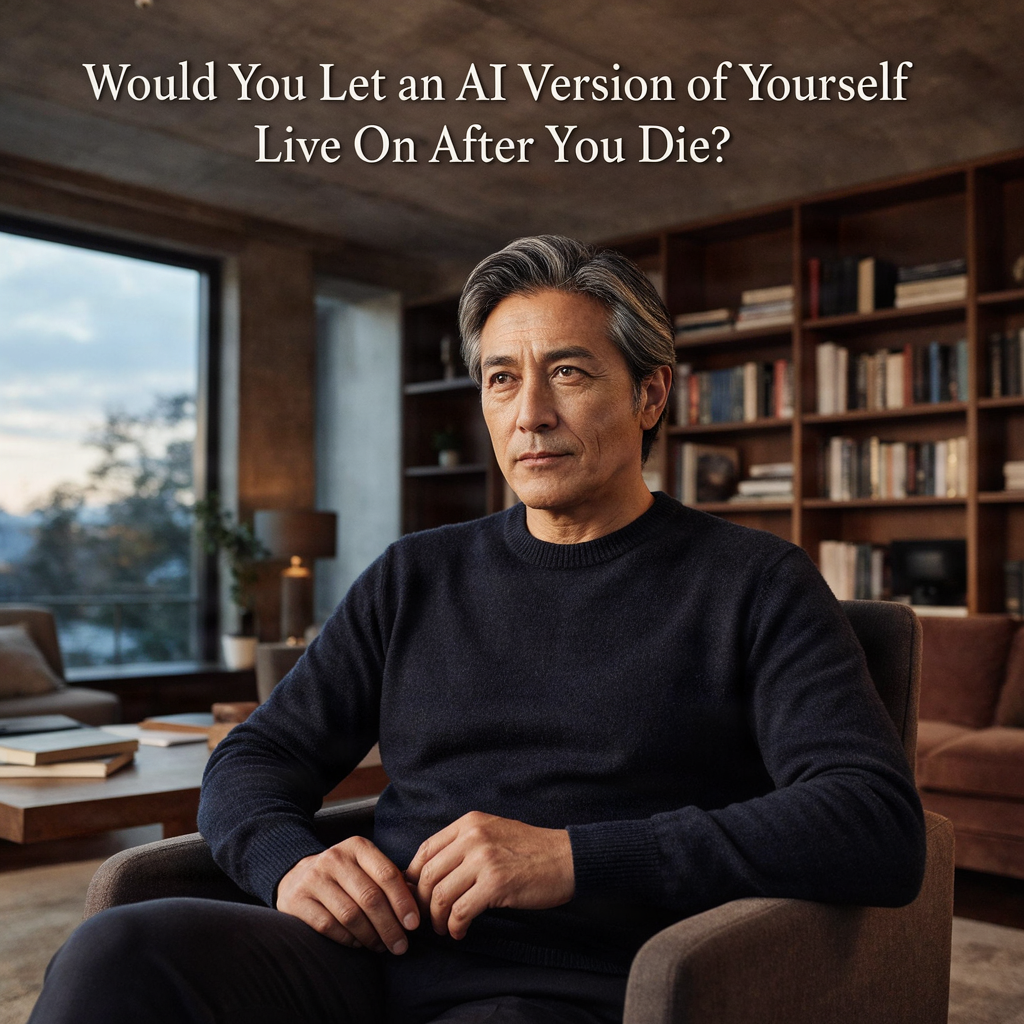
A dead man spoke in an Arizona courtroom through AI. Now the disturbing question is: who controls your voice, your memories, and your identity after you’re gone?
By Thomas Green | Well After 50
Can AI bring back a loved one after they die, and who controls your digital self?
Short answer: AI can already bring back a person’s face and voice after they die, built from old messages, photos and videos, and some companies sell it as a service. The law hasn’t settled who controls your digital self once you’re gone, so it’s worth telling your family now whether you’d want an AI version of you or not.
A dead man spoke in an Arizona courtroom. His face looked real. His voice sounded real. But the words coming out of his mouth were written by someone else.
And those words helped overturn a criminal sentence.
In May 2025, the family of Christopher Pelkey played an AI-generated video of him at the sentencing of the man convicted of killing him. The digital Pelkey spoke about forgiveness and God. His sister had written the words, imagining what her brother might have said.
The judge said he loved the AI video and sentenced Gabriel Horcasitas to 10½ years.
On September 30, 2026, the Arizona Court of Appeals threw out that sentence. The judges found that the video’s influence made the sentencing fundamentally unfair. The conviction stood. The sentence did not.
Read the Arizona court’s ruling.
Think about that. A man who was no longer alive appeared to speak in court, and a judge treated his artificial words as meaningful evidence of his character.
If AI can speak for the dead in a courtroom, what happens when it starts speaking for the rest of us?
Your Voice. Your Face. Somebody Else’s Words.
Would you let an AI version of yourself live on after you die?
At 64, that question hits differently. We think about the photographs, family stories and memories we’ll leave behind. But what about leaving behind a version of ourselves that can answer questions?
This technology already exists. And there is an important difference between two ways it works.
One records you while you’re alive. Your family can later ask questions and hear answers you actually recorded.
The other uses your texts, emails, photographs and voice recordings to generate new conversations in your style.
One preserves what you said.
The other puts words in your mouth after you’re gone.
And people have already discovered how emotional that difference can become.
He Paid $5 to Talk to His Dead Fiancée
In 2020, Joshua Barbeau paid five dollars to use a service called Project December.
His fiancée, Jessica Pereira, had died eight years earlier. He still had some of her old messages and used them to create a chatbot that sounded like her.
Their first conversation lasted hours.
He knew Jessica wasn’t really there. But the chatbot’s replies brought back familiar expressions, humor and the feeling of talking to someone he had loved.
In a remarkable 2021 investigation, the San Francisco Chronicle documented how Barbeau became emotionally attached to the experience.
Imagine sitting alone at night, missing somebody, and suddenly being able to type a message and receive a reply that sounds like them.
Would you close the conversation?
Or would you keep talking?
A Man in China Still Talks to His Mother
Chinese technology executive Sun Kai lost his mother in 2018.
He later helped develop an AI version of her, using technology to recreate her appearance and voice.
In a 2024 NPR report, Sun described speaking with the digital version of his mother when he felt stressed.
He said he regarded the avatar as his mother, not merely a computer-generated character.
That is the part I keep coming back to.
What happens when a person stops thinking of an AI recreation as software and starts treating it as someone who is still alive?
And what if the company controlling that recreation changes it, sells it or shuts down?
The Dead Could Become a Subscription Business
Writer and grief advocate Nora McInerny raised that concern in her March 2026 subscriber episode, AI Deadbots Want To Cure Your Grief.
McInerny questioned whether companies with commercial interests should be trusted to manage something as vulnerable as human grief.
It is worth asking who benefits financially when someone keeps returning to a digital recreation of a lost loved one.
Technology writer Michael Routhier explored a similar dilemma in AI Is Bringing Back the Dead, And We Need to Talk About It, published in May 2026.
He examined the tension between comforting grieving families and turning their emotional attachment into a business model.
Neither writer dismissed the pain of losing someone. Their concern was what happens when that pain becomes a product.
And there is a practical problem too.
Companies can close. Subscriptions can expire. Digital files can disappear.
StoryFile, a pioneer in interactive recorded memories, filed for Chapter 11 bankruptcy protection in 2024.
Imagine spending months recording your life story, believing future generations will hear it, only to discover that accessing those memories depends on a business that no longer exists.
Who owns your digital ghost when the company owns the technology?
Even Meta Has Considered an Online Afterlife
In December 2025, Meta received a patent describing technology that could simulate a person’s social-media activity during an absence or after death.
The system could potentially generate posts or responses based on a person’s past online activity.
Meta has said it has no current plans to develop the patented system.
Still, the idea is unsettling.
Imagine dying, but your account keeps commenting on photographs, responding to friends and participating in conversations.
Would people know those words were generated by software?
Would they care?
And who would decide when your account finally stopped talking?
What If Your Family Wants You Back—but You Never Agreed?
The law has not settled every question about digital recreations.
California and several other states have enacted protections covering particular uses of people’s voices and likenesses. Federal lawmakers have debated broader protections through legislation such as the NO FAKES Act.
On September 30, 2026, Senator Ted Cruz objected to an attempt to pass that legislation by unanimous consent, preventing its passage through that procedure.
But the legal debate goes beyond whether someone can profit from a dead person’s image.
Suppose your children want to create a digital version of you.
They love you. They miss you. They want to hear your voice again.
But you never agreed to it.
Should their grief outweigh your wishes?
And what happens when family members disagree about what the digital version should be allowed to say?
Only 8% Wanted to Come Back
Here is a finding that surprised me.
A published Japanese study asked 296 older adults about digital immortality.
Only 8% said they wanted to be virtually resurrected after death.
That doesn’t establish what every older adult thinks. It was one study in Japan.
But consider the contrast.
Companies are developing increasingly convincing ways to recreate people after death, while most participants in this study didn’t want that experience for themselves.
Perhaps the people who want to bring someone back are not always the people who would have wanted to return.
Would It Help You Grieve—or Keep You From Letting Go?
Researchers are still investigating how prolonged interaction with AI recreations affects grieving people.
Some users describe comfort. Others report that a simulation sounding almost—but not quite—like someone they loved can be disturbing.
And the long-term psychological effects remain uncertain.
Writer Barrie Kreinik offered a different perspective in her essay, I Could Bring My Father Back as a Deadbot. I’d Rather Miss Him.
She described how memories of her father’s voice, cooking and everyday habits still bring him close.
For Kreinik, remembering him is not the same as recreating him.
That is a distinction worth considering.
Maybe the pain of missing someone is not a problem technology should always try to solve.
So Would I Let AI Bring Me Back?
When I first considered this, my answer was no.
Now I’m not quite so sure.
If I could record my real voice, answer questions in my own words and leave those memories for people I love, I can see the appeal.
But an AI inventing new conversations in my voice after I’m gone?
No.
I wouldn’t want my family wondering whether the words were mine or something a computer decided I might say.
I wouldn’t want a company controlling what my digital likeness could say—or how much somebody would have to pay to hear it.
If you are considering preserving your memories, record them while you can. Keep your own copies. Make your wishes clear to your family, particularly whether you consent to an AI recreation that generates new statements.
Because the unsettling part isn’t that technology might someday make death look less permanent.
It’s that your voice could keep talking long after you’ve lost the ability to say no.
What about you?
Would you let an AI version of yourself live on after you die? Or should your digital identity die with you?
Thomas Green | Well After 50
About Tom Green
Tom Green writes Well After 50. He was born in Pell City, Alabama, in 1962, and he’s a country boy and a true Southerner through and through. He’s a regular, laid-back 64-year-old who keeps things simple and passes along what he learns about getting older. Tom isn’t a doctor. He reads up on the research and shares what’s useful, plain and simple. Read more about Tom.