Tag: anti-aging routine

  • How to Keep Your Neck Looking Better After 50

    How to Keep Your Neck Looking Better After 50

    How do you keep your neck looking better as you age?

    Short answer: There’s no miracle neck cream. Give your neck the same basics as your face: gentle cleansing, moisturizer when it needs it, and sunscreen every day, since the neck gets just as much sun. Good posture can change the whole look too, and more products isn’t better.

    The neck is easy to ignore because most of us build a skincare routine around the face. Then one day we look at a photograph and realize the neck has been getting just as much sun and time as the face.

    I don’t think the answer is a miracle neck cream. A few boring habits done consistently make more sense to me.

    Start With the Same Basics as Your Face

    Gentle cleansing, moisturizer when your skin needs it and daytime sun protection are reasonable foundations. If a facial product works well on your neck, you may be able to extend it downward, but don’t assume every active ingredient will be equally comfortable there.

    Sun Protection Is Easy to Forget

    Your neck gets exposed while driving, walking, gardening, sitting outside, and doing everyday errands. If sunscreen stops at your jawline, the neck is still getting the exposure.

    You don’t need to make this complicated. When the neck is exposed, include it in the same sun-protection habit you use for the rest of your exposed skin.

    Posture Can Change the Whole Look

    Skincare cannot correct every visual change. The way you carry your head and shoulders also affects how the neck and jaw area look.

    • Raise your phone instead of constantly looking down.
    • Change positions during long periods of sitting.
    • Work on upper-back and shoulder strength with exercises appropriate for you.
    • Think about standing comfortably tall rather than forcing your chin upward.

    Be Careful With “More Is Better.”

    The neck can be sensitive. Adding strong acids, retinoids, and exfoliants all at once is not a badge of honor. If something causes persistent burning, redness, peeling, or discomfort, back off and let your skin settle.

    What Realistic Improvement Looks Like

    Healthy-looking skin is a better target than trying to erase every crease. Consistent moisture can improve the look of dryness. Sun protection helps protect the skin you have. Better posture can improve how the whole area is carried.


    For more mature-skin routine ideas, Allison Cohen’s Never Say Die Beauty covers skincare, beauty products, and practical advice for people who want to look their best. For neck care, consistency and sun protection matter more than expecting a single product to do everything.

    Common Questions

    Why does your neck show signs of aging after 50?
    After 50, changes in collagen, elastin, moisture, and years of sun exposure can make neck skin look thinner, looser, and more wrinkled.

    What are the simplest ways to keep your neck looking better after 50?
    Extend your face routine to your neck: cleanse gently, moisturize, use sunscreen, and consider a targeted anti-aging ingredient if your skin tolerates it.

    Should you put your skincare products on your neck after 50?
    Yes. If a product is appropriate for your face and your neck tolerates it, there’s usually no reason to stop at your jawline.

    How important is sunscreen for your neck after 50?
    Very. Daily broad-spectrum sunscreen helps protect neck skin from the UV exposure that contributes to wrinkles, discoloration, and loss of firmness.

    Can moisturizer make an older neck look better?
    Yes. Keeping the skin hydrated can make dry, crepey skin look smoother and feel more comfortable, although moisturizer can’t tighten loose skin.

    Can retinol help your neck after 50?
    It may help improve the appearance of fine lines and skin texture. Because neck skin can be sensitive, introduce it slowly and use moisturizer.

    Do you need a special neck cream after 50?
    Not necessarily. A good facial moisturizer and sunscreen may be all you need unless you have a specific concern you want to target.

    Can you actually tighten loose neck skin with skincare?
    Skincare can improve hydration and the appearance of texture, but creams can’t completely reverse significant skin laxity.

    What is one neck-care mistake people 50+ often make?
    Focusing on the face while forgetting the neck and chest. These areas need the same basic protection from sun exposure and dryness.

    A gentle health note: These tips are for general skincare information, not personalized medical advice. If you notice a new or changing spot, growth, unusual discoloration, bleeding, or a sore that doesn’t heal, have it checked by a qualified healthcare professional.

    My Take

    I want my neck to look cared for, not artificially erased. A simple routine that I can actually follow beats a shelf full of products that I use for two weeks and abandon.

    If you notice a new, unusual, or concerning skin change, have it evaluated rather than assuming it is just aging.

    I share personal experience and researched healthy-aging information here, not medical advice.

    Written by Tom Green, creator of Well After 50

    Tom Green writes Well After 50. He was born in Pell City, Alabama, in 1962, and he’s a country boy and a true Southerner through and through. He’s just a regular, laid-back 64-year-old who keeps things simple. He shares what he learns about skincare, fitness and getting older, and what’s working for him. He’s also the author of A Practical Guide to Getting Older Without Giving Up on Yourself. Tom isn’t a doctor. He reads up on the research and passes along what’s useful, plain and simple.

    I’ve also mapped out some great tools on my new Tech for Independent Living After 50 page.

  • The Longevity Blueprint: How to Align Your Skincare and Fitness Routines for Cellular Health

    The Longevity Blueprint: How to Align Your Skincare and Fitness Routines for Cellular Health

    How do you build a skincare and fitness routine for longevity?

    Short answer: The best longevity routine is about staying capable, not just looking younger. Protect your skin from the sun, keep building muscle, don’t skip cardio, eat to support your body, and give recovery real respect. Be skeptical of products that promise “cellular health.”

    What if the best “anti-aging” routine has less to do with looking younger—and more to do with staying capable?

    After 50, skincare and fitness can seem like completely separate subjects. One is about your face; the other is about your body. But the bigger picture is healthy aging: protecting yourself from avoidable damage while keeping your muscles, heart, balance and everyday function working as well as possible.

    That is what I mean by a longevity blueprint. It isn’t a promise that a particular cream or workout will make you live to 100. It is a practical framework built around habits that have actual evidence behind them.

    1. Protect the Skin You Have

    Sun exposure is one of the major contributors to premature visible skin aging. The American Academy of Dermatology recommends broad-spectrum SPF 30 or higher and other sun-protection measures.

    There is real trial evidence here. In a randomized study of 903 adults, daily sunscreen use was associated with 24% less skin aging over 4.5 years compared with discretionary use. That doesn’t mean sunscreen stops aging—it means regular protection can reduce one important source of premature skin damage.

    2. Keep Your Muscles in the Conversation

    Cardio is important, but it shouldn’t be the entire fitness plan. The National Institute on Aging recommends a combination of aerobic, muscle-strengthening and balance activities as we get older.

    The evidence for strength training is especially encouraging. A systematic review of randomized trials found that resistance training improved strength and muscle size even in adults 75 and older. A newer meta-analysis of 16 studies involving adults 60 and older also found improvements in muscle mass, strength and functional performance.

    In practical terms, that means resistance training isn’t just about building bigger arms or a better-looking chest. It can help you stay capable of doing the things you want to keep doing.

    3. Don’t Ignore Aerobic Fitness

    CDC guidance calls for adults to work toward 150 to 300 minutes of moderate aerobic activity per week, or the vigorous equivalent, along with strength training at least two days a week. For adults 65 and older, balance activity is also part of the recommendation.

    Moderate intensity doesn’t have to mean destroying yourself. Brisk walking is a classic example. A useful rule of thumb is that you can talk, but singing a full song would be difficult.

    4. Eat to Support the Body You’re Trying to Keep

    There is no single “longevity food” that can make up for everything else. A better approach is a varied diet that supplies enough protein and a broad range of nutrients.

    Protein becomes particularly relevant when you’re trying to maintain muscle. Your exact needs depend on factors such as body size, activity level and health, so this is one area where individualized advice from a qualified health professional can be useful.

    5. Give Recovery Some Respect

    Training is only part of the equation. Sleep, recovery and managing stress affect how well you can keep up the habits that support healthy aging. You don’t need a perfect stress-free life; you need enough recovery that your routine remains sustainable.

    6. Be Skeptical of “Cellular Health” Claims

    “Cellular health” sounds scientific, and sometimes it is used that way. But it can also become a marketing phrase attached to supplements, powders and expensive skincare products.

    There is no magic serum or supplement that has been shown to guarantee longer life. When a product claims to “activate longevity” or “repair aging cells,” ask a simple question: What human evidence supports that exact claim?

    Amazon.com: The Death of Aging: A Comprehensive Medical Guide to Living A Longer Healthier Life: 9798194907588: Swierczewski M.D., Magdalena, Michalos M.D., Peter: Books Amazon.com: The Death of Aging: A Comprehensive Medical Guide to Living A Longer Healthier Life: 9798194907588: Swierczewski M.D., Magdalena, Michalos M.D., Peter: Books

    Anti-aging… yes, it’s possible. Learn about the latest advancements and staying younger and healthier, longer than ever before, in this comprehensive guide written by anti-aging physician experts with over 50 years of combined medical experience. https://link.amazon/B00dYrYBv #AFFILIATE 

    Your Simple After-50 Blueprint

    • Every morning: protect exposed skin with broad-spectrum SPF 30+.
    • Most weeks: build toward at least 150 minutes of moderate aerobic activity.
    • At least 2 days: train the major muscle groups.
    • 65 and older: include balance work.
    • At meals: choose nutrient-rich foods and get adequate protein for your needs.
    • Every night: make sleep and recovery part of the plan.
    • All year: ignore miracle claims that cannot show good human evidence.

    The Part I Like Most

    None of this requires you to become obsessed with aging. In fact, the whole point is almost the opposite.

    You want to be able to walk comfortably, lift something when you need to, get up from a chair, protect your skin, enjoy a meal, sleep reasonably well and keep doing the things that make life yours

    Common Questions

    Can skincare and exercise really work together to support healthy aging?
    Yes. Skincare helps protect and maintain your skin, while exercise supports muscle, circulation, cardiovascular health, and overall physical function. Together, they can be part of a broader healthy-aging routine.

    What skincare habits matter most for longevity?
    Daily sunscreen, consistent moisturizing, gentle cleansing, and using proven ingredients that your skin tolerates well are practical places to start.

    Does exercise help your skin look healthier after 50?
    Regular exercise supports circulation and overall health, which can contribute to a healthier appearance. It also helps maintain muscle and physical function as you age.

    What type of workout fits into a longevity routine after 50?
    A combination of strength training, aerobic activity, mobility work, and balance exercises can give you a well-rounded routine without making every workout feel like a major production.

    Can strength training help you look younger?
    It can improve muscle tone, posture, strength, and body composition, all of which can affect how you look and carry yourself after 50.

    How important is sunscreen if you’re focused on healthy aging?
    Very important for skin health. Regular UV protection can help reduce cumulative sun damage and visible signs of premature skin aging.

    What’s the simplest way to build a skincare and fitness routine after 50?
    Keep it consistent rather than complicated: protect your skin from the sun, moisturize, stay active, strength train regularly, eat well, sleep enough, and give your body time to recover.

    Tom’s take: Aging well isn’t one product, one workout or one supplement. It’s a collection of boring little decisions that become powerful because you keep making them. That’s the kind of longevity plan I can believe in.

    Sources and Evidence

    CDC: Older Adult Activity Guidelines
    National Institute on Aging: Types of Exercise
    Systematic review: Resistance Training in Very Elderly Adults
    Systematic review and meta-analysis: Resistance Training in Adults 60+
    Randomized trial: Sunscreen and Prevention of Skin Aging
    American Academy of Dermatology: Selecting Anti-Aging Products

    About Tom Green

    Tom Green writes Well After 50. He was born in Pell City, Alabama, in 1962, and he’s a country boy and a true Southerner through and through. He’s just a regular, laid-back 64-year-old who keeps things simple. He shares what he learns about skincare, fitness and getting older, and what’s working for him. He’s also the author of A Practical Guide to Getting Older Without Giving Up on Yourself. Tom isn’t a doctor. He reads up on the research and passes along what’s useful, plain and simple.

    I’ve also mapped out some great tools on my new Tech for Independent Living After 50 page.

  • Why Your Face Looks Different After 50—Even at the Same Weight

    Why Your Face Looks Different After 50—Even at the Same Weight

    Why does your face look different after 50 even at the same weight?

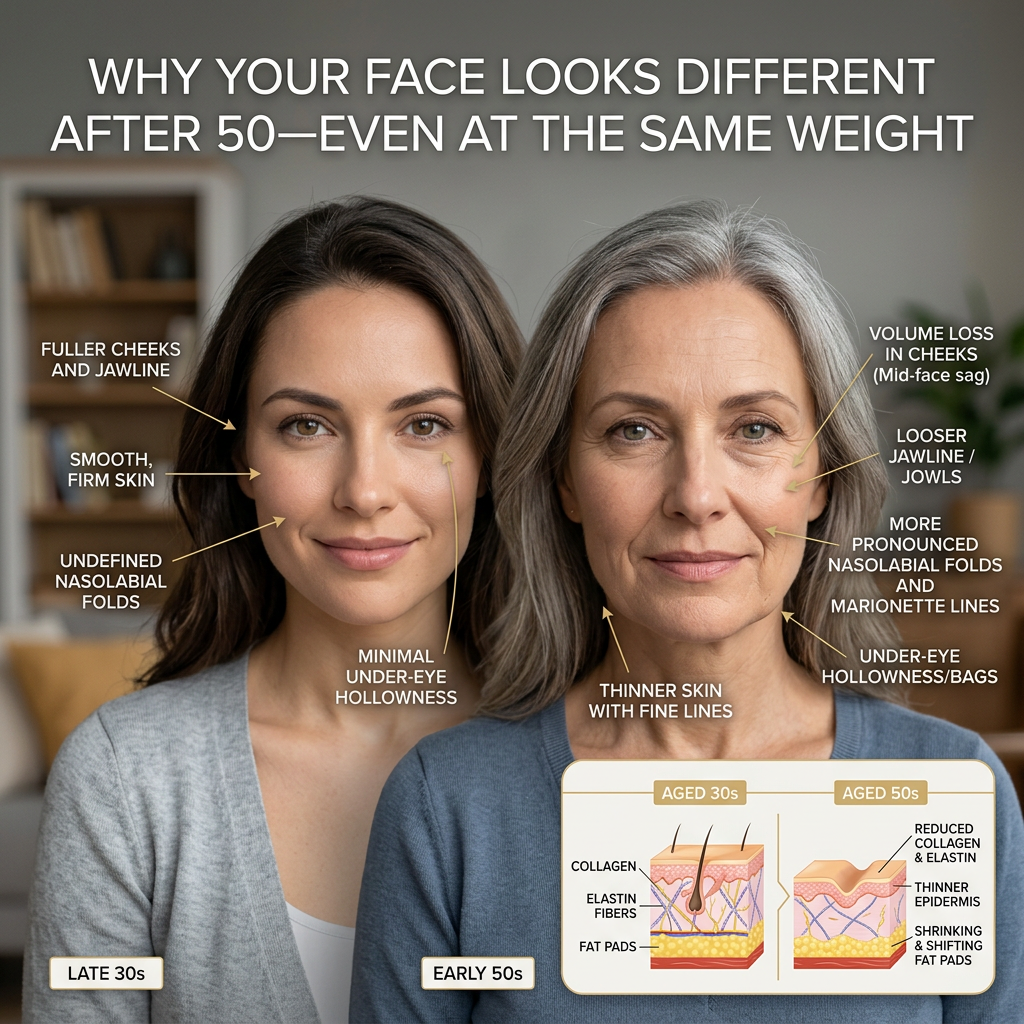
    Short answer: Your face can look different after 50 even at the same weight because more is changing than your skin. Facial fat shifts and loses volume, and the support underneath, from ligaments to bone, changes too. Creams can help dryness and fine lines, but they can’t replace that deeper volume.

    Ever catch your reflection and wonder why your cheeks or jawline look different even though the scale has hardly moved? I have. The explanation is more interesting than a new wrinkle—and it isn’t always something a cream can fix.

    Have you ever looked in the mirror and thought, “I haven’t gained or lost much weight, so why does my face look different?” I think this is one of the most confusing parts of getting older.

    We tend to blame the scale, but the scale doesn’t tell the whole story. After 50, the face can change because several things are happening at once: skin changes, shifts in facial fat, changes in body composition, sun exposure, hydration, sleep and simply the passage of time.

    Weight Is Only One Piece of the Picture

    When your face changes, it is tempting to assume you need to lose weight, gain weight or buy a new anti-aging product. Sometimes the change has very little to do with the number on the scale.

    • Skin gradually changes in firmness and elasticity.
    • Facial fat can change position and volume over time.
    • Sun exposure can contribute to visible texture and pigmentation changes.
    • Sleep and hydration can affect how tired or drawn the face looks from day to day.
    • Changes in overall muscle and body composition can alter appearance even when weight barely moves.

    Why Your Face Can Look Different From One Day to the Next

    Not every change in the mirror is permanent. Poor sleep, allergies, alcohol, salty meals and normal fluid changes can affect puffiness and definition. That’s one reason I wouldn’t judge my appearance from one bad morning.

    What You Can Actually Work On

    • Protect your skin: Consistent sun protection is one of the most useful long-term habits for exposed skin.
    • Keep skincare simple: Gentle cleansing, appropriate moisture and carefully chosen active ingredients can support healthier-looking skin.
    • Maintain muscle: Resistance training supports strength, function and body composition.
    • Eat enough nutritious food: Constant crash dieting can make some people look drawn while also making muscle maintenance harder.
    • Sleep and recover: A rough stretch of sleep can show up surprisingly quickly.

    Don’t Let Anti-Aging Become a Full-Time Job

    There is nothing wrong with wanting to look your best. I just don’t think every hollow area, line or change in facial shape needs to become a problem that must be fixed.

    My goal is simpler: I want my face to look healthy, cared for and like me. That means taking care of my skin and health without spending every morning searching for something new to fight normal aging.

    It’s Not Just Your Skin: What Changes Underneath

    Your face has layers: skin, fat pads, ligaments, muscles and bone. Over time, those layers can change at different rates. A plumper cheek may become flatter, or the same skin may have less support underneath it. A cream can improve dryness and fine lines, but it cannot rebuild lost facial bone or replace deeper volume.

    Dermatologist Dr. Neil Sadick and coauthors describe how separate superficial and deep facial fat compartments contribute to aging changes in the cheeks, chin and jowls. Surgeons David Kahn and Robert Shaw discuss changes to both soft tissue and the facial skeleton. A review of facial anatomy similarly identifies bone, fat, muscle and skin as interacting factors. None suggests that everybody’s face changes in exactly the same way.

    Three Changes You Might Notice—and What They Mean

    • Cheeks look flatter: ordinary shifts in facial volume and skin support may contribute. More moisturizer won’t replace deeper tissue.
    • Jawline looks softer: skin elasticity and changes in deeper tissues can both play a part; surface products have limits.
    • Fine lines look sharper in the morning: dryness or temporary puffiness can exaggerate appearance; consistent moisturizer may help the surface look smoother.

    Where I’d Spend Money—and Where I Wouldn’t

    I’d start with a gentle cleanser, a moisturizer that suits my skin, and broad-spectrum SPF 30+ when outdoors. The American Academy of Dermatology’s guidance for skin in your 40s and 50s puts sun protection and moisturizing before a cabinet full of miracle products. A carefully chosen retinoid may help certain visible effects of sun damage, but don’t expect topical skincare to change facial bone structure.

    If you’re considering fillers or procedures, ask a qualified board-certified specialist about realistic outcomes, risks, alternatives and cost. There is no obligation to do anything. A natural-looking face that still looks like you is a perfectly good goal.

    A Useful Two-Week Mirror Check

    Instead of studying your reflection every morning, compare photos in the same lighting, time of day and camera angle a couple of weeks apart. Note changes in sleep, salt intake, weight and skincare. It’s an imperfect comparison, but better than letting one unflattering bathroom mirror decide how you feel.

    Keep reading: Skincare After 50: What to Buy and What to Skip. Sudden new facial weakness, drooping or difficulty speaking is an emergency—not normal aging.

    What Named Researchers Actually Found

    Plastic surgeon Dr. Rod Rohrich coauthored a review explaining how superficial and deep facial fat compartments contribute to changes in facial contour. That helps explain why a face can change shape without a dramatic change on the scale.

    Surgeon Dr. Joel Pessa coauthored anatomical research showing that facial fat is organized into distinct compartments, rather than one uniform layer. Those structures matter when understanding aging cheeks and jowls.

    Surgeon Dr. Robert Shaw and colleagues examined age-related changes in the facial skeleton. Their work provides another reason not to promise that a moisturizer alone can reverse every change you notice in the mirror.

    Common Questions

    Why does your face look different after 50?
    Changes in collagen, elastin, facial fat, bone structure, skin thickness, and hydration can gradually change how your face looks.

    Why does your face lose some firmness after 50?
    Collagen and elastin decline with age, which can contribute to looser skin and softer facial contours.

    Why do cheeks look different after 50?
    Changes in facial fat and skin support can make the cheeks look less full or change the way your facial contours appear.

    Why does your jawline change after 50?
    Changes in skin elasticity, facial fat, and underlying tissues can make the jawline appear softer or less defined.

    Can dry skin make your face look older after 50?
    Yes. Dryness can make fine lines and rough texture more noticeable and leave skin looking dull.

    Can skincare improve how your face looks after 50?
    Yes. A consistent routine can improve hydration, texture, and the appearance of some signs of aging.

    Does sunscreen still matter after 50?
    Absolutely. Daily broad-spectrum sunscreen helps protect against UV damage that contributes to wrinkles and uneven skin tone.

    Can exercise affect how your face looks after 50?
    Regular exercise supports overall health, muscle tone, circulation, and body composition, all of which can contribute to a healthier appearance.

    What is a simple skincare routine after 50?
    Morning: Gently cleanse or rinse, moisturize, and apply broad-spectrum sunscreen.
    Evening: Cleanse, use a targeted treatment if appropriate, and moisturize your face and neck.

    Do you need lots of anti-aging products after 50?
    No. A few products you use consistently can be more practical than a complicated routine with too many active ingredients.

    Can you really change how your face looks after 50?
    You can’t stop normal aging, but skincare, sleep, nutrition, exercise, sun protection, and other healthy habits can help you look and feel your best.

    A gentle health note: Facial changes are usually gradual. Sudden or unusual changes—especially swelling, weakness, numbness, or significant asymmetry—should be discussed with a healthcare professional.

    My Take After 50

    If your weight hasn’t changed but your face has, don’t automatically assume you’ve done something wrong. Look at the bigger picture—skin care, sun exposure, sleep, nutrition, activity, muscle and normal aging.

    If a facial change is sudden, dramatic or accompanied by other symptoms, that’s different from ordinary aging and is worth discussing with a healthcare professional.

    I’m sharing personal observations and general healthy-aging information, not medical advice. Everyone ages differently, and persistent or concerning changes should be evaluated by a qualified professional.


    About Tom Green

    Tom Green writes Well After 50. He was born in Pell City, Alabama, in 1962, and he’s a country boy and a true Southerner through and through. He’s just a regular, laid-back 64-year-old who keeps things simple. He shares what he learns about skincare, fitness and getting older, and what’s working for him. He’s also the author of A Practical Guide to Getting Older Without Giving Up on Yourself. Tom isn’t a doctor. He reads up on the research and passes along what’s useful, plain and simple.

    I’ve also mapped out some great tools on my new Tech for Independent Living After 50 page.
  • Skincare Routine Order After 50: What Goes First?

    Skincare Routine Order After 50: What Goes First?

    What order should you put skincare on after 50?

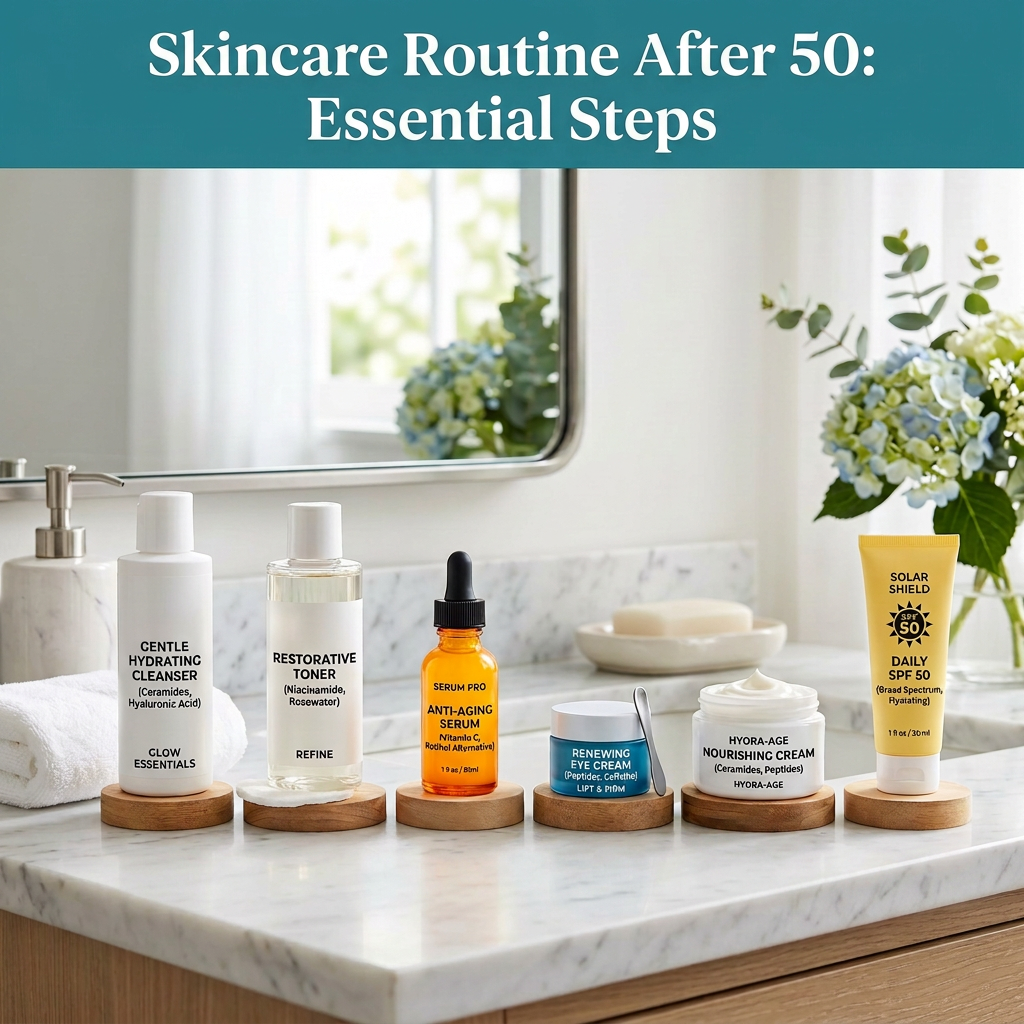
    Short answer: Go from thinnest to thickest. In the morning: cleanser, vitamin C or a serum, eye cream, moisturizer, then sunscreen last. At night: take off makeup and sunscreen, cleanse, then retinol or a treatment, eye cream and moisturizer. A good routine can be just three things: cleanser, moisturizer and sunscreen.

    Skincare after 50 can get confusing fast. Cleanser, serum, vitamin C, retinol, moisturizer, eye cream, sunscreen. Suddenly the bathroom counter looks like a chemistry lab.

    The good news is you don’t need a complicated routine. You just need to know what goes first, what belongs in the morning or at night, and what you can skip. Here’s the simple version, with a chart you can screenshot.

    The quick answer

    Thinnest to thickest. Treat before you moisturize. Sunscreen last in the morning.

    Morning: cleanse → vitamin C or serum → eye cream → moisturizer → sunscreen

    Night: remove makeup/sunscreen → cleanse → retinol or treatment → eye cream → moisturizer → face oil (optional)

    Skincare order after 50: the chart

    StepMorningNight
    1. CleanseGentle cleanser or just a rinseRemove makeup and sunscreen, then cleanse
    2. Toner (optional)Hydrating toner, if you like oneHydrating toner, if you like one
    3. Treatment / serumVitamin C, niacinamide or a hydrating serumRetinol, or a peptide or hydrating serum
    4. Eye cream (optional)Light layerLight layer
    5. MoisturizerLighter lotion or creamRicher cream
    6. Face oil (optional)Usually skipA few drops, last
    7. SunscreenBroad-spectrum SPF 30+, always lastNot needed

    Everything marked optional really is optional. A good routine after 50 can be just three products: cleanser, moisturizer and sunscreen. Add a treatment only when you have a specific goal.

    Where does each product go?

    Serum or moisturizer first?

    Serum first, moisturizer second. Serums are thinner and made to go on clean skin. Moisturizer goes on top to seal everything in. If you use more than one serum, more isn’t automatically better. Check the directions and be careful stacking strong treatments.

    Where does vitamin C go?

    Usually in the morning, right after cleansing: cleanse → vitamin C → moisturizer → sunscreen. If vitamin C irritates your skin, you don’t have to force it. Your face doesn’t get extra credit for tolerating six active ingredients.

    Where does retinol go?

    At night: cleanse → retinol → moisturizer. Retinol can cause dryness or irritation at first, so start two or three nights a week and build up. If your skin gets irritated, scale back rather than adding another product to fix it. If a dermatologist prescribed yours, follow their plan.

    Where does eye cream go?

    After serum and before moisturizer. Pat a small amount around the eye area with your ring finger. Plenty of people skip eye cream and just use a gentle moisturizer around the eyes, and that’s fine too.

    Where does face oil go?

    Last at night, over your moisturizer, to lock in moisture. In the morning, oil usually goes before sunscreen, or gets skipped so sunscreen goes on smoothly.

    Where does sunscreen go?

    Always the last skincare step in the morning, before makeup. Use broad-spectrum SPF 30 or higher, and bring it down onto your neck and the backs of your hands. If you skip everything else, don’t skip this.

    Do you need an exfoliant after 50?

    Maybe, but not automatically. Exfoliants can help rough or dull skin, but overdoing acids or scrubs leaves mature skin dry and irritated. If your face already feels tight or sensitive, simplify before adding one. If you do use one, use it at night, a couple of times a week, and not on the same nights as retinol.

    Do you have to wait between products?

    Usually not. You don’t need to stand at the mirror with a timer. Just let each layer settle for a moment so products don’t pill or slide around, and follow any specific directions on a prescription. Using too many actives at once causes far more problems than the exact number of seconds between layers.

    The layering mistake I would avoid

    Don’t start everything at once. Imagine buying a new cleanser, vitamin C, retinol, exfoliating acid and moisturizer on Monday, then waking up Friday with irritated skin. Which product caused it? Good luck figuring that out.

    Add one new product at a time and give it a couple of weeks before adding the next. That’s the easiest way to learn what your skin likes.

    What if your skin gets dry, red or irritated?

    That’s your cue to simplify, not to buy another product. Stop any recently added actives and go back to gentle cleanser, moisturizer and sunscreen until your skin calms down. Talk with your prescriber before changing a prescription. Persistent burning, swelling, rash or cracking deserves a visit to a dermatologist.

    My 4-question test before buying another bottle

    1. What problem am I trying to solve?
    2. Do I already have something that does this job?
    3. Is my current routine comfortable?
    4. Will I actually use this every day?

    If you can’t answer those, the new bottle can stay on the store shelf for now.

    Need help choosing each step? See my guides to picking a cleanser, picking a serum, picking a moisturizer, and whether Korean peptide serums are worth it.

    Three experts on skincare order

    Dermatologist Dr. Sean McGregor describes a simple morning order of cleanse, optional serum, moisturizer and sunscreen, and notes that using too many products increases the chance of side effects.

    Cosmetic chemist Dr. Michelle Wong explains why cleansing can stress the skin barrier. If your routine starts with a harsh wash, six expensive serums afterward won’t make it gentler.

    Dermatologist Dr. Rebecca Kazin recommends matching moisturizer texture to your skin’s needs and stresses daily sun protection.

    Common Questions

    What order should you apply skincare products after 50?
    Thinnest to thickest: cleanse, serum or treatment, eye cream, moisturizer, then sunscreen in the morning.

    Should serum or moisturizer go first?
    Serum first, then moisturizer.

    Does vitamin C go before or after moisturizer?
    Before. Apply vitamin C to clean skin, then moisturizer, then sunscreen.

    Do you put retinol on before or after moisturizer?
    Usually before. If your skin is sensitive, some people apply moisturizer first to buffer it. Follow the product’s directions.

    Where does sunscreen go in your routine?
    Last in the morning, after moisturizer and before makeup.

    Should you use skincare on your neck after 50?
    Yes. Bring your moisturizer and sunscreen down onto your neck and chest. More on that in how to keep your neck looking better after 50.

    What if products pill when you layer them?
    Use smaller amounts, let each layer settle, and cut back on the number of products.

    The bottom line

    Skincare after 50 doesn’t have to be a race to collect products. The goal is a routine that makes sense, feels comfortable and is easy enough to stick with. Start with the basics, add one treatment at a time, and pay attention to how your skin responds.

    Your turn: How many steps are in your routine right now? Tell me in the comments, and whether you think you could cut one.

    Skincare needs vary from person to person. This article is general skincare information and personal experience, not medical advice.

    Tom Green writes Well After 50. He was born in Pell City, Alabama, in 1962, and he’s a country boy and a true Southerner through and through. He’s just a regular, laid-back 64-year-old who keeps things simple. He shares what he learns about skincare, fitness and getting older, and what’s working for him. He’s also the author of A Practical Guide to Getting Older Without Giving Up on Yourself. Tom isn’t a doctor. He reads up on the research and passes along what’s useful, plain and simple.

    I’ve also mapped out some great tools on my new Tech for Independent Living After 50 page.
  • Skincare After 50: What to Buy and What to Skip

    Skincare After 50: What to Buy and What to Skip

    What skincare should you buy after 50, and what can you skip?

    Short answer: Spend on the basics first: a gentle cleanser that doesn’t leave your face tight, a moisturizer that suits your skin, and daily broad-spectrum sunscreen. Most other “anti-aging” extras are optional. If a skin problem is new or keeps changing, see a dermatologist instead of buying another product.

    Skincare After 50: Build a Routine Around Your Skin

    Skincare after 50 doesn’t need to be expensive or complicated. Whether you’re dealing with dryness, fine lines or irritation, this guide shows which basics deserve your money, which extras are optional and when to ask a dermatologist.

    Walk down the skincare aisle and you can come away feeling that getting older requires a whole new bathroom cabinet. There is a cream for lines, another for dark spots, a serum for firmness, and a special product for the skin around your eyes. Before long, the bill is bigger than the routine—and it still may not be clear what is helping. My view at Well After 50 is straightforward: skincare should make your skin more comfortable and help protect it, not leave you chasing every promise on a label. After 50, your skin may be drier or more easily irritated than it used to be. That is a reason to pay attention, not a reason to buy everything marketed as “anti-aging.”

    Start by paying attention to your own skin

    There is no single routine that every person over 50 needs. Some people are dealing with dryness; others have oily skin, acne, sensitivity, uneven tone, or a mix of concerns. Age matters, but it does not tell the whole story. Weather, sun exposure, medications, health conditions, and the products you already use can all affect how your skin behaves. For a week, notice what your skin is telling you. Does it feel tight after washing? Does a product sting? Are you getting flaky patches, or is a new spot changing? Those clues are more useful than an advertisement showing a perfect face. The National Institute on Aging’s skin-care guidance explains that skin can become thinner and drier with age and that new or changing skin problems deserve attention. If a concern is persistent or unusual, do not assume it is just aging.

    Spend on the basics before chasing extras

    Choose a cleanser that leaves your face comfortable

    Your face should not feel stripped, raw, or painfully tight after you wash it. Use lukewarm water, your fingertips, and a gentle cleanser that suits your skin. You do not need to scrub hard to get clean, and a rough brush is not a requirement for healthy skin. If cleansing leaves you uncomfortable, try changing one thing at a time: the product, the water temperature, or how often you wash. My guide to choosing a facial cleanser after 50 offers more help with that decision.

    Use moisturizer for a practical reason

    A moisturizer can help reduce dryness and make skin feel softer. You do not have to buy the most expensive jar or choose one because the packaging looks scientific. Look for a formula that fits your skin and budget, and that you will actually use. If fragrance tends to bother you, a fragrance-free product may be a sensible place to start. Texture can matter: a lotion may feel lighter, while a cream or ointment can be more helpful when skin is very dry. The American Academy of Dermatology has a useful guide to choosing a moisturizer. You can also read our plain-language guide to picking a moisturizer after 50.

    Make sun protection a habit, not an occasional extra

    If you are choosing where to put your skincare money, sun protection deserves serious consideration. Use a broad-spectrum, water-resistant sunscreen with SPF 30 or higher when you will be outdoors, follow its label directions, and reapply as directed—especially after swimming or sweating. A hat, protective clothing, and shade add another layer of protection. The American Academy of Dermatology’s advice for skin in your 40s and 50s puts sun protection among the core habits that help protect skin. Sunscreen will not erase the years behind you, but protecting your skin now is still worthwhile.

    Before buying another serum, ask three questions

    1. What exactly am I trying to improve? “Better skin” is too vague. Are you trying to relieve dryness, improve the look of uneven tone, or address rough texture? A clear goal makes it easier to judge whether a product is relevant.
    2. Is there a reasonable basis for the claim? Be cautious with promises of dramatic results in a few days, claims that one product fixes everything, or before-and-after pictures that do not tell you how they were produced. Cosmetics can improve how skin looks or feels, but a cream cannot deliver every result its marketing suggests.
    3. Can I use it without irritation, and can I afford to keep using it? A product is not a bargain if it sits unused or leaves your skin angry. Price alone does not prove that a formula will work better.
    The American Academy of Dermatology’s product-selection guidance recommends realistic expectations, choosing products for your skin type, and working within your budget. That is advice worth remembering before reaching for your wallet.

    Be careful with strong ingredients

    Ingredients such as retinol and other retinoids may help some people with fine lines, acne, or uneven texture, but they can also cause dryness and irritation. They are not essential for everyone, and stronger does not automatically mean better. If you decide to try one, follow the product directions, introduce it cautiously, and ask a dermatologist if you have a skin condition or are unsure whether it is suitable for you. The AAD explains the differences and cautions in its guide to retinoids and retinol. Avoid starting several new active products at once; if your skin reacts, you will not know which product caused the problem. Exfoliating acids and scrubs deserve the same common sense. If your skin is already dry, sore, or irritated, more exfoliation may make things worse. Our guides on ingredients to reconsider on mature skin and serums you should not layer together can help you think through those choices.

    A simple way to reset your routine

    If your bathroom shelf has become crowded, you do not need to replace everything this weekend. Try this measured approach instead:
    • Keep: products you tolerate and use consistently, especially a gentle cleanser, moisturizer if you need one, and sunscreen for outdoor exposure.
    • Pause: products that repeatedly sting, burn, cause a rash, or leave your skin more uncomfortable. If a treatment was prescribed, contact the prescriber before changing how you use it.
    • Change one thing at a time: give yourself a fair chance to notice how your skin responds rather than introducing three new products together.
    • Track the basics: note the product, how often you use it, and whether your skin feels better or worse. A simple note on your phone is enough.
    • Skip the pressure: toner, eye cream, face oil, masks, and extra serums are optional. Add one only when you have a clear reason for wanting it.
    For a deeper look at what evidence can and cannot tell us about skincare, see Skincare After 50: What Actually Deserves a Place on Your Counter.

    Know when a product is not the answer

    Persistent redness, itching, swelling, or burning deserves attention rather than another product layered on top. Stop using a new non-prescription product that causes a reaction. Seek medical advice if symptoms persist or are severe. Also have a dermatologist assess a spot or growth that is new, changing, bleeding, or not healing; do not automatically label it an age spot. Skin-care products can help with comfort and appearance, but they are not a substitute for medical assessment when something seems wrong. If you are unsure what you are seeing, getting it checked is a better investment than guessing.

    Three Specialists Whose Advice Can Save You Money

    Dermatologist Dr. Tina Alster says people interested in retinoids should generally begin with less-intense formulas and introduce them gradually. You don’t need a high-strength prescription-style routine to start taking skincare seriously.

    Dermatologist Dr. Anne Chapas points out that red, inflamed or highly sensitive skin may call for a different approach. Trying a strong active when your face already stings can be money wasted.

    Cosmetic chemist Dr. Michelle Wong writes about evaluating beauty products through chemistry and evidence. Her approach is a helpful antidote to paying extra for a trendy ingredient without understanding what the finished product does.

    My Budget Priority List

    Buy first: gentle cleanser, a moisturizer that feels good on your skin, and sun protection you will use. Consider next: one treatment for a specific issue—such as a tolerated retinoid for texture or a targeted product for uneven tone. Skip unless you have a clear reason: a separate eye cream, face mist, elaborate toner, several peeling products and duplicate serums.

    The American Academy of Dermatology’s shopping advice explicitly prioritizes sunscreen and moisturizer and warns that impressive marketing is not proof of dramatic results.

    A Seven-Day Routine Audit

    For a week, write down what you apply, the cost and whether your skin is calmer, drier or more irritated afterward. If you’re adding several products, change only one at a time. If your skin is persistently irritated, pause new nonprescription actives and seek advice for ongoing symptoms. This gives you a better basis for spending than comparing before-and-after photos under different lighting.

    Know Which Changes Don’t Belong in a Skincare Shopping Cart

    Deep lines, significant sagging and volume loss will not disappear with a moisturizer. A new or changing mole, a sore that doesn’t heal, or persistent bleeding deserves professional assessment—not an exfoliating serum. Honest expectations can protect both your skin and your budget.

    For more specific help, read our moisturizer-buying guide and our practical The Ordinary routine.

    Common questions about skincare after 50

    What is the first thing I should improve in my routine? Start with comfort and protection. Use a cleanser that does not leave your skin stripped, moisturize if you are dry, and use sunscreen when you are outdoors. Build from there only if you have a specific concern. Do I need a separate eye cream? Not necessarily. Eye cream is optional. Some people like the texture or find it comfortable around their eyes, but you do not have to buy a separate product just because it is marketed for that area. Are expensive products better? Not automatically. Choose something suited to your skin, with realistic claims, at a price you can manage. The most useful routine is one you can maintain. Should everyone over 50 use retinol? No. Some people may benefit, while others find it irritating or have reasons to avoid it. Consider your skin’s condition and ask a dermatologist if you are uncertain. When should I ask a dermatologist for help? Get advice for a persistent reaction, a skin problem that is not improving, or a new or changing spot. Do not try to treat a suspicious growth with an ordinary skincare product.

    My takeaway

    Getting older does not mean you have to turn skincare into a complicated project. Pay attention to what your skin needs, protect it from the sun, keep it comfortable, and be skeptical of expensive promises. You are allowed to leave products on the shelf. The goal is not to look like you did at 25. It is to care for the skin you have now, without wasting money or making it miserable in the process.

    Further reading

    Allison Palmer’s Miami Herald article, “How to Build a Skincare Routine That Actually Works After 50”, was published in February 2026. This Well After 50 guide takes a separate practical approach, focusing on how to evaluate products, avoid unnecessary spending, and recognize when a skin concern needs professional attention. One optional product some readers may want to consider: CeraVe Eye Repair Cream. An eye cream is not a necessity and no product suits everyone; check the ingredients and consider your own sensitivities before buying. Health note: This article provides general skincare information, not personal medical advice. A dermatologist can help with persistent symptoms, changing spots, or questions about treatments for your skin.

    About Thomas Green

    Tom Green writes Well After 50. He was born in Pell City, Alabama, in 1962, and he’s a country boy and a true Southerner through and through. He’s just a regular, laid-back 64-year-old who keeps things simple. He shares what he learns about skincare, fitness and getting older, and what’s working for him. He’s also the author of A Practical Guide to Getting Older Without Giving Up on Yourself. Tom isn’t a doctor. He reads up on the research and passes along what’s useful, plain and simple.

    I’ve also mapped out some great tools on my new Tech for Independent Living After 50 page.