Tag: men over 50

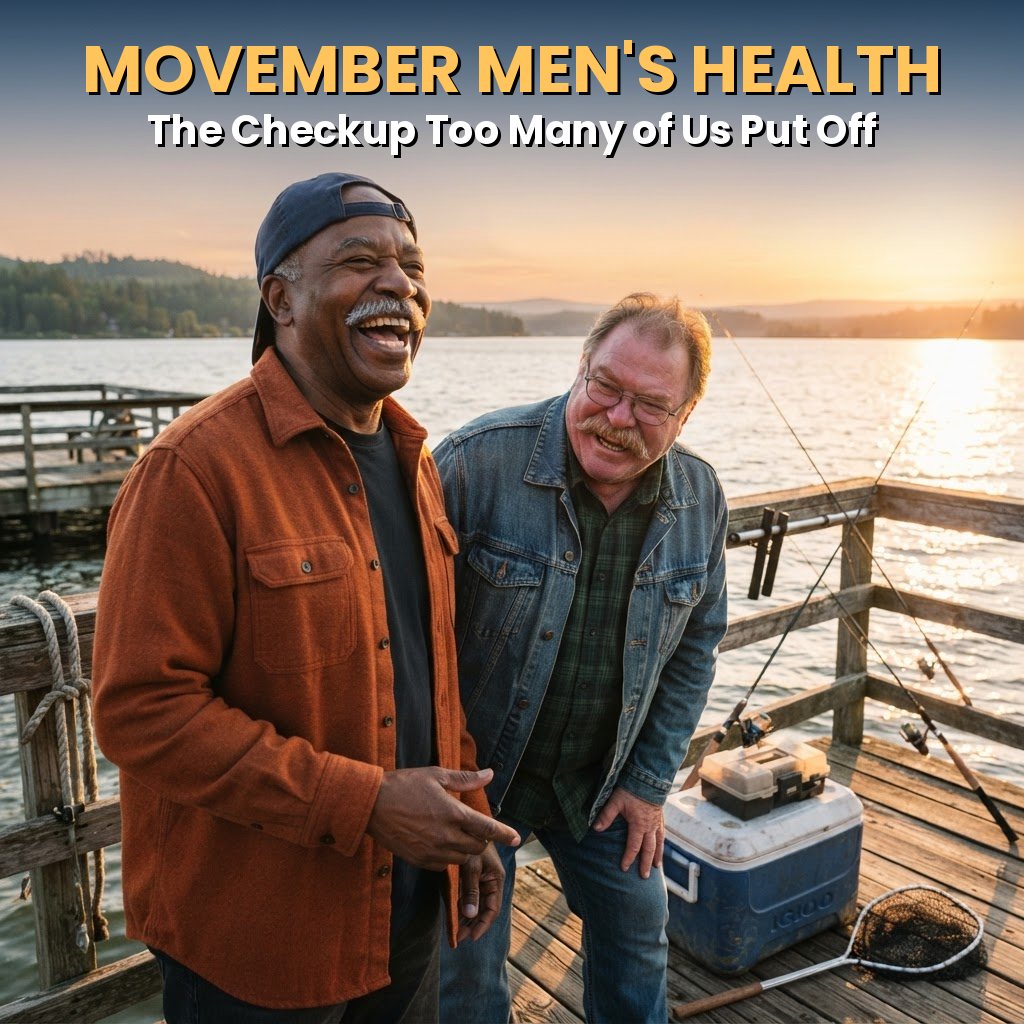
  • Movember Men’s Health: The Checkup Too Many of Us Put Off

    Movember Men’s Health: The Checkup Too Many of Us Put Off

    What checkup should a man get this Movember?

    Short answer: Book a yearly checkup and take a short list with you. Ask about your blood pressure, cholesterol and blood sugar, colon cancer screening if you’re 45 to 75, the PSA test if you’re 55 to 69, a one-time belly ultrasound if you’re a man 65 to 75 who ever smoked, and which shots you’re due for. If you’ve had Medicare Part B for over a year, the Annual Wellness Visit costs you nothing when your doctor accepts Medicare.

    Every November you’ll see fellas walking around with brand new mustaches. Some of them look mighty proud. Some look like a caterpillar crawled up and took a nap on their lip. That’s Movember, and behind all the whiskers is a simple idea I can get behind: a man ought to look after himself before something breaks.

    I’m a 64-year-old country boy from Pell City, Alabama. A lot of us were raised on “rub some dirt on it and get back to work.” That’s fine advice for a skinned knee. It’s a poor plan for high blood pressure. I wrote a while back that I refuse to act my age, and part of staying in the game is knowing what’s going on under the hood. I’ve already been in for my checkup, so I’m not asking you to do anything I haven’t done myself. This Movember I’m asking the men reading this, and the women who love them, to do one thing. Get that checkup on the calendar.

    What is Movember, anyway?

    Back in 2003, two friends named Travis Garone and Luke Slattery were having a beer in Melbourne, Australia, and got to talking about how the mustache had gone plumb out of style. They decided to bring it back and hitch it to a good cause. They rounded up 30 guys that first year.

    Today Movember is a worldwide charity that raises money for prostate cancer, testicular cancer and men’s mental health, and it has funded more than 1,250 men’s health projects. Their big point is worth chewing on. On average, men die several years earlier than women, and a good share of that gap comes from problems that could have been caught early or headed off.

    Why do so many men put off going to the doctor?

    Cleveland Clinic asked about 1,174 men across the country that very question in 2019, and the answers made me laugh and wince at the same time. Seventy-two percent said they’d rather do chores, like scrubbing the bathroom or mowing the lawn, than go see a doctor. Only half said a yearly checkup was a regular part of taking care of themselves. About 1 in 5 owned up to not being completely honest with their doctor.

    Brett and Kate McKay at The Art of Manliness, one of the best-known men’s sites on the internet, put their finger on why. A lot of us were taught as boys that being a man means sucking it up when you’re sick or hurt, so walking into a doctor’s office can feel like admitting weakness.

    Our age group comes off better, though. When AARP wrote up that same survey, the older men in it were a whole lot better about it. Seventy-four percent of them said they get a yearly physical, compared with 43% of men 35 to 54. So if you’re in your 60s and still dodging the doctor, most of the fellas your age have already beat you to the waiting room.

    Why is catching things early such good news?

    Because most of what a checkup looks for can be treated when it’s found early. Take prostate cancer, one of Movember’s big causes. According to the American Cancer Society, when it’s found while it’s still inside the prostate, the five-year survival rate is over 99%. When it’s found after spreading to faraway parts of the body, that number drops to 38%. Same disease. What changed was when somebody caught it.

    Actor Ben Stiller found that out for himself. His internist gave him a “baseline” PSA test when he was about 46, even though he had no family history and no symptoms. His number kept creeping up, more tests followed, and in 2014 doctors found an aggressive prostate cancer. He got treated, and by 2016 he was cancer-free and wrote about it in a Medium essay called “The Prostate Cancer Test That Saved My Life.” His words: “Taking the PSA test saved my life. Literally.”

    Now, I’ll be straight with you. The PSA test isn’t a yes for everybody. It can turn up slow-growing cancers that never would have hurt you, and that can lead to biopsies and treatment you didn’t need. That’s why the U.S. Preventive Services Task Force says men 55 to 69 should talk it over with their doctor and decide together, and it recommends against routine PSA screening at 70 and up. Stiller himself said his essay was his own story, not a scientific one. The point is to have the talk.

    What should you ask for at your checkup after 60?

    Snap a picture of this with your phone and take it with you. It comes from the U.S. Preventive Services Task Force, the panel most doctors go by for screenings. Your doctor may add some or skip some depending on your health, and that’s how it ought to be.

    • Blood pressure. High blood pressure usually doesn’t feel like anything, and the checkup is the easy way to catch it.
    • Cholesterol and blood sugar. One blood draw covers both.
    • Colon cancer screening from 45 to 75. There’s more than one kind of test, including stool tests you do at home and mail in, so ask which one fits you.
    • The PSA talk if you’re 55 to 69.
    • A one-time belly ultrasound if you’re 65 to 75 and ever smoked. It looks for an abdominal aortic aneurysm, a weak, bulging spot in the body’s main blood vessel that usually gives no warning.
    • Lung cancer screening if you’re 50 to 80, smoked the equivalent of a pack a day for 20 years, and still smoke or quit within the last 15 years.
    • Your shots. Ask which ones you’re due for, like shingles and pneumonia.
    • How you’ve really been feeling. If you’ve been down or not yourself, say so. Your mind is part of your health, and Movember puts men’s mental health right up front for good reason.

    Does Medicare pay for a yearly checkup?

    Mostly, yes, with one catch worth knowing about. Once you’ve had Medicare Part B for more than 12 months, you get an Annual Wellness Visit once a year. According to Medicare.gov, you pay nothing for it as long as your doctor accepts Medicare assignment, and the Part B deductible doesn’t apply.

    The catch is that it isn’t a full head-to-toe physical. The visit covers things like your blood pressure, height and weight, a look at your medical and family history and your prescriptions, a quick memory check, and a written plan of the screenings and shots you need. If the doctor runs extra tests or works on a new problem that same day, you may owe something for that part. So when you call, say the words “Annual Wellness Visit.” In your first year on Medicare Part B, you’d book the “Welcome to Medicare” visit instead.

    Not on Medicare yet? Most private insurance plans cover a yearly preventive visit too, so call the number on the back of your card and ask. And if you’re sorting out your coverage right now, my post on Medicare open enrollment 2026 changes walks through what’s different this year.

    How do you get the man in your life to go?

    Ladies, this part’s for you, and for the sons, daughters and fishing buddies too. In a piece on Katie Couric’s website, Dr. Peter Attia, the longevity doctor who wrote the bestseller Outlive, said men do best when they keep up with their screenings and shots and build a relationship with a doctor they trust. Getting him in the door is the first step toward that.

    Nagging hardly ever works on a stubborn man. Making it easy does. Offer to make the phone call. Book your own checkup the same week and ride over together. And tell him plain that you’d like to keep him around a good long while. That lands a lot better than “you never listen.”

    Fellas, if you’re the one dragging your feet, think of it like changing the oil in your truck. You don’t wait for the engine to lock up before you take care of it. A stitch in time saves nine.

    Can you still get in on Movember this late?

    You sure can. Movember runs through November 30, and you can donate or sign up to fundraise at Movember.com. If your new mustache comes in gray, I reckon that just means you earned it. But the best thing you can do for Movember won’t cost you a dime. Pick up the phone and book that checkup before the month’s out.

    Then keep the good work going at home. Strong hands and strong legs go a long way, and my post on grip strength and a simple band routine is an easy place to start.

    Common Questions

    What is Movember?

    Movember is a men’s health charity that started in Melbourne, Australia, in 2003. Each November, people grow mustaches and raise money for prostate cancer, testicular cancer and men’s mental health.

    How often should a man over 60 get a checkup?

    Once a year is a good habit. Medicare covers one Annual Wellness Visit every 12 months at no cost if your doctor accepts Medicare assignment.

    Should men over 70 get a PSA test?

    The U.S. Preventive Services Task Force recommends against routine PSA screening at 70 and older. Talk with your doctor about your own health and history.

    What is the survival rate for prostate cancer caught early?

    When prostate cancer is found before it spreads beyond the prostate, the five-year relative survival rate is over 99%, according to the American Cancer Society.

    Does Medicare cover a yearly physical?

    Medicare covers a yearly Annual Wellness Visit, but not a routine head-to-toe physical. Extra tests done during the visit may cost you something.

    So fellas, when was your last checkup? And ladies, what finally got the man in your life through that doctor’s door? Tell me in the comments.

    Tom

    About Tom Green

    Tom Green writes Well After 50. He was born in Pell City, Alabama, in 1962, and he’s a country boy and a true Southerner through and through. He’s a regular, laid-back 64-year-old who keeps things simple and passes along what he learns about getting older. Tom isn’t a doctor. He reads up on the research and shares what’s useful, plain and simple. Read more about Tom.

    Health note: This article is for general education and isn’t medical advice. Which screenings you need depends on your own health and history, so talk with your doctor. If you notice a new symptom, don’t wait for a yearly visit to get it checked.

    Research & Sources

  • What Can a Man Over 50 Do to Look Younger?

    What Can a Man Over 50 Do to Look Younger?

    What can a man over 50 do to look younger?

    Short answer: Looking younger after 50 isn’t about looking 30. For men, muscle makes the biggest difference, especially in the shoulders and legs, along with a trimmer waist. Take care of your skin, stand up straight, and wear clothes that fit. Your hair doesn’t have to be dark to look good.

    If you ask a man over 50 what he could do to look younger, you might get some predictable answers.

    Get a better haircut. Lose some weight. Buy better clothes. Use a good moisturizer. Maybe even color the gray.

    All of those things can change how a man looks. But there is one thing that can change much more than his face.

    Build and maintain muscle.

    That doesn’t mean a man in his 50s, 60s or 70s needs to become a bodybuilder. It means doing enough resistance training to keep his shoulders, chest, back, arms and legs strong and developed.

    And there is a good reason this matters as we get older: muscle mass and strength naturally tend to decline with age, while resistance training can help maintain and build them. The CDC specifically recommends muscle-strengthening activity for older adults.

    Looking Younger Isn’t Really About Looking 30

    I don’t think most men over 50 actually need to look 30.

    Trying to erase every sign of age can sometimes have the opposite effect.

    Gray hair isn’t necessarily aging a man badly. Neither are a few wrinkles.

    What tends to make a man look older is looking tired, weak, poorly groomed or physically inactive.

    A man with gray hair, some wrinkles and a strong body can look considerably younger than a man the same age who has spent years becoming inactive.

    That’s why the goal shouldn’t necessarily be “look young.”

    A better goal is:

    Look healthy, strong, energetic and well cared for.

    Why Muscle Makes Such a Difference

    Think about the male body when you are young. The shoulders are generally broader than the waist. The chest and back have shape. The arms have some size. The legs have muscle.

    As men age and become less active, some of that shape can disappear. The shoulders may look narrower. The chest can become softer. The arms lose some fullness. The waist may get larger. Posture can deteriorate.

    Put all of that together and a man can look considerably older—even if his face hasn’t changed dramatically.

    Resistance training attacks several of those problems at once.

    The CDC notes that muscle-strengthening activity can increase or maintain muscle mass and strength, and recommends working the major muscle groups, including the legs, hips, back, chest, abdomen, shoulders and arms.

    And you don’t have to lift enormous weights. Consistency matters much more than trying to impress everybody in the gym.

    Your Shoulders May Be More Important Than You Think

    One of the easiest ways to change a man’s overall appearance is to develop the upper body.

    • shoulders
    • upper chest
    • back
    • arms

    A little more muscle in these areas can change the proportions of the entire body.

    A stronger upper body can make the waist appear smaller simply because the shoulders and torso have more shape.

    That’s one reason I wouldn’t recommend that a man over 50 focus exclusively on losing weight.

    If you lose weight but also lose muscle, you can end up smaller without necessarily looking younger.

    The goal is different: lose excess body fat while protecting or building muscle.

    Don’t Forget Your Legs

    There is another mistake men make. They train their chest and arms because those are the muscles they see in the mirror. Then they neglect their legs.

    That’s a mistake at any age, but especially as you get older.

    Strong legs contribute to mobility, balance and everyday function. The CDC recommends combining aerobic activity, muscle strengthening and balance activities as part of healthy aging.

    And visually, muscular legs help keep the entire body looking proportionate.

    You don’t need enormous legs. You need strong legs that still look like they belong to an active man.

    Then There’s the Waist

    A man can build muscle and still look older if his waist continues getting larger.

    That’s why the combination of muscle plus reasonable body-fat control is so important.

    You don’t have to become extremely lean. In fact, some older men look worse when they chase a very low body-fat percentage and lose too much fullness from their face and body.

    Instead, think about keeping your waist under control while maintaining muscle throughout your body. That’s a much more sustainable goal.

    Your Skin Gives Away More Than Your Hair

    You can have a great haircut, a strong body and nice clothes—but badly sun-damaged skin can still make you look older.

    And unlike a lot of anti-aging claims on the internet, there is actual clinical research behind sun protection. A randomized trial found that regular sunscreen use slowed the progression of skin aging compared with discretionary sunscreen use.

    That doesn’t mean sunscreen is going to erase 20 years from your face. It means protecting your skin from additional UV damage is one of the few anti-aging strategies with solid evidence behind it.

    For a man over 50, a simple routine can be enough: Morning: cleanse if needed, moisturizer, broad-spectrum sunscreen. Night: cleanse, moisturizer, and whatever additional skin-care product fits your skin and routine.

    You don’t need a bathroom counter full of products.

    Hair Doesn’t Have to Be Dark to Look Younger

    This is something I’ve been thinking about more lately.

    A lot of men automatically assume gray hair makes them look old. Not necessarily.

    Gray hair that’s clean, shaped and intentional can look fantastic.

    The bigger issue is whether the haircut suits the man’s face and whether the hair looks cared for.

    If you color your hair, that’s fine too. But you don’t necessarily need to eliminate every gray hair to look younger.

    Posture Can Change Your Appearance in Seconds

    Here’s a free anti-aging trick: stand up straight.

    It sounds almost too simple, but posture changes the way the body presents itself.

    A man who walks with his head up, shoulders comfortably back and chest open can immediately look more energetic.

    And good posture isn’t just about appearance. Strengthening the back, abdomen and legs can help support physical function and balance as we age.

    You don’t need to walk around stiffly with your chest pushed out. Just stop folding yourself forward.

    Clothes Matter More Than Expensive Clothes

    You don’t need designer clothes to look younger. You need clothes that fit the man you are now.

    Too-big shirts can make a man look older and less defined. Extremely tight clothes can make him look like he’s trying too hard.

    Find clothes that fit your shoulders, chest, arms and waist properly. Keep them clean and current. And don’t be afraid of wearing something other than the same clothes you’ve worn for the last 20 years.

    Same goes for your glasses. If you’re still wearing the frames you bought ten years ago, a fresh pair can update your whole face faster than just about anything.

    What About Cardio?

    Absolutely. Building muscle doesn’t mean ignoring cardiovascular fitness.

    The CDC recommends regular aerobic activity along with muscle-strengthening and balance activities as people get older.

    Walking is a great place to start. You can also cycle, swim, hike, use an elliptical, dance or do whatever activity you will actually continue doing.

    The best exercise program isn’t the one that looks impressive on paper. It’s the one you keep doing.

    So What’s the One Thing?

    If you force me to choose only one thing for a man over 50, I’d choose:

    Resistance training.

    Not because lifting weights magically removes wrinkles. It doesn’t.

    I choose it because maintaining muscle changes so many parts of aging at the same time.

    It can help you stay stronger. It can help preserve physical function. It can change your body shape. It can improve the way your clothes fit.

    And when combined with regular walking or other cardiovascular activity, it becomes part of a much bigger strategy for staying active as you age.

    Keep your waist reasonable. Protect your skin. Get a good haircut. Take care of your teeth. Dress for your current body. Stand up straight. Stay active.

    For additional practical skincare and grooming perspectives for men, David Evans’s Grey Fox Blog covers style, grooming, and looking your best as you age. Choose advice that fits your own needs and budget.

    Common Questions

    What can a man 50+ do to look younger?
    Simple changes can make a noticeable difference, including taking better care of your skin, staying active, getting enough sleep, maintaining a healthy weight, and keeping your hair and clothing looking current.

    What skincare products can help a man 50+ look younger?
    A basic routine with a gentle cleanser, moisturizer, and daily sunscreen is a good starting point. Targeted ingredients such as retinoids or vitamin C may also help with specific signs of skin aging.

    Does exercise help men 50+ look younger?
    Regular exercise can help maintain muscle, posture, mobility, and a healthy body composition. Strength training can be particularly useful for maintaining muscle as you age.

    Can losing excess weight make a man look younger after 50?
    If someone is carrying excess weight, gradual weight loss may improve overall appearance and health. However, losing weight too quickly can sometimes make the face look thinner or more aged.

    Does a haircut make a difference in looking younger after 50?
    Yes. A well-maintained haircut that suits your face and current hair can make a man look more polished and refreshed without trying to look like someone much younger.

    How important is sleep for looking younger after 50?
    Getting consistent, good-quality sleep can affect how rested and refreshed you look. Sleep also supports overall health and recovery.

    Do men 50+ need expensive products to look younger?
    Not necessarily. Consistent basics—good skincare, sun protection, exercise, sleep, grooming, and healthy habits—can matter more than having an expensive collection of products.

    Can you really look younger after 50?
    You can’t stop the natural aging process, but you can improve many visible signs of aging and present a healthier, more energetic appearance at any age.

    My Take

    I think men over 50 sometimes make the mistake of fighting age instead of taking care of themselves.

    There’s nothing wrong with gray hair. There’s nothing wrong with wrinkles. There’s nothing wrong with looking your age.

    But there’s a big difference between looking your age and looking like you’ve stopped taking care of yourself.

    Build some muscle. Move your body. Take care of your skin. Get cleaned up. Wear clothes that fit. And stay interested in life.

    You may not look 30. You may not even want to.

    But you can look like a strong, healthy, well-groomed man in his 50s, 60s, 70s or beyond.

    And to me, that’s a much better goal.

    This article is for general informational purposes and reflects my personal observations along with information from health and research sources. I am not a doctor or medical professional

    About Tom Green

    Tom Green writes Well After 50. He was born in Pell City, Alabama, in 1962, and he’s a country boy and a true Southerner through and through. He’s just a regular, laid-back 64-year-old who keeps things simple. He shares what he learns about skincare, fitness and getting older, and what’s working for him. He’s also the author of A Practical Guide to Getting Older Without Giving Up on Yourself. Tom isn’t a doctor. He reads up on the research and passes along what’s useful, plain and simple.

    I’ve also mapped out some great tools on my new Tech for Independent Living After 50 page.