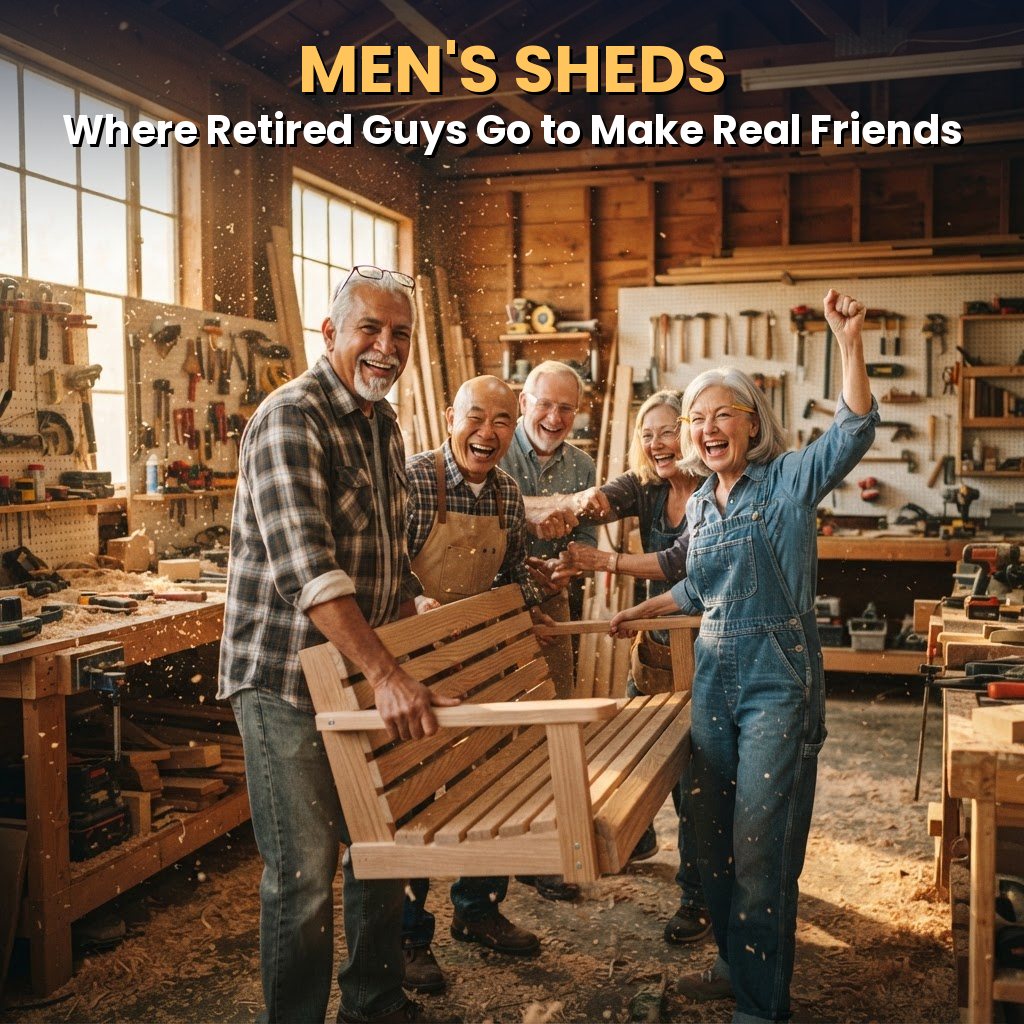
What is a Men’s Shed, and why are retired guys joining them?
Short answer: A Men’s Shed is a community workshop where mostly retired men, and plenty of women too, get together to build, fix and swap stories. The idea started in Australia in the 1990s, and Australia now has more than 1,300 of them. Men join for something to do with their hands and stay for the friends. In one Canadian survey, about a quarter of members said they felt isolated before joining, and fewer than 1 in 10 did afterward.
When I was a boy, I spent my school breaks and holidays fishing. Some days it was the lake on my mama’s daddy’s farm. Other days it was Logan Martin Lake right there in Pell City, from daybreak to sundown, and I loved every minute of it. My daddy’s daddy knew everything under that water. He’d sawmilled the land down there before it ever became a lake.
I started when I was just a tiny boy. My first fish was a big ole crappie, caught on a winter day in my granddad’s green aluminum boat, and I didn’t even know how to reel it in yet. Men have always done their best learning and their best talking side by side like that, in a boat or at a workbench. Somebody in Australia figured out that’s exactly what a lot of retired men are missing, and they built a whole movement around it called the Men’s Shed. It’s one of the happiest ideas I’ve run across in a long time. I spent my working years in design, making things with color and texture, so I know the good feeling of standing back and looking at something you made with your own two hands. It feels even better with a buddy standing next to you.
Where did Men’s Sheds come from?
The first one opened in 1993 in Goolwa, South Australia, at a day center for older folks. The coordinator, Maxine Chaseling, had noticed that the only thing that seemed to give her own father a sense of purpose was puttering in his shed. So she set one up for the men who came to her center. The first shed to actually go by the name “Men’s Shed” opened in Tongala, Victoria, in 1998, and from there the idea took off.
Today the Australian Men’s Shed Association supports more than 1,300 sheds. Here’s a fact I love: that’s more sheds than there are McDonald’s restaurants in Australia. The UK has over 1,150 more, and Ireland, Canada and New Zealand caught on too.
Their motto came from researcher Barry Golding, who has written two books on the movement. At a 2007 shed conference he told the crowd, “Men don’t talk face to face, they talk shoulder to shoulder.” Sheds all over the world use that line now, and I reckon any man who’s ever worked on a truck with his buddy knows it’s true.
Why do men need a place like this?
Because a lot of us let our friendships slide without ever meaning to. Pollster Daniel Cox, who runs the Survey Center on American Life, calls it a “friendship recession.” His research found the share of men with no close friends at all jumped from 3% in 1990 to 15%. That’s a big change in one lifetime.
Retirement can make it worse. When the job goes, so do the guys you saw every day at work. And it matters for more than your mood. The U.S. Surgeon General’s advisory on loneliness said being cut off from people can be about as hard on your health as smoking up to 15 cigarettes a day. I covered the hopeful flip side of that in my post on the Yale study showing nearly half of us get better with age. Staying connected is a big part of how that happens.
Boston Globe writer Billy Baker learned all this the hard way. His editor handed him an assignment on why middle-aged men don’t have friends, and he realized he’d lost touch with nearly all of his. He turned it into a book, We Need to Hang Out, and told NPR that men’s friendships are nearly always built around doing something together. One of his buddies told him golf is just a way to keep your hands busy while you talk. Baker said on The Art of Manliness podcast that the Men’s Shed idea of giving men somewhere to go, something to do and someone to talk to is what got him to finally go out and make new friends.
Do Men’s Sheds really help?
The early numbers look good. This spring, Raza Mirza of HelpAge Canada shared research on Canadian shed members. About a quarter of the men said they’d felt isolated before they joined, and fewer than 10% felt that way after. Sixty-seven percent said their life had gotten better since they became a “shedder,” according to Taproot Edmonton.
The stories are even better than the numbers. Alison Biggar of the American Society on Aging wrote about the Honolulu Men’s Shed, where a member named Walt Miyashiro looked after another shedder going through bypass surgery. They’d had the same surgeon. The other fella wasn’t much of a talker in person, but he opened up to Walt over email. Up in Hopkins, Minnesota, when one member lost his wife suddenly, the whole shed gathered around him and carried him through it.
Nobody signed up for a support group. They signed up to fix canoes and build porch swings, and the friendship snuck in the side door.
What do people actually do at a Men’s Shed?
Pretty much whatever the members want. Next Avenue visited a shed in Ruston, Louisiana, where members turn out porch swings, bird feeders and charcuterie boards, then donate them to local nonprofits or sell them to keep the lights on. The shed’s president, Tommy Folk, is a 77-year-old retired contractor who mostly sits back, lends a hand now and then, and visits with everybody.
The North Palm Beach County shed in Florida does a lot less sawing. They’ve played bocce, gone fishing, toured a 911 call center and watched cooking demonstrations. The Honolulu crew works out of a 6,000-square-foot warehouse and restores old outrigger canoes.
And if you’ve never held a hammer in your life, that’s fine too. Steve Werner of the US Men’s Sheds Association told Next Avenue that even a man who “doesn’t know what a screwdriver is” belongs there. Somebody will show you. Many hands make light work.
Can women join a Men’s Shed?
Yes, and plenty do. That Ruston shed is about half women. Some of them head for the craft room to sew and paint, and others are right out there doing woodworking with the men. The US Men’s Sheds Association says women have been key founders and leaders, and that everyone is welcome.
Ladies, Werner gave y’all some credit too. He said that in a lot of cases, it’s the wives who “literally and figuratively will drive men to the sheds.” Honolulu’s shed only exists because founder Glenn Sears’s wife showed him an article about the sheds in Australia.
How do you find or start a Men’s Shed?
Start with the “Find a Shed” page on the US Men’s Sheds Association website. The movement is still young here, with only a few dozen sheds across the country, so there may not be one close to you yet.
If there isn’t, you’re in good company. When Glenn Sears went looking in Honolulu, he couldn’t find a single shed anywhere in the country. So he called the folks in Australia, and they told him to start one. That shed has more than 100 members now.
You don’t need a warehouse to get going. Billy Baker started his own crew by inviting about a dozen guys to a barn on a Wednesday night. He found that just sitting around talking got old fast, so the group needed what he calls a “velvet hook,” a soft excuse to keep showing up. For them it was a plan to build a dirt bike track. For you it might be fixing up lawn chairs for the senior center or building a little free library for the neighborhood. A garage, a coffee pot and a standing day of the week will do the rest.
Your local senior center, library, church or VFW hall is a good place to ask about room to meet. And if you want something to do with your new friends besides sanding, my winter checklist has a whole section on why putting people on the calendar every week is good for you.
Common Questions
What is a Men’s Shed?
A Men’s Shed is a community workshop or meeting place where mostly older and retired men gather to build, fix, learn and talk. The idea started in Australia in the 1990s.
Do Men’s Sheds help with loneliness?
Early research says yes. In a Canadian survey, about a quarter of shed members felt isolated before joining, compared with fewer than 10% after.
Can women join a Men’s Shed?
Yes. The US Men’s Sheds Association says everyone is welcome, and some sheds, like the one in Ruston, Louisiana, are about half women.
Do you need woodworking skills to join a Men’s Shed?
No. Many sheds also fish, cook, play games and take field trips, and members are happy to teach beginners.
How do I find a Men’s Shed near me?
Check the “Find a Shed” page on the US Men’s Sheds Association website. If none is nearby, the association can help you start one.
So tell me in the comments: if your town opened a shed tomorrow, what’s the first thing you’d want to build? And if you’re already a shedder, I’d love to hear about your crew.
Tom
About Tom Green
Tom Green writes Well After 50. He was born in Pell City, Alabama, in 1962, and he’s a country boy and a true Southerner through and through. He’s a regular, laid-back 64-year-old who keeps things simple and passes along what he learns about getting older. Tom isn’t a doctor. He reads up on the research and shares what’s useful, plain and simple. Read more about Tom.
Health note: This article is for general education and isn’t medical advice. If loneliness or low moods have been hanging on for a while, let your doctor know. It’s a real health concern, and help is out there.
Research & Sources
- Men’s Sheds Canada: History of Men’s Sheds
- Wikipedia: Men’s Shed
- Australian Men’s Shed Association: About Us
- Australian Men’s Shed Association: The Ripple Effect
- UK Men’s Sheds Association: Who We Are
- National Review: American Men Suffer a Friendship Recession
- U.S. Surgeon General: Our Epidemic of Loneliness and Isolation
- NPR: ‘We Need To Hang Out’ with Billy Baker
- The Art of Manliness: Making Friends in Adulthood
- Taproot Edmonton: Study of Men’s Sheds Reveals Decreased Loneliness
- American Society on Aging: Men’s Shedders Engage One Another
- Next Avenue: The Camaraderie of Men’s Sheds
- US Men’s Sheds Association