Tag: skin barrier

  • Skin Longevity After 50: Can You Really Reverse Skin Aging?

    Skin Longevity After 50: Can You Really Reverse Skin Aging?

    Can you really reverse skin aging?

    Short answer: No. Nothing you can buy today reverses skin aging, not a cream, a serum or a pill. “Skin longevity” means helping your skin age as well as it can, and the thing that does the most is sunscreen every day, followed by plain basics like a good moisturizer and a strong skin barrier.

    Lately I keep seeing a new phrase on skincare labels: skin longevity. It sounds exciting. It also sounds a whole lot like a promise.

    So let me give you the straight answer to the question up top first, before anybody spends ninety dollars on a jar.

    No, you can’t reverse cellular aging with anything you can buy today. Not with a cream, not with a serum, not with a pill.

    Now, I’m not knocking the idea. I work out four days a week and I’ve started taking a longevity supplement myself, so I’m all for anything that helps us age well. I’ve just learned to read the fine print before I open my wallet.

    And fellas, this one’s for us too. The sun doesn’t care whether you call it skincare or not.

    So where did the idea come from?

    It’s not all hype. Back in 2022, a team at the Babraham Institute in England, led by Professor Wolf Reik, took skin cells from older people and “rewound” them in the lab. By their measurements, the cells acted about 30 years younger, and they even started making more collagen again.

    That’s a big deal. But here’s the catch. It happened in a dish, in a lab, using a genetic technique. Nobody’s tried it on a living person’s face, and the scientists themselves said they don’t fully understand how it works yet. That’s years away from anything you or I could use, if it ever gets here at all.

    So when a bottle on the shelf says “longevity,” it’s borrowing the excitement from research like that. It’s not selling you the research itself.

    What skin longevity really means

    Dr. Jane Yoo is a board-certified dermatologist in New York, and she wrote a good piece on this. The way she puts it, old-school anti-aging was about how your skin looks. Skin longevity is about how well your skin works as it gets older: holding onto moisture, keeping a strong barrier, and bouncing back from wear and tear.

    She also warns that the word is spreading faster than the science behind it. Just because a label says “longevity” doesn’t mean that product was ever tested to do anything special.

    I reckon that’s a pretty fair way to see it. Think of it like taking care of an old truck. You can’t make it new again, but good upkeep keeps it running a lot longer.

    The three things your skin cells need

    1. Energy

    Your skin cells run on energy to repair damage and make collagen. One molecule in the middle of all that is called NAD+, and our levels of it drop as we get older. That’s why NAD+ creams are suddenly everywhere. (It’s the same idea behind the NMN pills I looked at in my post on NMN supplements.)

    The honest truth? The skin research on NAD+ creams is still early. They’re aimed at something real, but nobody’s proven they turn back the clock on a real person’s face.

    2. A strong barrier

    Your skin barrier is the outer wall that keeps moisture in and junk out. When it gets weak, your skin turns dry, tight and touchy, and no fancy ingredient can do its job. Plain stuff like ceramides and glycerin in a good moisturizer does more here than most folks think. I went through what to look for in how to pick a moisturizer after 50.

    3. Repair signals

    Peptides are little pieces of protein that act like messengers, nudging your skin to keep up its repair work. Some have better evidence than others, and they help a little over time. They’re not magic. I dug into the popular ones in Korean peptide serums for mature skin.

    You’ll also see CoQ10 in a lot of these products. It’s an antioxidant your body already makes, and like NAD+, you make less of it as you age. It’s a sensible add-on, not a time machine.

    What actually does the most

    Here’s the part that won’t sell a fancy serum, but it matters more than anything else in this post: sunscreen, every day.

    A study of nearly 300 women, published in 2013, found the sun seemed to be behind about 80% of the visible signs of aging on their faces. Wrinkles, spots, sagging, a lot of what we blame on birthdays is really years of sunshine.

    Dr. Michelle Wong, a chemist who runs Lab Muffin Beauty Science, has spent years cutting through skincare marketing, and sunscreen is one of the things she keeps coming back to. If you like knowing the “why” behind a product, her site is a good one to bookmark.

    After sunscreen, the plain basics carry the most weight:

    • A gentle routine you’ll actually stick with. Simple beats complicated.
    • Don’t strip your skin. Harsh scrubs and too many strong products wear the barrier down.
    • Sleep. Your skin does its repair work at night. More on that in can poor sleep make your skin look older.
    • Real food and no smoking. Not exciting, but it shows on your face.

    The trendy ingredients can sit on top of that foundation. They just can’t replace it.

    Can you improve wrinkles and sun damage you already have?

    Here’s the encouraging part: even if you’ve spent years in the sun, you can still improve some of the signs it left behind. Dermatologists call this photoaging. It can show up as fine lines, uneven color, rough texture, and sun spots. The American Academy of Dermatology says treatment can reduce some visible damage, although it can’t erase everything. Sunscreen helps prevent more damage; treatment is what may improve changes that are already there.

    What about retinol, retinal, and prescription tretinoin?

    These vitamin A relatives, called retinoids, deserve a spot in this conversation. They aren’t cellular time machines, but they can improve the appearance of aging skin. A systematic review of eight randomized trials, involving 1,361 people, found that prescription tretinoin improved fine and deeper wrinkles caused by sun exposure. A separate review comparing topical treatments found evidence of improvement in several photoaging measures with retinoids, including retinol. These products can also irritate skin, especially at first, so stronger isn’t automatically better for everybody.

    If you’re wondering whether the newer retinal is worth paying extra for, I dig into the differences, the evidence, and the irritation question in Retinal vs. Retinol After 50: Which One Actually Works Better? It’s a useful next step before buying another bottle.

    Looking younger isn’t the same as making skin cells younger

    Here’s the distinction I don’t want lost in all the excitement. A treatment might soften wrinkles, fade spots, or improve texture without reversing the biological age of your skin cells. Those are two different claims. In the Babraham Institute’s 2022 experiment, scientists changed age-related markers in skin cells in a laboratory. That’s fascinating research, but it isn’t an anti-aging cream or a proven treatment for people. So yes, visible skin aging can sometimes be improved. Reversing cellular aging in a person’s skin is a much bigger scientific hurdle.

    Other voices worth following

    If you want to keep learning about this, here are a few folks I trust:

    • Dr. Michelle Wong of Lab Muffin Beauty Science explains skincare science in plain language and calls out hype.
    • Angie of Hot & Flashy writes about style, beauty and health for women in their “hot-flash years,” and she tests a lot of skincare and sunscreen on her own 60-something skin.
    • Caroline Hirons, the British skincare expert who wrote Skincare: The Ultimate No-Nonsense Guide, keeps things practical.

    Common Questions

    What is skin longevity?
    It’s a newer way of thinking about skincare. Instead of just hiding wrinkles, the goal is keeping your skin healthy and working well as it ages: a strong barrier, good moisture, and steady repair.

    Can you reverse cellular aging in your skin?
    Not with anything you can buy today. Scientists have made skin cells act younger in a lab dish, but that’s research, not a product.

    Do NAD+ skin creams work?
    The research is still early. NAD+ does drop with age, but no cream has been proven to reverse aging in real people.

    What’s the best thing you can do for aging skin after 50?
    Wear sunscreen every day. After that, a gentle routine, a good moisturizer, sleep and real food do more than any trendy ingredient.

    So no, nobody can turn back the clock on your skin. But you can sure help it age about as well as it possibly can. Protect it from the sun, keep the barrier strong, and don’t fall for the miracle jars.

    Next week in this little series, I’m looking at retinal vs. retinol, and why doctors keep bringing it up for mature skin.

    What’s one thing in your skincare routine you’d never give up? Tell me in the comments.

    — Tom

    This is general information, not medical advice. If you have a skin condition or are thinking about a new treatment, talk with your dermatologist.

    I’ve also mapped out some great tools on my new Tech for Independent Living After 50 page.

  • Fall Skin Problems After 50: Why Your Skin May Suddenly Feel Dry, Tight or Itchy

    Fall Skin Problems After 50: Why Your Skin May Suddenly Feel Dry, Tight or Itchy

    Why does skin get dry, tight or itchy in the fall after 50?

    Short answer: Cooler air and indoor heat dry out skin that’s already making less oil after 50, and hot showers and harsh cleansers make it worse. Turn the shower down to warm, put moisturizer on right after washing, go easy on scrubs and exfoliants, and see a doctor if the itching or irritation won’t quit.

    One week your skin feels fine. Then the weather changes and suddenly your face feels tight after washing, your hands feel dry and your usual moisturizer seems to disappear almost instantly.

    That can be especially frustrating after 50, when skin may already feel less forgiving than it did years ago.

    What may be happening

    Cooler outdoor air and indoor heating can contribute to a drier environment. Hot showers, harsh cleansers and overusing exfoliating products can make the uncomfortable feeling worse.

    Turn down the water temperature

    A steaming shower feels wonderful on a cold morning, but very hot water can leave already-dry skin feeling even drier. Warm water is usually a better choice.

    Moisturize before you forget

    Keep moisturizer where you will use it. After washing, apply it while the skin is still slightly damp. For hands and body, a thicker cream may feel better than a lightweight summer lotion.

    Be careful with exfoliation

    If your skin is already dry or irritated, more exfoliation is not automatically the answer. Give your skin a break from aggressive scrubs or strong acids and see whether comfort improves.

    Do not ignore persistent irritation

    Occasional dryness is one thing. A persistent rash, severe itching, cracking, swelling or ongoing redness deserves professional attention. A dermatologist can help determine whether something besides ordinary seasonal dryness is going on.

    Fall skincare is about comfort first

    You do not need to fight the season with a dozen new products. Gentle cleansing, regular moisturizing, sensible shower habits and daytime sun protection can go a long way.

    After 50, I think comfortable skin is a much better goal than chasing perfection. When your skin feels good, you are more likely to enjoy the season instead of constantly worrying about it.

    Common Questions

    Why does my skin get drier in the fall after 50?
    Cooler air, lower humidity, indoor heating, and an already less resilient skin barrier can contribute to dryness.

    Why does mature skin feel tight after washing?
    A cleanser that is too harsh or water that is too hot can strip oils and leave skin feeling tight.

    What can I do for itchy dry skin after 50?
    Use a gentle cleanser, moisturize regularly, avoid very hot showers, and protect your skin from cold, dry air.

    Should I use a thicker moisturizer in the fall after 50?
    If your skin becomes drier, a richer cream may be more comfortable than a lightweight lotion.

    Do I still need sunscreen in the fall?
    Yes. UV exposure continues year-round, so broad-spectrum sunscreen remains important.

    How often should I moisturize dry skin after 50?
    Apply moisturizer regularly, especially after bathing while skin is still slightly damp.

    Can hot showers make fall dryness worse?
    Yes. Very hot water can remove protective oils and worsen dryness.

    Should I change my cleanser in the fall?
    If your usual cleanser leaves your skin tight or dry, consider a gentler, more hydrating formula.

    When should itchy skin be checked?
    Persistent, severe, widespread, or unexplained itching should be discussed with a healthcare professional.

    What is the simplest fall skincare routine after 50?
    Cleanse gently, moisturize well, protect exposed skin from the sun, and adjust products if cooler weather makes your skin uncomfortable.

    Practical takeaway: Keep the ideas from this post simple enough to use consistently. Small, repeatable habits usually work better than trying to change everything at once.

    A gentle health note: This post provides general information, not personalized medical advice. If you have persistent, severe, or unusual symptoms, or are making a major change to exercise or health routines, discuss it with a qualified healthcare professional.

    Written by Tom Green, creator of Well After 50

    Tom Green writes Well After 50. He was born in Pell City, Alabama, in 1962, and he’s a country boy and a true Southerner through and through. He’s just a regular, laid-back 64-year-old who keeps things simple. He shares what he learns about skincare, fitness and getting older, and what’s working for him. He’s also the author of A Practical Guide to Getting Older Without Giving Up on Yourself. Tom isn’t a doctor. He reads up on the research and passes along what’s useful, plain and simple.

    I’ve also mapped out some great tools on my new Tech for Independent Living After 50 page.
  • Fall Skincare After 50: How to Keep Your Skin Comfortable When the Air Gets Cooler

    Fall Skincare After 50: How to Keep Your Skin Comfortable When the Air Gets Cooler

    How should you change your skincare in the fall?

    Short answer: When the air turns cool, keep fall skincare simple: switch to a gentler cleanser, put more moisture back into your routine, don’t pile on extra serums, keep wearing sunscreen, and pay attention to what your skin is telling you.

    There is something about the first real stretch of fall that makes me notice my skin again. The air feels cooler, the humidity changes, and a routine that felt perfectly comfortable in summer can suddenly leave my face feeling tight.

    If you are over 50, you may already know what I mean. I am not interested in having a bathroom counter covered with ten products just because the season changed. I would rather make a few smart adjustments and keep my skin comfortable.

    Why fall can feel different on mature skin

    Cooler, drier air and indoor heating can make skin feel less comfortable. Mature skin can also be more prone to dryness and irritation, especially when we use too many strong products at once.

    That does not mean you need a completely new skincare routine. In many cases, the better move is to simplify it and add moisture where you actually need it.

    1. Start with a gentler cleanse

    If your cleanser leaves your face feeling squeaky or tight, fall is a good time to rethink it. I look for a cleanser that removes sunscreen, sweat and everyday buildup without making my skin feel stripped afterward.

    2. Put moisture back into the routine

    A good moisturizer becomes more important when skin starts feeling dry. Applying it while skin is slightly damp can help it feel more comfortable.

    3. Do not automatically pile on more serums

    When skin looks dull, it is tempting to add another serum or treatment. Sometimes that is exactly what makes things worse. If your skin is irritated, simplify the routine and give it a chance to settle.

    4. Keep sunscreen in the picture

    Cool weather does not mean you stop protecting your skin from UV exposure. If you are outside during the day, sunscreen still belongs in the routine.

    5. Pay attention to what your skin is telling you

    There is no prize for sticking with a product that burns, stings or leaves your skin uncomfortable. Persistent redness, itching or a rash is a reason to talk with a dermatologist rather than adding another product.

    My fall approach is simpler, not bigger

    For me, fall skincare is about comfort: cleanse gently, moisturize consistently, keep daytime sun protection and use treatments thoughtfully. After 50, sometimes the best seasonal change is simply doing a little less, but doing it better.

    For more mature-skin routine ideas as the seasons change, Felice Shapiro’s Better After 50 shares stories and ideas about wellness, style, and life after 50. In cooler weather, keep the focus on a gentle routine and moisturizer your skin tolerates rather than buying every product marketed for aging skin.

    Common Questions

    Why does my skin feel drier when the weather gets cooler?
    Cooler air and lower humidity can make it easier for skin to lose moisture, leaving it feeling dry, tight, or uncomfortable.

    Should I change my skincare routine in the fall?
    You may benefit from switching to a more moisturizing routine as the weather changes, especially if your skin starts feeling dry or irritated.

    What is the best moisturizer for 50+ skin in the fall?
    Look for a moisturizer that helps support the skin barrier and provides lasting hydration. The best choice depends on your skin type and how dry your skin becomes.

    Should I still use sunscreen in the fall?
    Yes. UV exposure doesn’t disappear when summer ends, so daily broad-spectrum sunscreen remains an important part of skincare.

    How can I help prevent dry, flaky skin after 50?
    Use a gentle cleanser, moisturize regularly, avoid very hot water, and consider adding moisture soon after washing while your skin is still slightly damp.

    Can I exfoliate when my skin is dry in the fall?
    You may need to exfoliate less often if your skin becomes dry or sensitive. Over-exfoliating can make irritation worse, so pay attention to how your skin responds.

    What if my skin stays extremely dry or irritated?
    If dryness, itching, redness, cracking, or irritation persists despite a gentle skincare routine, consider discussing it with a healthcare professional or dermatologist.


    About Tom Green

    Tom Green writes Well After 50. He was born in Pell City, Alabama, in 1962, and he’s a country boy and a true Southerner through and through. He’s just a regular, laid-back 64-year-old who keeps things simple. He shares what he learns about skincare, fitness and getting older, and what’s working for him. He’s also the author of A Practical Guide to Getting Older Without Giving Up on Yourself. Tom isn’t a doctor. He reads up on the research and passes along what’s useful, plain and simple.

    I’ve also mapped out some great tools on my new Tech for Independent Living After 50 page.
  • Skincare Routine Order After 50: What Goes First?

    Skincare Routine Order After 50: What Goes First?

    What order should you put skincare on after 50?

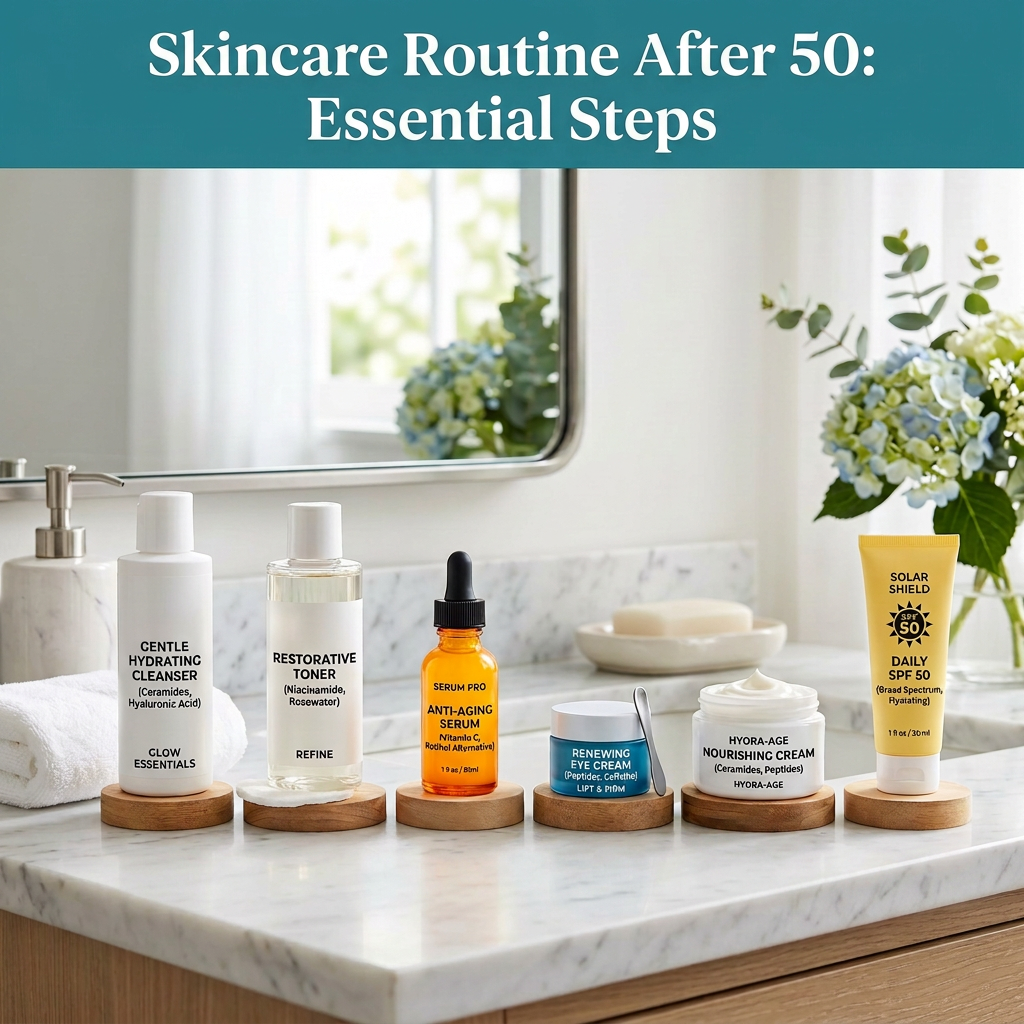
    Short answer: Go from thinnest to thickest. In the morning: cleanser, vitamin C or a serum, eye cream, moisturizer, then sunscreen last. At night: take off makeup and sunscreen, cleanse, then retinol or a treatment, eye cream and moisturizer. A good routine can be just three things: cleanser, moisturizer and sunscreen.

    Skincare after 50 can get confusing fast. Cleanser, serum, vitamin C, retinol, moisturizer, eye cream, sunscreen. Suddenly the bathroom counter looks like a chemistry lab.

    The good news is you don’t need a complicated routine. You just need to know what goes first, what belongs in the morning or at night, and what you can skip. Here’s the simple version, with a chart you can screenshot.

    The quick answer

    Thinnest to thickest. Treat before you moisturize. Sunscreen last in the morning.

    Morning: cleanse → vitamin C or serum → eye cream → moisturizer → sunscreen

    Night: remove makeup/sunscreen → cleanse → retinol or treatment → eye cream → moisturizer → face oil (optional)

    Skincare order after 50: the chart

    StepMorningNight
    1. CleanseGentle cleanser or just a rinseRemove makeup and sunscreen, then cleanse
    2. Toner (optional)Hydrating toner, if you like oneHydrating toner, if you like one
    3. Treatment / serumVitamin C, niacinamide or a hydrating serumRetinol, or a peptide or hydrating serum
    4. Eye cream (optional)Light layerLight layer
    5. MoisturizerLighter lotion or creamRicher cream
    6. Face oil (optional)Usually skipA few drops, last
    7. SunscreenBroad-spectrum SPF 30+, always lastNot needed

    Everything marked optional really is optional. A good routine after 50 can be just three products: cleanser, moisturizer and sunscreen. Add a treatment only when you have a specific goal.

    Where does each product go?

    Serum or moisturizer first?

    Serum first, moisturizer second. Serums are thinner and made to go on clean skin. Moisturizer goes on top to seal everything in. If you use more than one serum, more isn’t automatically better. Check the directions and be careful stacking strong treatments.

    Where does vitamin C go?

    Usually in the morning, right after cleansing: cleanse → vitamin C → moisturizer → sunscreen. If vitamin C irritates your skin, you don’t have to force it. Your face doesn’t get extra credit for tolerating six active ingredients.

    Where does retinol go?

    At night: cleanse → retinol → moisturizer. Retinol can cause dryness or irritation at first, so start two or three nights a week and build up. If your skin gets irritated, scale back rather than adding another product to fix it. If a dermatologist prescribed yours, follow their plan.

    Where does eye cream go?

    After serum and before moisturizer. Pat a small amount around the eye area with your ring finger. Plenty of people skip eye cream and just use a gentle moisturizer around the eyes, and that’s fine too.

    Where does face oil go?

    Last at night, over your moisturizer, to lock in moisture. In the morning, oil usually goes before sunscreen, or gets skipped so sunscreen goes on smoothly.

    Where does sunscreen go?

    Always the last skincare step in the morning, before makeup. Use broad-spectrum SPF 30 or higher, and bring it down onto your neck and the backs of your hands. If you skip everything else, don’t skip this.

    Do you need an exfoliant after 50?

    Maybe, but not automatically. Exfoliants can help rough or dull skin, but overdoing acids or scrubs leaves mature skin dry and irritated. If your face already feels tight or sensitive, simplify before adding one. If you do use one, use it at night, a couple of times a week, and not on the same nights as retinol.

    Do you have to wait between products?

    Usually not. You don’t need to stand at the mirror with a timer. Just let each layer settle for a moment so products don’t pill or slide around, and follow any specific directions on a prescription. Using too many actives at once causes far more problems than the exact number of seconds between layers.

    The layering mistake I would avoid

    Don’t start everything at once. Imagine buying a new cleanser, vitamin C, retinol, exfoliating acid and moisturizer on Monday, then waking up Friday with irritated skin. Which product caused it? Good luck figuring that out.

    Add one new product at a time and give it a couple of weeks before adding the next. That’s the easiest way to learn what your skin likes.

    What if your skin gets dry, red or irritated?

    That’s your cue to simplify, not to buy another product. Stop any recently added actives and go back to gentle cleanser, moisturizer and sunscreen until your skin calms down. Talk with your prescriber before changing a prescription. Persistent burning, swelling, rash or cracking deserves a visit to a dermatologist.

    My 4-question test before buying another bottle

    1. What problem am I trying to solve?
    2. Do I already have something that does this job?
    3. Is my current routine comfortable?
    4. Will I actually use this every day?

    If you can’t answer those, the new bottle can stay on the store shelf for now.

    Need help choosing each step? See my guides to picking a cleanser, picking a serum, picking a moisturizer, and whether Korean peptide serums are worth it.

    Three experts on skincare order

    Dermatologist Dr. Sean McGregor describes a simple morning order of cleanse, optional serum, moisturizer and sunscreen, and notes that using too many products increases the chance of side effects.

    Cosmetic chemist Dr. Michelle Wong explains why cleansing can stress the skin barrier. If your routine starts with a harsh wash, six expensive serums afterward won’t make it gentler.

    Dermatologist Dr. Rebecca Kazin recommends matching moisturizer texture to your skin’s needs and stresses daily sun protection.

    Common Questions

    What order should you apply skincare products after 50?
    Thinnest to thickest: cleanse, serum or treatment, eye cream, moisturizer, then sunscreen in the morning.

    Should serum or moisturizer go first?
    Serum first, then moisturizer.

    Does vitamin C go before or after moisturizer?
    Before. Apply vitamin C to clean skin, then moisturizer, then sunscreen.

    Do you put retinol on before or after moisturizer?
    Usually before. If your skin is sensitive, some people apply moisturizer first to buffer it. Follow the product’s directions.

    Where does sunscreen go in your routine?
    Last in the morning, after moisturizer and before makeup.

    Should you use skincare on your neck after 50?
    Yes. Bring your moisturizer and sunscreen down onto your neck and chest. More on that in how to keep your neck looking better after 50.

    What if products pill when you layer them?
    Use smaller amounts, let each layer settle, and cut back on the number of products.

    The bottom line

    Skincare after 50 doesn’t have to be a race to collect products. The goal is a routine that makes sense, feels comfortable and is easy enough to stick with. Start with the basics, add one treatment at a time, and pay attention to how your skin responds.

    Your turn: How many steps are in your routine right now? Tell me in the comments, and whether you think you could cut one.

    Skincare needs vary from person to person. This article is general skincare information and personal experience, not medical advice.

    Tom Green writes Well After 50. He was born in Pell City, Alabama, in 1962, and he’s a country boy and a true Southerner through and through. He’s just a regular, laid-back 64-year-old who keeps things simple. He shares what he learns about skincare, fitness and getting older, and what’s working for him. He’s also the author of A Practical Guide to Getting Older Without Giving Up on Yourself. Tom isn’t a doctor. He reads up on the research and passes along what’s useful, plain and simple.

    I’ve also mapped out some great tools on my new Tech for Independent Living After 50 page.

  • Skincare Mistakes After 50: 7 Habits That Can Make Skin Look Older

    Skincare Mistakes After 50: 7 Habits That Can Make Skin Look Older

    What skincare mistakes make your skin look older?

    Short answer: The most common skincare mistakes after 50 are using too many strong products at once, exfoliating too often, skipping moisturizer, going without daily sunscreen, and switching products so often you never learn what’s working. If your skin is dry, red or stinging, your routine may need less, not more.

    Sometimes the skincare routine meant to make you look better is the thing leaving your skin looking worse. If your face is dry, red, shiny in the wrong way or constantly peeling, adding another “anti-aging” product may not be the answer.

    After 50, I think one of the smartest skincare moves is learning when to stop adding things.

    Five mistakes I would look for first

    1. Using too many strong actives at once. Several effective ingredients can become an irritating combination when layered without a plan.
    2. Exfoliating too often. Smooth skin does not require aggressive scrubbing every day.
    3. Skipping moisturizer. If your skin is dry, removing moisture support can make texture look worse.
    4. Ignoring daily sun protection. A great nighttime routine cannot undo every day of unprotected UV exposure.
    5. Changing products constantly. If you replace everything every week, you never learn what is actually helping.

    Look at your skin before your shopping list

    Ask whether your skin feels comfortable. Is it tight after cleansing? Is it peeling? Are you getting redness or burning? Those clues may tell you more than a marketing label.

    Try a reset when your skin is unhappy

    If your skin is irritated, simplify. Gentle cleansing, moisturizer and daytime sun protection can give you a basic foundation while you figure out what went wrong. Then add targeted products back one at a time.

    Don’t confuse irritation with results

    Burning, persistent redness and severe peeling are not trophies proving that a product is powerful. More irritation can make the skin look rougher and can make it harder to maintain a routine.

    Give products a fair chance

    Some changes in hydration or texture may be noticeable fairly quickly, while other cosmetic improvements take longer. Constant switching makes it difficult to judge a product fairly.

    What I want from skincare after 50

    I want skin that looks healthy and cared for, not a bathroom full of products that I am afraid to stop using. A good routine should fit real life.

    Two More Mistakes Worth Adding to the List

    6. Treating every new dark spot as harmless aging. Sun spots are common, but a new, changing, bleeding or nonhealing lesion should be checked by a clinician. A brightening serum is not a diagnosis.

    7. Using products because the label says ‘mature skin.’ Shop for whether your skin is dry, oily, acne-prone or sensitive. A product marketed to older women isn’t automatically more appropriate for an older man—or for you.

    A Three-Stage Reset When Your Face Is Irritated

    First, stop introducing nonprescription active products. If you recently added several serums, scrubs or acids, simplify to a gentle cleanser, moisturizer and suitable sunscreen. Don’t stop a prescribed treatment without discussing significant side effects with the prescribing clinician.

    Next, watch for improvement. If the discomfort settles, consider whether you need an active at all. A small patch test and one new product at a time can help reveal what your skin tolerates.

    Finally, rebuild cautiously. Introduce a specific product for a specific problem, following the label and avoiding combinations that repeatedly sting. If redness, swelling, burning or rash persists, see a dermatologist.

    Three Dermatologists Explain Why ‘More’ Isn’t Better

    Dr. Anne Chapas explains that people with significant dryness, allergies or inflamed skin may not be good candidates for some retinoids. This matters when you feel tempted to solve irritation by buying something stronger.

    Dr. Tina Alster recommends starting a retinoid at a less-intense level and building tolerance gradually. A daily high-strength routine isn’t a badge of commitment.

    Dr. Sonia Badreshia-Bansal warns that irritation can cause dark marks on skin of color. It’s an especially good reason to prevent avoidable over-treatment instead of assuming peeling means progress.

    The American Academy of Dermatology’s guide to maximizing skincare results recommends introducing one anti-aging product at a time and testing a new product before full-face use.

    What Changes Can You Expect—and When?

    Moisturizer may make dry skin look smoother fairly quickly, but treatments for pigmentation and fine lines can require weeks or months. More product or more frequent application doesn’t guarantee faster results. If a product’s irritation is worse than the cosmetic concern you’re trying to improve, reconsider the routine.

    Related: The Ordinary skincare after 50 and choosing a moisturizer after 50.

    Common Questions

    Can your skincare routine make your skin look older after 50?
    Yes. Over-cleansing, using too many strong products, skipping moisturizer, or neglecting sunscreen can leave mature skin looking dry, irritated, or more lined.

    What skincare habits can make skin look older after 50?
    Using harsh cleansers, over-exfoliating, layering too many active ingredients, and failing to protect your skin from the sun can work against your routine.

    Can washing your face too much make your skin look older after 50?
    It can contribute to dryness and irritation, especially if you’re using a harsh cleanser or washing more often than your skin needs.

    Can too much exfoliation damage mature skin?
    Yes. Over-exfoliating can cause dryness, redness, irritation, and a weakened skin barrier.

    Can using too many skincare products make your skin look worse after 50?
    Yes. More products aren’t automatically better. Too many active ingredients can increase the chance of irritation.

    Should you moisturize after 50 even if you have oily skin?
    Usually, yes. Choose a lightweight moisturizer suited to your skin type rather than skipping moisturizer altogether.

    Can skipping sunscreen make your skin look older after 50?
    Yes. Regular UV exposure is a major contributor to visible skin aging, including wrinkles, uneven pigmentation, and loss of firmness.

    What is a simple skincare routine after 50?
    Morning: gentle cleanse or rinse → targeted serum if desired → moisturizer → broad-spectrum sunscreen.
    Evening: gentle cleanse → one targeted treatment if appropriate → moisturizer.

    How do you know when your skincare routine is too much?
    Persistent dryness, burning, redness, peeling, or increased sensitivity can be signs that you need to simplify your routine.

    What is the biggest skincare mistake after 50?
    Trying to do too much. A consistent, gentle routine that protects and moisturizes your skin can be more useful than constantly adding new products.

    Practical takeaway: After 50, your skincare routine should leave your skin feeling comfortable—not tight, burning, excessively dry, or irritated. If your routine is doing the opposite, simplify it.

    A gentle health note: Persistent redness, swelling, burning, rash, or other significant skin changes should be discussed with a dermatologist rather than assumed to be normal aging.

    General skincare information and personal experience, not medical advice.


    About Tom Green

    Tom Green writes Well After 50. He was born in Pell City, Alabama, in 1962, and he’s a country boy and a true Southerner through and through. He’s just a regular, laid-back 64-year-old who keeps things simple. He shares what he learns about skincare, fitness and getting older, and what’s working for him. He’s also the author of A Practical Guide to Getting Older Without Giving Up on Yourself. Tom isn’t a doctor. He reads up on the research and passes along what’s useful, plain and simple.

    I’ve also mapped out some great tools on my new Tech for Independent Living After 50 page.