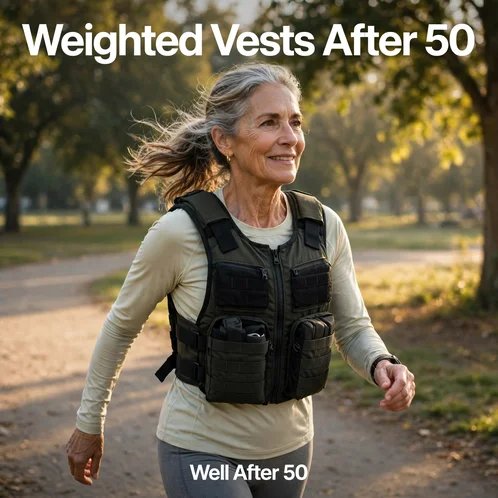
Does a weighted vest help bone density after 50?
Short answer: Not on its own, it doesn’t. I wanted the answer to be yes as bad as anybody, but the best study we’ve got says no pretty plain. A vest only helps while you’re up and moving in it, and heavy lifting plus impact work does more for your bones. There are some real weighted vest benefits, though, and I’ll get to those.
You’ve seen them too. Folks walking the neighborhood in a vest that looks like something off a SWAT team, folks at the gym, folks online swearing it’ll save their bones. It sounds so simple. Strap on a little extra weight, go for your walk, and your bones get stronger while you’re at it.
So I went and looked at what the research really says about weighted vests, bone density and osteoporosis. Some of it surprised me, and some of it’s good news if you already own one.
The year-long study that put weighted vests and bone density to the test
The best test of this idea is the INVEST trial, led by Dr. Kristen Beavers at Wake Forest. It ran a full year with 150 older adults, average age 66, about three out of four of them women. All of them were living with obesity and losing weight on purpose, which matters, because losing weight tends to cost you some bone too.
They split folks into three groups. One just did the diet. One did the diet and wore a weighted vest during the busiest part of the day, with weight added to the vest as they lost pounds. The third did the diet plus supervised strength training three times a week.
And the vest people stuck with it. They wore it a little over 7 hours a day on average and carried about 78 percent of the weight they’d lost right there in the vest.
After a year, all three groups had lost some hip bone, somewhere between 1.2 and 1.9 percent. The vest group did no better than diet alone, and the strength group didn’t either, at least not in this setting. Dr. Beavers said in the Wake Forest announcement that these strategies “alone may not be enough.”
Now here’s the part the headlines skipped. She also said it’s no reason to quit using a vest, and more than half the people in the study said they didn’t mind wearing one. So it’s not a bad tool. It’s just not a bone treatment all by itself.
Walking with a weighted vest: you’ve got to be up and moving
Earlier this year, Dr. Jason Fanning and the same research team took a second look at those vest wearers. They’d had everybody wear a little tracker, and it turned out the vest folks who spent more time standing and stepping had better hip bone results than the ones who mostly sat.
Fanning put it about as simple as you can in Wake Forest’s write-up: a vest can be a great tool, but “it’s not going to do the work for you.”
That makes good sense to me. Sitting in a vest loads the chair, not your hips. It only does your skeleton any good while you’re up on your feet in it.
The real weighted vest benefits
There’s some good news here. In August, a review in Osteoporosis International pulled together nine trials with 368 middle-aged and older adults. People who exercised in a vest did better on bone density at the hip and spine, and trimmed more body fat, than people who just went about their usual day.
But when they stacked vest-plus-exercise against the same exercise with no vest, there wasn’t enough good evidence to say the vest added anything extra. So a lot of the credit likely goes to the exercise itself.
That lines up with what Dr. Len Kravitz wrote for the American College of Sports Medicine. The main weighted vest benefits are that it’s a handy, hands-free way to make a walk burn more calories and work your legs harder. He also says walking in one doesn’t do much for bone density, and he points folks to impact work and strength training for that.
One more thing worth knowing: more weight on your frame isn’t free. In the INVEST trial, the vest group reported 17 muscle and joint complaints and the strength group 19, against just 6 for the diet-only group.
Writer Jolene Edgar, who wrote about weighted vests for Allure and talked with Dr. Beavers while the trial was still running, made a fair point on her Substack, Aesthetics Unfiltered. Some folks online took the results as proof vests are worthless, and that’s not right either. Vests aren’t magic, but they’re not junk.
Can a weighted vest help osteoporosis? The old study everybody points to
If you’ve read up on vests, you’ve probably run across a 2000 study from Christine Snow’s bone lab at Oregon State. Nine women past menopause did vest exercises plus jumping three times a week, most of the year, for five years. They held onto their hip bone. Nine other active women who didn’t do the program lost around 4 percent.
That’s real, but it was a tiny group, and you can’t pull the vest apart from the jumping. My guess is the jumping did a good share of the work.
What works better for bone density after 50
Bone answers to load that’s heavy and quick, like lifting and landing a little jump. A slow, steady walk just doesn’t push it that hard, even with a vest on.
The study that changed a lot of minds is the LIFTMOR trial out of Australia, led by Professor Belinda Beck. Researchers took 101 women past menopause, average age 65, who already had low bone mass. Half did supervised heavy lifting and impact work, things like deadlifts, squats, overhead presses and jumping, for 30 minutes twice a week for eight months.
Their spine bone density went up 2.9 percent while the comparison group lost 1.2 percent. At the top of the thigh bone by the hip, they held steady while the others lost 1.9 percent. Those women were screened carefully and coached the whole way, so this isn’t something to try heavy on your own. Find a trainer or physical therapist who knows bone health.
If you’re starting from scratch, my post on getting back the muscle you lose after 50 and the one on building muscle after 60 without getting hurt are good places to begin.
And don’t forget what actually breaks most hips, which is a fall. Balance work is what cuts falls, and I laid out a simple kitchen-counter routine in Does Walking Prevent Falls After 65?
How to start walking with a weighted vest safely
I’m not telling you to throw yours in the closet. If it gets you out the door and makes your walk a little harder, that’s a win. Here’s how the experts say to go about it.
- Start light. Both Dr. Sharon Hame at UCLA Health and the ACSM say begin around 5 percent of your body weight. That’s about 7 or 8 pounds if you weigh 150.
- Start short. The ACSM suggests about 10 minutes of weighted walking at first. Dr. Hame says keep a weighted walk to less than half the length of your usual walk when you’re starting out.
- Build up slow. Add a little weight or a little time as you get stronger. Trying to do too much too soon is how folks get hurt.
- Wear it for the walk, not all day. The ACSM warns that all the twisting and turning of a whole day in a vest can strain your muscles and joints.
- Get a good fit. Look for padding and snug straps, with the weight spread front and back. If it shifts around when you move, it doesn’t fit right. Weighted Vest
- Watch your form. If you catch yourself hunching, leaning forward or shortening your stride, or you can barely finish your walk, take some weight out.
And talk to your doctor first if you’ve got back or neck trouble, arthritis in your hips, knees or ankles, osteoporosis or a past fracture, balance problems, or heart trouble. If something starts hurting, take it off and get it checked.
My take from the porch
I’m not buying a vest to save my hips. I’ll keep walking, I’ll keep doing my strength work, and I’ll keep holding onto that kitchen counter for my balance work, because that’s what the research backs up.
If you like your vest, I reckon keep wearing it, men and women both. Just wear it while you’re moving, start light, and don’t count on it to do the heavy lifting for you. Think of it as a helper, not a cure.
This is general information only, not medical advice, and it’s no substitute for your own doctor who knows your history. If you’ve fallen, feel unsteady or have a condition that affects your bones or balance, talk to your doctor before starting a new exercise routine.
— Tom, Well After 50
Sources
- Beavers et al., INVEST in Bone Health trial, JAMA Network Open, June 2025 (150 adults, 12 months)
- Wake Forest announcement on the INVEST results, June 2025
- Fanning et al., time spent upright and vest results, Frontiers in Aging, 2026
- Wake Forest News, Wearing a weighted vest to strengthen bones? Make sure you’re moving, March 2026
- Wang et al., weighted vests and bone health review, Osteoporosis International, August 2026 (9 trials, 368 adults)
- Snow et al., Long-term exercise using weighted vests prevents hip bone loss in postmenopausal women, Journal of Gerontology, 2000
- Watson, Beck et al., LIFTMOR trial, Journal of Bone and Mineral Research, 2018 (101 women)
- UCLA Health, Should you walk with a weighted vest?, October 2025
- Len Kravitz, Are Weighted Vests Worth the Hype?, American College of Sports Medicine
- Jolene Edgar, Can a Weighted Vest Halt Bone Loss?, Aesthetics Unfiltered, July 2025
Join the Conversation