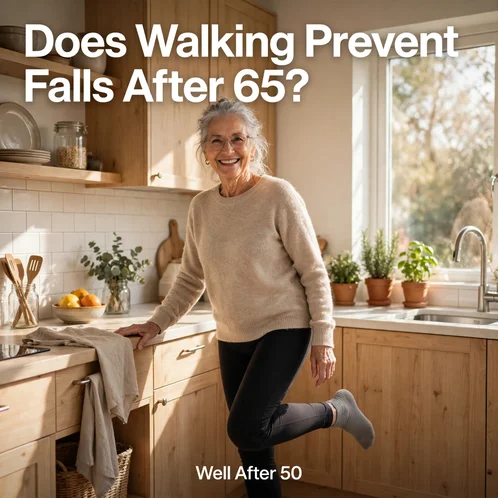
Does walking prevent falls after 65?
Short answer: Walking alone doesn’t cut falls much. In one Australian trial of 386 inactive people 65 and older, a 48-week walking program didn’t lower falls in any way that mattered. What works is balance exercise. A big review of 108 trials found balance and everyday-movement exercise cut falls by about 24 percent, and about 34 percent when strength work was added.
Does walking prevent falls after 65? Not on its own, it doesn’t. I wish somebody had sat me down and told me that plain years ago.
Now don’t get me wrong, I walk every day and I’m not about to quit. It’s good for my heart and my blood pressure and my mood, and it gets me out the door. But walking doesn’t teach your body how to catch itself when your toe snags a rug, or how to stay steady when you spin around too quick in the kitchen. That takes a different kind of work, and the good news is it’s simple, it’s free and you can do it holding onto your own counter.
So I went digging through what the research actually says. Here’s what I found and what I’m doing about it.
The big study that surprised a lot of folks
This September a big Cochrane review came out on tailored fall-prevention plans. That’s the kind where a professional checks all your risks and builds a plan just for you. It pulled together 110 studies and close to 49,000 older people living in their own homes.
Here’s what caught me off guard. Those fancy personalized plans did no better than plain good fall-prevention advice, the kind you’d get in a leaflet. Matter of fact, compared with just getting the advice, people on the tailored plans probably had a few more falls, not fewer.
That doesn’t mean fall prevention doesn’t work. It means the complicated stuff isn’t the magic answer. Dr. Cynthia Swarnalatha at the University of Exeter, one of the lead researchers, put it pretty simple: give people good advice and get them exercising. Those simpler things looked like they help the most.
So what does work? Balance work
It’s the boring-sounding answer, but it’s the one that holds up.
Back in 2019, Professor Cathie Sherrington and her team in Sydney rounded up 108 exercise trials with more than 23,000 people, average age 76. Exercise overall cut the rate of falls by about 23 percent. Balance and functional exercise, the kind that challenges your balance on purpose and works the moves you do every day, cut falls by about 24 percent. That was high-certainty evidence, the strongest kind they’ve got.
Put some strength work together with that balance work and the drop looked even bigger, around 34 percent fewer falls. Tai Chi helped too, about 19 percent fewer.
And walking all by itself? The evidence was uncertain. Not proven to stop falls and not proven not to. In one Australian trial, 386 inactive people 65 and older followed a walking program for 48 weeks. They walked more, sure enough, but their falls didn’t go down in any way that mattered.
Dr. Peter Attia, who wrote the bestseller Outlive, says he treats stability as just as important as cardio and strength. I reckon he’s onto something. You can have a strong heart and still go down hard if your balance is shot.
So keep walking. Just don’t count on walking alone to keep you on your feet.
If Tai Chi sounds like more your speed, an easy way to get started at home is Tai Chi Walking for Weight Loss. It’s a beginner 28-day plan with 10 minutes a day, it comes in large print, and it mixes slow Tai Chi moves into your walk, so you’re working your balance while you’re out there anyway. It’s a how-to book, not a study, so think of it as a friendly guide to the kind of moves the research backs.
As an Amazon Associate I earn from qualifying purchases. It doesn’t cost you a penny more.
The 10-minute routine your doctor might hand you
Here’s a newer one I really liked. It’s called the eSTEPS trial, led by Nancy Latham and her team at Mass General Brigham, and it came out in JAMA Network Open this October. They followed 11,945 people 65 and older who were at risk of falling, across 22 regular doctor’s offices.
Doctors in half the offices got a tool that helped them hand patients a simple home exercise plan that fit their balance level, plus handouts or an app to follow along. Those offices ended up with about 9 percent fewer falls showing up in patients’ medical records.
Nine percent might not sound like a lot, but think about this. Only about 1 in 5 of those patients actually got the exercise plan. Imagine what could happen if more of us got it and stuck with it. It’s not some fringe idea either. The US Preventive Services Task Force tells doctors to recommend exercise to folks 65 and up who are at higher risk of falling. So if your doctor hasn’t brought it up, you bring it up.
A lot of these home routines come from the Otago Exercise Programme, which was built in New Zealand. Done properly with a physio, about 30 minutes three times a week, it cut falls and fall injuries by about 35 percent, and folks over 80 got the most out of it.
A starter routine for your kitchen counter
Here’s a simple version you can start with at home. Stand at the kitchen counter so you’ve got something to grab.
- Chair rise. Stand up from a sturdy chair and sit back down, 10 to 15 times. Use your hands only if you need to.
- One-leg stand. Hold the counter, lift one foot, hold for 5 to 10 seconds, then switch. Build up over the weeks.
- Heel-to-toe walk. Walk a straight line along the counter with your heel right in front of your toes, holding on at first.
- Toe stands. Rise up on your toes, hold a second, then lower down slow, 10 to 15 times.
Do it three times a week and push it a little each week. Hold a second longer, use one less finger on the counter, stand a little further from the wall. Give it at least 12 weeks and then keep right on going. The World Falls Guidelines say the same thing: balance and strength work that gets a little harder over time, and that you keep doing. This isn’t a 12-week fix, it’s a habit.
If you want to see where your balance stands right now, try the 10-second one-leg test from Dr. Claudio Gil Araújo’s research. I wrote about it in The Floor Test That May Predict Longevity. And if you’re working on the strength side too, my post on getting back the muscle you lose after 50 is a good place to start.
If you already feel unsteady or dizzy, or you’ve had a fall, talk to your doctor first and ask about seeing a physical therapist. Don’t try to push through pain or dizziness on your own.
It’s not just exercise
Two more things in the research are worth knowing.
Your home. Occupational therapist Lindy Clemson and her team looked at 22 trials with 8,463 people in 2023. Fixing trip hazards like loose rugs, cluttered walkways, poor lighting and missing grab bars cut falls by about 26 percent overall, and about 38 percent in people at higher risk, like folks who’d already had a fall or just come home from the hospital. That 38 percent number was the strongest kind of evidence there is. It didn’t do much for people who weren’t at much risk to begin with, and just reading about it without fixing anything didn’t help much either. So go walk your house tonight and look at it like a stranger would.
Your medicines. Some medicines are strongly tied to falls, especially certain antidepressants, antipsychotics and sleeping pills. That doesn’t mean stop taking them, and never stop a medicine on your own. It means ask your doctor or pharmacist for a medicine review, and speak up if you feel dizzy, sleepy or wobbly after starting something new.
Getting your eyes checked matters for plenty of reasons, but in the trials, just fixing vision didn’t clearly cut falls on its own. Still get them checked.
My take from the porch
I’m still walking every day, and I hope you are too.
But I’m adding the balance work three times a week, ten minutes at my kitchen counter. The way I see it, walking keeps you moving and balance work keeps you upright. Men and women both, it doesn’t matter, our balance slips as we get older if we don’t use it, and it comes back when we do.
Start with the good advice like the researchers said, clear out the trip hazards, and then do the exercise. That’s the part that can cut falls by about a quarter, and it’s never too late to start.
This is general information only, not medical advice, and it’s no substitute for your own doctor who knows your history. If you’ve fallen, feel unsteady or have a condition that affects your balance, talk to your doctor before starting a new exercise routine.
— Tom, Well After 50
Sources
- Swarnalatha et al., Multifactorial and multiple component interventions for preventing falls, September 2026 (110 studies, 48,919 people)
- University of Exeter news release on the 2026 falls study
- Sherrington et al., Exercise for preventing falls in older people living in the community, 2019 (108 trials, 23,407 people)
- Latham et al., eSTEPS trial, JAMA Network Open, October 2026 (11,945 people 65+)
- Robertson et al., Otago Exercise Programme meta-analysis, 2002
- Clemson et al., Environmental interventions for preventing falls in older people living in the community, 2023 (22 trials, 8,463 people)
- US Preventive Services Task Force, falls prevention recommendation, June 2024
- World Falls Guidelines, Age and Ageing, 2022
- Dr. Peter Attia, author of Outlive





What do you think? Have a tip, question, or personal experience to share? We’d love to hear from you. After 50, there’s always something new to discover—and your thoughts might help someone else, too!