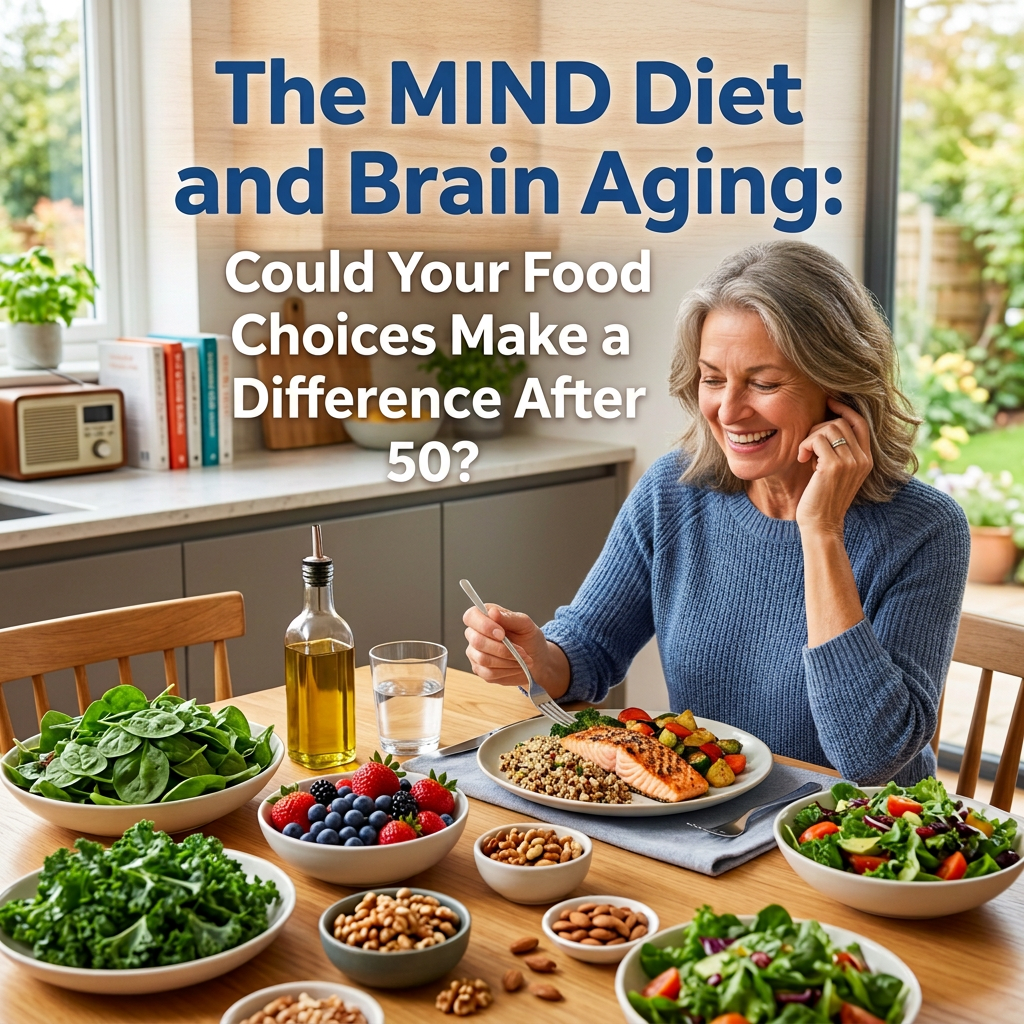
What you eat may matter for your brain as you get older. A 2026 study gives us another reason to pay attention to the food on our plates—but the finding needs a little explanation.
Researchers studying adults in the long-running Framingham Heart Study found that people who followed the MIND diet more closely experienced slower loss of gray matter over time. The difference associated with a three-point increase in their MIND diet score was estimated to be equivalent to about 2.5 years of age-related brain change over the study period.
That is an interesting finding. But let’s keep it honest: the study does not prove that this diet makes your brain younger, prevents Alzheimer’s disease, or guarantees that your memory will stay sharp. It does give us a practical reason to look at how we eat—and a few changes that may be worth making after 50.

What Is the MIND Diet?
MIND stands for Mediterranean-DASH Intervention for Neurodegenerative Delay. The name is a mouthful, but the basic idea is simple. It combines elements of the Mediterranean and DASH eating patterns, with an emphasis on foods that fit into a generally healthy way of eating.
You don’t need special powders, expensive supplements, or a refrigerator full of trendy products to understand it. The focus is on everyday foods:
- Leafy green vegetables: spinach, kale, collards and other greens.
- Other vegetables: add variety and color to your meals.
- Berries: blueberries, strawberries and other berries.
- Whole grains: oatmeal, brown rice and whole-grain bread.
- Beans and legumes: beans, lentils and chickpeas.
- Nuts: a small handful can be an easy snack.
- Fish and poultry: practical sources of protein.
- Olive oil: a useful replacement for some less healthful fats.
The eating pattern also encourages limiting foods such as butter, fried foods, pastries, sweets, and large amounts of red meat and cheese. This isn’t about never eating a piece of cake again. It’s about what you do most of the time, not whether every meal is perfect.
What Did the Researchers Find?
The 2026 research examined 1,647 adults from the Framingham Heart Study Offspring cohort. Participants were followed for a median of about 12 years, and researchers used brain imaging to examine changes in brain structure over time.
People with higher MIND diet scores tended to show slower loss of gray matter. Gray matter contains many of the brain’s nerve cell bodies and plays important roles in thinking, memory and other functions.
The researchers estimated that each three-point increase in the MIND diet score was associated with a difference equivalent to about 2.5 years of age-related gray-matter change over the follow-up period.
Here’s the important distinction: this was an observational study. Researchers observed people’s eating patterns and brain changes; they did not randomly assign participants to follow the diet and prove that the diet caused the difference. People who eat healthier diets may also differ in other ways, including exercise habits, sleep, income, education and general health. Researchers can account for some factors, but they cannot eliminate every possible explanation.
So the finding is promising evidence of an association, not a guarantee of results. And a change in brain structure is not the same thing as proving better memory or preventing dementia.
Berries and poultry stood out in the researchers’ analysis of individual foods. That doesn’t mean blueberries or chicken are miracle foods. The study looked at a broader dietary pattern, and its findings about individual foods should not be treated as proof that any one item independently slows brain aging.
Still, both can fit easily into everyday meals. You could add berries to oatmeal at breakfast, have them with plain yogurt, or keep frozen berries on hand when fresh ones are expensive. Poultry can be part of a simple lunch or dinner alongside vegetables and a whole grain.
You don’t have to buy organic berries, expensive specialty foods, or a stack of supplements to get started. Use foods you enjoy and can afford.
You don’t have to overhaul your kitchen overnight. Start with one or two changes you can keep doing.
If vegetables aren’t a regular part of lunch or dinner, start there. Frozen vegetables count, too. They’re convenient, often affordable and can save preparation time.
Fresh berries are great, but frozen ones are useful when prices are high. Add a handful to oatmeal or yogurt, or eat them as a snack.
Try oatmeal for breakfast, brown rice with dinner, or whole-grain bread for a sandwich. You don’t have to change everything at once.
Beans and lentils can be inexpensive, filling sources of fiber and plant protein. Add them to soup, chili, salads or a side dish.
A single meal won’t determine your future brain health. What matters more is the pattern you build over time. If you eat fried food today, that doesn’t mean you’ve failed. Make your next meal a reasonable one and keep going.
Eating well matters, but it isn’t the only thing worth doing after 50. Regular physical activity, adequate sleep, social connection, and managing conditions such as high blood pressure and diabetes are also important parts of looking after your health.
If you have concerns about memory or changes in thinking, talk with a qualified health professional rather than assuming food alone will solve the problem. Be wary of products that promise to reverse brain aging or prevent dementia. A promising study is not proof that a supplement, a single food, or a particular diet can deliver those results.
My Takeaway
I like research that gives us something practical to work with without pretending there’s a magic answer.
The MIND diet study doesn’t mean we can turn back the clock on our brains. It does suggest that healthier eating patterns may be associated with more favorable changes in brain structure as we age.
For me, the sensible approach is straightforward: eat more vegetables, include berries and beans when you can, choose whole grains more often, and pay attention to the overall pattern. Keep moving, get enough sleep, and look after your general health, too.
You don’t have to eat perfectly. You just have to keep making reasonable choices.
Getting older is part of life. Giving up on looking after yourself doesn’t have to be.

The Easy and Tasty MIND Diet Cookbook for Seniors Over 60: A Brain Health Cookbook With Flavorful Recipes Based on the Mediterranean DASH Diet to Support Healthy Aging (Healthy Cookbooks for Seniors) — by Amber Hampton
Common Questions About the MIND Diet
Does the MIND diet prevent Alzheimer’s disease?
We cannot say that it does. Research has found associations between the MIND eating pattern and certain measures of brain health, but this study does not prove that the diet prevents Alzheimer’s disease or other forms of dementia.
What does “2.5 years less brain aging” actually mean?
It refers to an estimated difference in age-related gray-matter loss associated with a higher MIND diet score over the study period. It does not mean participants’ brains were literally rejuvenated by 2.5 years, nor does it guarantee better memory.
Do I need to follow the MIND diet perfectly?
No. Focus on the overall pattern of your eating rather than making every meal perfect. Start with changes that are affordable, enjoyable and realistic for you.
Are blueberries the most important food for brain health?
The study highlighted berries among the foods associated with favorable brain-imaging findings, but it did not establish blueberries as a miracle food. The overall eating pattern matters, and no single food guarantees protection.
Is the MIND diet expensive?
It doesn’t have to be. Frozen vegetables and berries, dried or canned beans, oatmeal, brown rice and other basic foods can help you build meals without relying on costly specialty products. Compare prices and choose what works for your budget.
Research and Further Reading
- Chen H. and colleagues, “Adherence to the MIND diet and longitudinal brain structural changes over a decade: evidence from the Framingham Heart Study Offspring cohort.” Journal of Neurology, Neurosurgery & Psychiatry, 2026. Read the original study on PubMed.
- Harvard Health Publishing, “MIND diet may slow age-related brain changes”.
For another perspective on brain health and aging, explore the work of neuroscientist Dr. Lisa Mosconi, whose research and writing focus on the brain and women’s brain health. This is additional reading, not a claim that she reviewed or endorsed this article.
Keep Reading
Explore more Well After 50 articles on practical nutrition, fitness, skincare and healthy aging.
About the Author
Thomas Green writes Well After 50, sharing practical, plain-spoken ideas about skincare, fitness, nutrition, wellness, and making the most of life after 50.
Health Disclaimer
This article is for general educational purposes and is not a substitute for individual medical advice, diagnosis or treatment. Research findings do not guarantee individual results. Talk with a qualified health professional about dietary changes if you have medical conditions, special nutritional needs, or concerns about memory or thinking.
Affiliate Disclosure
Some Well After 50 articles may contain affiliate links. If you purchase through qualifying links, the site may earn a commission at no additional cost to you. Recommendations should be based on usefulness and relevance, not on a promise of health benefits.
What do you think? Have a tip, question, or personal experience to share? We’d love to hear from you. After 50, there’s always something new to discover—and your thoughts might help someone else, too!