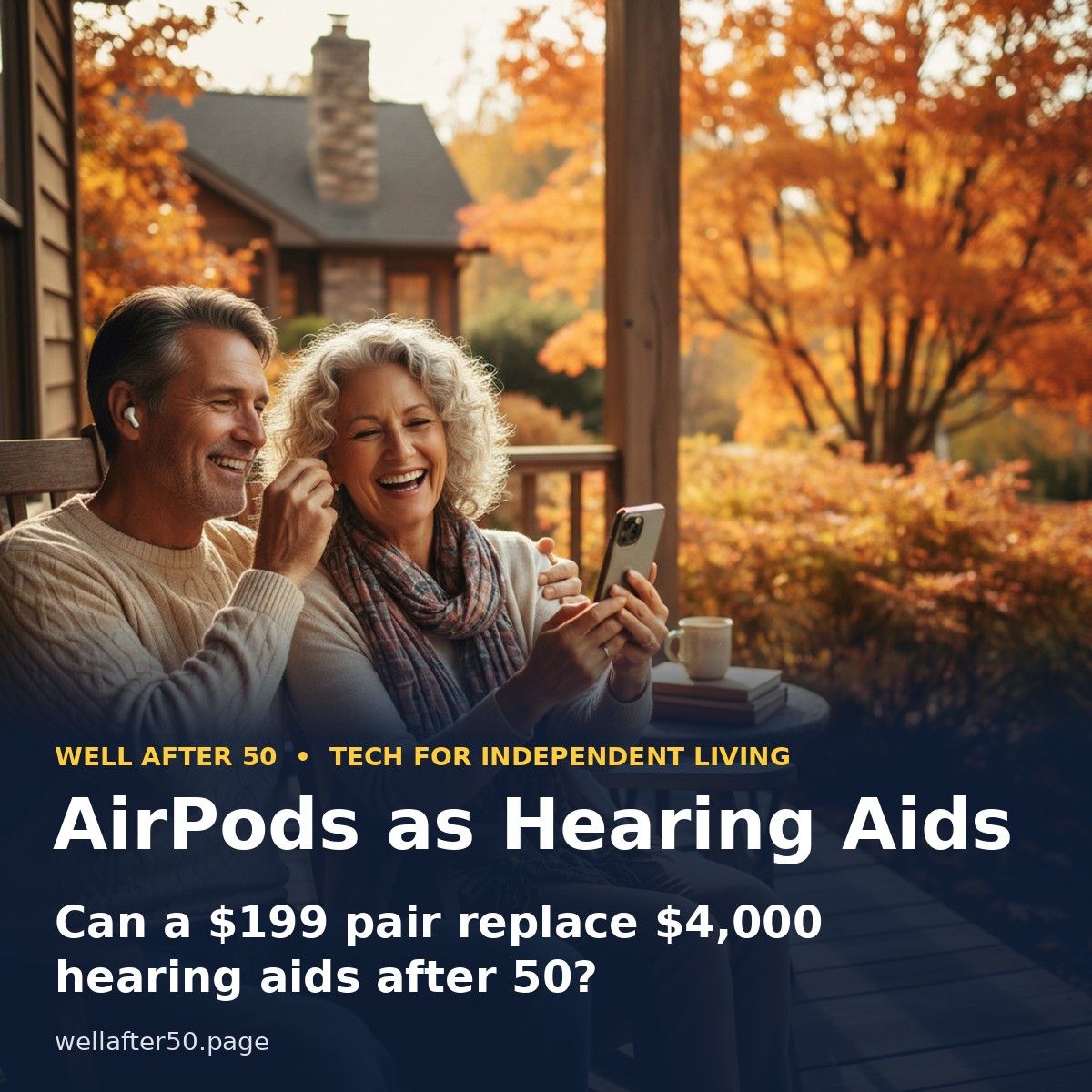
Apple’s earbuds can now work as over-the-counter hearing aids, and they’re on sale for Black Friday. Here’s who they help, who they don’t, and what to check before you spend a dime.
Most of us don’t like to talk about this one. Somewhere along the way, a lot of us started saying “What?” more than we used to. We turn the TV up a notch. We nod along at the restaurant table and hope we laughed at the right part.
And when we finally think about doing something about it, we find out a pair of hearing aids from an audiologist can run $4,000 to $7,000. Original Medicare doesn’t pay for them. That’s enough to make anybody put it off another year.
So when folks heard that a pair of Apple AirPods Pro can work as a hearing aid, and that AirPods Pro 3 are going for about $199 in early Black Friday sales, down from $249, a lot of ears perked up.
Check today’s price on AirPods Pro 3 at Amazon
I dug through the reviews, the studies and what the hearing experts are saying. Here’s what I found, for men and women alike.
Can AirPods Really Work as Hearing Aids?
Yes, for some people. In September 2024 the FDA authorized Apple’s hearing aid feature as the first over-the-counter hearing aid software. It runs on AirPods Pro 2 and AirPods Pro 3. Regular AirPods don’t have it.
It’s made for adults with mild to moderate hearing loss. That’s the kind where quiet talk gets muddy, voices blur in a busy room and you keep asking folks to repeat themselves. It is not made for severe hearing loss.
Here’s what you get:
- A free hearing test. You take it at home with your AirPods and iPhone. It takes about five minutes and gives you a hearing chart you can show your doctor.
- Hearing aid mode. The AirPods use your test results to turn up the sounds you’re missing, like voices, and leave the rest alone.
- Hearing protection. They can turn down loud noise like a lawn mower, a concert or a ballgame crowd.
- Regular earbuds too. Phone calls, music, audiobooks and TV straight into your ears.
AirPods vs. Hearing Aids: The Real Costs
| Option | Typical price | Battery | Who it fits |
|---|---|---|---|
| AirPods Pro 3 | About $199 to $249 | About 8 to 10 hours in hearing mode | Mild to moderate loss, iPhone users |
| Other OTC hearing aids | About $300 to $1,500 | Most run 16 to 24 hours | Mild to moderate loss |
| Prescription hearing aids | About $4,000 to $7,000 a pair | All day | Any level, fitted by a pro |
Prices come from 24/7 Wall St., the National Council on Aging and HearingTracker. They change with sales, so check before you buy.
What the Hearing Experts Say
I didn’t want to take Apple’s word for it, so I looked at what the people who test hearing aids for a living found.
The good news. The audiologists at HearingTracker, Dr. Steve Taddei and Dr. Abram Bailey, gave AirPods Pro 3 a 4.1 out of 5. They said they can do the job as OTC hearing aids at a fair price. Jill Waldbieser at the National Council on Aging found they sound good in quiet places and make a fine way to try hearing help before buying real hearing aids.
The not-so-good news. Tech writer Stewart Wolpin tested them for Techlicious and called them “still flawed” as hearing aids. In loud places, like a room full of people talking, they sometimes cut back the help right when he needed it most. Wind noise was a problem outdoors. And the settings were scattered across several screens, which he said would be hard on folks who aren’t comfortable with phones. HearingTracker’s testers had the same gripe about the settings.
Pretty much everybody agrees on three things:
- The battery won’t last all day. Plan on putting them back in the case for a while at lunch.
- They’re easy to spot. Some folks don’t mind that. Earbuds are everywhere now. Others want something more hidden.
- Fit matters. If they keep slipping, try the other ear tip sizes in the box.
Why Your Hearing Matters More Than You Think
This isn’t just about catching the punch line. Dr. Frank Lin, founder of the Cochlear Center for Hearing and Public Health at Johns Hopkins, co-led a big study called ACHIEVE, published in The Lancet in 2023.
Across everybody in the study, hearing help didn’t make a big difference in memory and thinking over three years. But in one group of older adults who were most at risk, it slowed the decline in thinking skills by 48%. The researchers say that finding needs more study, but it’s worth knowing.
Hearing also ties into getting out and staying connected. When it’s hard to follow a conversation, a lot of us quit going to the places where conversations happen. If that sounds familiar, I wrote about making new friends after 50 too.
Who Should Try AirPods First (and Who Shouldn’t)
They might be a good fit if:
- You already use an iPhone.
- Your trouble is mild, like soft voices, TV dialogue or busy restaurants.
- You want to try hearing help without spending thousands.
- You’d use them part of the day, not from sunup to bedtime.
Skip them and see a doctor or audiologist first if you have:
- Hearing that went away suddenly in one or both ears.
- One ear that’s a lot worse than the other.
- Ringing, roaring or buzzing in your ears.
- Ear pain or dizziness.
- No idea how bad your hearing loss is.
That list comes from Dr. Devin McCaslin, director of audiology at Michigan Medicine. Those can be signs of something a doctor needs to look at. He also points out that 72% of men over 65 have never had a hearing test, so fellas, that one’s for us.
And if you use an Android phone, these aren’t your best pick. The hearing features need an iPhone or iPad. An OTC hearing aid built for Android will serve you better.
How to Turn On the Hearing Aid Feature
Once your AirPods Pro 2 or 3 are connected to an iPhone with the latest iOS update, here’s how it goes, according to Apple’s own instructions:
- Put your AirPods in and sit somewhere quiet.
- Open Settings and tap your AirPods’ name near the top.
- Tap Take a Hearing Test. If you don’t see it, tap Hearing Health first. It takes about five minutes.
- Go back and tap Hearing Assistance.
- Follow the steps and turn on Hearing Aid.
Already have a hearing test from an audiologist? You can use those results instead of taking Apple’s test.
Ask a family member or a neighbor to help with setup if you’d like. I reckon there’s no shame in that. Better to have somebody show you twice than fumble with it for a week.
Shopping Smart This Black Friday
- Make sure it says “Pro.” Only AirPods Pro 2 and Pro 3 have the hearing aid feature. The cheaper regular AirPods don’t.
- Buy from a real store. Fake AirPods are all over the internet, and they won’t have the hearing features. Stick with Apple, Amazon (sold by Amazon), Best Buy, Target, Walmart or Costco.
- Check the return policy. If they don’t fit your ears or don’t help, you want your money back.
- Look at your Medicare Advantage plan. Some plans give an allowance for hearing aids. Open enrollment runs through December 7, so it’s a good time to compare plans on Medicare.gov.
- Got an HSA or FSA? Ask your plan whether OTC hearing aids count. Some do.
The Bottom Line
AirPods Pro won’t replace a good pair of prescription hearing aids for everybody. But for a lot of us with mild hearing trouble and an iPhone in our pocket, they’re a cheap, easy way to find out how much we’ve been missing.
Like the old saying goes, an ounce of prevention is worth a pound of cure. Take that free hearing test. Even if you never use the hearing aid part, you’ll know where you stand. Then you can decide what to do next.
Want more tools that make life easier after 50? Take a look at AI Tools for Seniors Living Alone and Best Free AI for Seniors.
Other Voices Worth Following
Dr. Frank Lin, founder of the Cochlear Center for Hearing and Public Health at Johns Hopkins and co-lead researcher of the ACHIEVE study.
Dr. Abram Bailey and Dr. Steve Taddei, audiologists at HearingTracker, who test and compare hearing aids for regular folks.
Jill Waldbieser, senior writer at the National Council on Aging, who reviewed AirPods as hearing aids.
Stewart Wolpin, tech writer at Techlicious, for an honest look at where AirPods fall short.
Research Sources
- Apple Newsroom, “Apple introduces groundbreaking health features” (September 2024)
- Axios, “FDA authorizes first OTC hearing aid software for Apple’s AirPods Pro”
- National Council on Aging, “AirPods as Hearing Aids”
- HearingTracker, Apple AirPods Pro 3 review
- Techlicious, “Apple AirPods Pro 3 as Hearing Aids Are Still Flawed”
- ACHIEVE study results, The Lancet (2023)
- Michigan Medicine, “Should you get an over-the-counter hearing aid or see a hearing specialist?”
- 24/7 Wall St., “Medicare Still Won’t Buy Your Hearing Aids” (June 2026)
- Apple Support, “Use hearing health features with AirPods Pro 2 or AirPods Pro 3”
Well After 50 isn’t paid by Apple. This article has one Amazon affiliate link, so I may earn a small commission if you buy through it, at no extra cost to you. Prices were checked in early November 2026 and may change.
Keep Reading
- AI Tools for Seniors Living Alone: Free and Cheap Ways to Stay Independent at Home
- 8 Amazing Technologies Changing Life After 50
- Best Free AI for Seniors: How to Use ChatGPT and Gemini Like a Personal Assistant After 50
- How to Save Money Without Making Life Miserable After 50
Your Turn
Have you tried the AirPods hearing test, or are you wearing hearing aids already? What helped and what didn’t? Tell me in the comments. Somebody reading might be on the fence and could use your two cents.
About the Author
Tom Green writes Well After 50. At 64, he shares practical research and everyday experiences about staying active, living well, and making the most of life after 50. He believes it’s never too late to keep learning.
Tom is not a doctor, audiologist or tech professional. This article is for general education only. Talk with your doctor or a hearing professional about your own hearing.
I’ve also mapped out more helpful tools on my Tech for Independent Living After 50 page.
