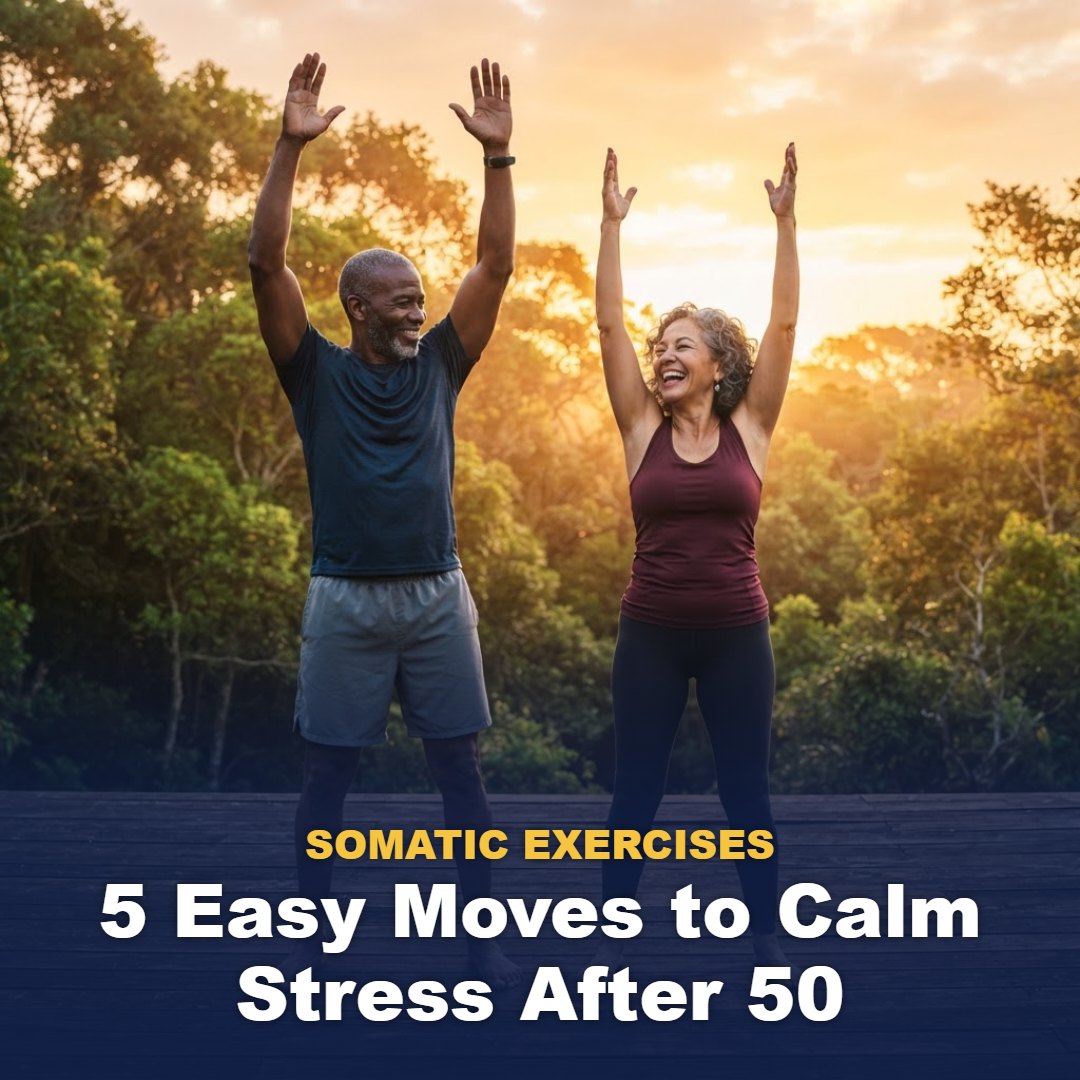
You know the feeling. Your shoulders are hiked up around your ears. Your jaw’s clenched and you didn’t even notice till just now. You’re worn out, but when you lie down at night, your mind won’t hush.
That’s your nervous system stuck in high gear. And trying to think your way out of it hardly ever works.
That’s where somatic movement comes in. It’s not a workout, and it’s not about burning calories. It’s slow, gentle movement paired with easy breathing and paying attention to how your body feels. The whole point is to help your body shift out of “fight or flight” and back toward rest.
I work out four days a week, but this is a different animal. It’s not about getting stronger. It’s about getting calmer, and that’s a skill most of us never got taught.
Where “somatics” came from
The word goes back to Thomas Hanna, a philosopher and movement teacher who coined the term “somatics” in 1976. Hanna had an idea I find pretty interesting for folks our age. He believed a lot of the stiffness and soreness we blame on getting older is really our muscles getting stuck in old habits from years of stress, and that we can teach them to let go again.
You don’t have to buy all of that to get something out of it. But I reckon most of us have a spot or two that’s been tight so long we forgot it could feel any different.
What the research says (and doesn’t)
Here’s the part that impressed me. In 2023, Stanford researchers Dr. David Spiegel and Dr. Andrew Huberman ran a study with 111 people. Each person did five minutes a day of either a breathing exercise or mindfulness meditation for a month.
Everybody felt better. But the breathing groups got a bigger boost in good mood than the meditation group, and the winner was a simple move called the cyclic sigh. I’ll show you how to do it below.
Now, an honest word. You’ll see somatic workouts online promising to “release trauma stored in your muscles.” That goes past what the science shows. Peter Levine’s Somatic Experiencing is a real body-based approach that trauma therapists use, and a 2021 review in the European Journal of Psychotraumatology called the early results encouraging. But the researchers also said it needs better studies before anybody can make big claims.
So here’s how I’d put it: this is for everyday stress. If you’re carrying real trauma, a trained therapist is the right call.
Five “movement snacks” you can do at home
Instead of one long session you never get around to, try short little breaks through the day. Most take five minutes or less. No equipment, no special clothes, no experience needed.
1. Morning body scan and shoulder rolls (2 to 5 minutes)
Sit on the edge of the bed when you wake up. Close your eyes and slowly notice your body from head to toe. What feels tight? Heavy? Warm? Don’t fix anything yet. Just notice. Then roll your shoulders slowly, tip your head gently side to side, and let out a long sigh.
2. The cyclic sigh (5 minutes)
This is the one from the Stanford study:
- Breathe in through your nose until your lungs feel full.
- Then sneak in one more short sip of air through your nose.
- Let it all out slowly through your mouth, nice and long, till you’re empty.
Keep that up for about five minutes. The long, slow breath out is what tells your body it’s okay to ease off.
3. Desk or chair breaks (1 to 3 minutes, a few times a day)
Roll your shoulders. Stretch your neck and open and close your hands. Sway a little side to side. Feel your feet flat on the floor and take a few breaths where the breath out is longer than the breath in. Small and often beats big and rare.
4. Evening unwind (3 to 10 minutes)
Lie on the floor or your bed with your knees bent. Scan your body again and let the leftover tension go where it can. Try some gentle rocking, a slow twist to each side, or just cross your arms and give yourself a hug. Some folks like a minute of loose, gentle shaking of the arms and legs. It feels sillier than it looks, and better than you’d expect.
A warm mug in your hands afterward makes a nice way to close out the day. Azomalli Tea makes a cacao shell tea that tastes a lot like hot cocoa, and it’s caffeine-free, so it won’t keep you up. (affiliate link)
5. The 4-7-8 wind-down (before bed)
This one comes from Dr. Andrew Weil, the integrative medicine doctor. Breathe in quietly through your nose for a count of 4, hold for 7, then breathe out through your mouth for 8. Do four rounds. If you’ve been waking up at 3 AM, it’s worth keeping in your back pocket.
One safety note: if you ever feel dizzy or overwhelmed, stop. Put a hand on your chest or belly, breathe normally, and look around the room till you feel settled.
Three rules that make it work
- Go slow. Slow movement is what your nervous system reads as “safe.”
- Keep it painless. This isn’t a “no pain, no gain” deal. If it hurts, back off.
- Pay attention to how it feels, not how it looks. Nobody’s grading you.
Five minutes most days does more than one big hour on a Sunday. Over time, you’ll start noticing tension sooner, before it turns into a headache or a bad night. Like the old saying goes, an ounce of prevention is worth a pound of cure.
If stiffness is part of your story, you might also like morning stiffness after 50: what helps and how posture can make you look older.
Other voices worth following
- Nancy L. Fitness: Nancy is a certified personal trainer who coaches folks over 50 on mobility and comfort, and her husband Roy covers strength for the fellas.
- Sixty and Me: Margaret Manning’s big community site for women over 60. Her piece on finding your center at any age fits right in with this.
- Essential Somatics: teaches movement based on Thomas Hanna’s work and offers a free beginner mini course if you want to go deeper.
Common Questions
What is somatic movement?
Slow, gentle movement done with easy breathing and close attention to how your body feels. The goal is to calm your nervous system and ease tension, not to burn calories.
Can somatic exercises help with stress after 50?
They can help with everyday stress. A 2023 Stanford study found just five minutes a day of slow breathing, especially the cyclic sigh, improved mood more than meditation did.
What is the cyclic sigh?
Breathe in through your nose, take a second short sip of air on top, then breathe out slowly through your mouth. Repeat for about five minutes.
Does somatic movement release trauma?
That claim goes beyond the evidence. Body-based trauma therapy shows early promise, but for real trauma, work with a trained therapist.
How long should I do somatic exercises each day?
Five minutes most days is a good start. Short and regular works better than long and rare.
You can’t think your way out of a stressed-out nervous system. But you can move and breathe your way toward calm, a few minutes at a time.
If you missed last week’s post, I looked at retinal vs. retinol for mature skin. Next week wraps up this series: the best non-invasive alternatives to face fillers.
Where do y’all carry your stress, shoulders, jaw, or somewhere else? Tell me in the comments.
— Tom
This is general wellness information, not medical advice. If you have a health condition, a history of trauma, or pain that worries you, talk with your doctor or a qualified professional before starting something new.
Keep Reading
About Tom Green
Tom Green writes Well After 50. He was born in Pell City, Alabama, in 1962, and he’s a country boy and a true Southerner through and through. He’s just a regular, laid-back 64-year-old who keeps things simple. He shares what he learns about skincare, fitness and getting older, and what’s working for him. He’s also the author of A Practical Guide to Getting Older Without Giving Up on Yourself. Tom isn’t a doctor. He reads up on the research and passes along what’s useful, plain and simple. Read more about Tom.
Advertisement

Self-Guided Somatic Therapy Workbook (affiliate link)