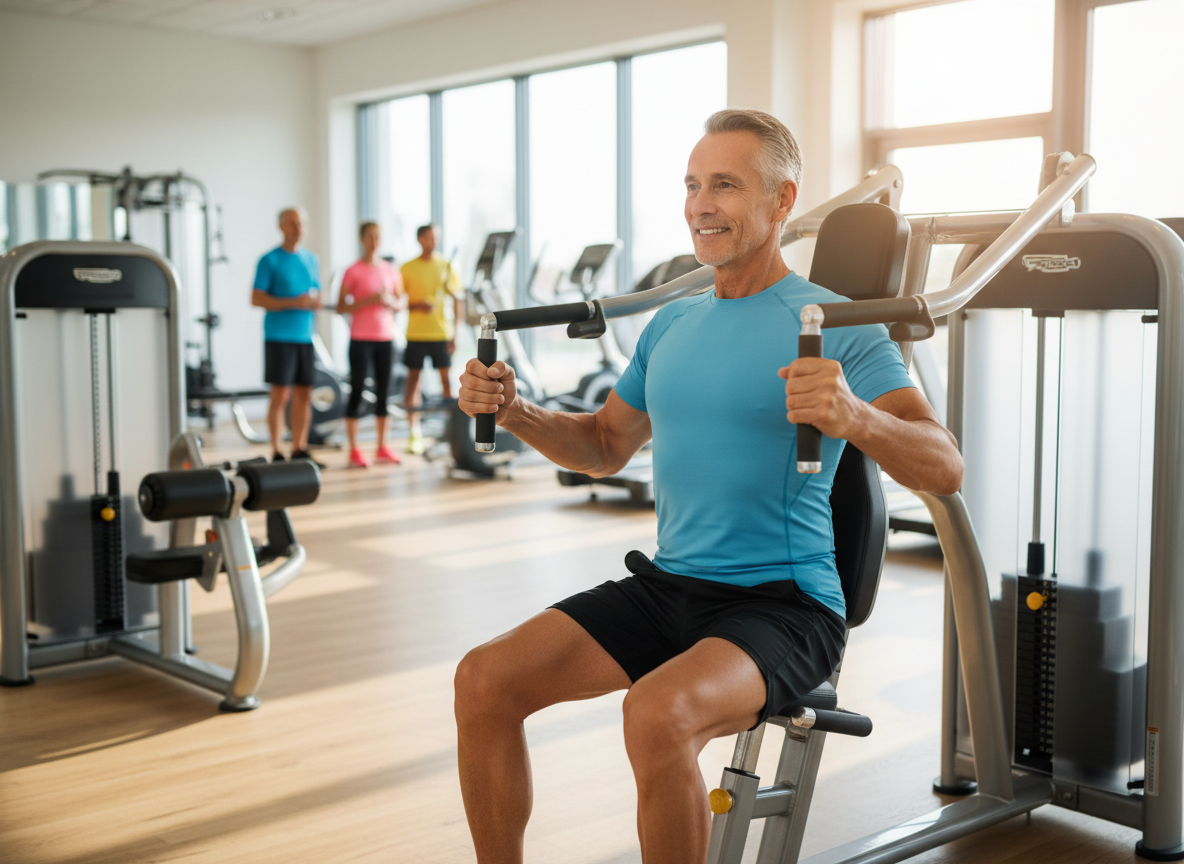
Getting stronger after 60 is absolutely possible. But the goal is not to prove how much you can lift. It is to build and keep the strength that helps you live your life—getting out of a chair, carrying groceries, climbing stairs, traveling, working around the house, and feeling capable in your own body.
For me, the biggest lesson is that strength after 60 is a long game. You need enough challenge to make your muscles adapt, but you also need consistency, recovery, good technique, and a plan you can actually stick with.
1. Make consistency more important than having a perfect workout
You do not need to destroy yourself every time you train. A workout that challenges you and leaves you able to come back and train again is more useful than an occasional heroic session followed by days of recovery.
Think in weeks and months, not one workout. Showing up regularly gives your muscles repeated opportunities to adapt.
2. Control the weight instead of letting the weight control you
Good strength training is not about throwing a weight around. Choose resistance you can control, use a sensible range of motion, and keep your attention on the movement.
If you have to jerk, swing, bounce, or twist to finish a repetition, it may be time to reduce the resistance. Effort is useful; sloppy repetitions are not.
3. Train the major muscle groups
A simple program can go a long way. Include a leg movement, a chest press, a rowing movement, a pulldown or other back exercise, and targeted work for areas you want to develop.
Machines, cables, free weights, and bodyweight exercises can all work. Machines can be especially convenient because they provide stability and let you concentrate on producing force with the muscles you are training.
4. Progress does not always mean adding more weight
Progress can mean one more good repetition, better control, a better range of motion, or making the same weight feel easier. Those are real improvements.
When you can consistently perform your target repetitions with good form, a small increase in resistance may be appropriate. There is no prize for forcing the weight up before you are ready.
5. Give recovery the same respect as training
The workout provides the stimulus. Your body needs recovery to respond to it. Sleep, adequate food, enough protein, and rest between hard sessions all matter.
If you are constantly exhausted, adding more training is not automatically the answer. Sometimes improving recovery is the better move.
6. Do not use soreness as your scorecard
You do not have to be extremely sore for a workout to be productive. If every workout leaves you struggling to move for several days, consistency becomes harder.
I would rather have a challenging workout that I can recover from and repeat than chase soreness just to feel like I worked hard.
7. Track your progress
Write down the exercise, resistance, repetitions, and anything important about how it felt. You do not need a complicated spreadsheet.
After several weeks, those notes can show you something your memory cannot: whether you are actually doing more, controlling the movement better, or handling exercises that once felt difficult.
A simple week can be enough
You do not need a dozen exercises for every body part. A straightforward routine that covers the major muscles and gives you enough recovery can be very effective.
- Lower body: leg press or another comfortable squat pattern, leg curl, leg extension, and calves.
- Upper body: chest press, row, pulldown, comfortable shoulder work, and a few arm exercises.
- Core: choose exercises that you can perform comfortably and consistently.
- Progression: gradually improve repetitions, control, range of motion, or resistance.
My take after 60
I still want my workouts to challenge me. I just do not believe every workout needs to leave me feeling wrecked. I want to train, recover, come back, and make another small improvement.
If you are over 60 and starting—or starting again—keep it simple. Train the major muscles, use resistance you can control, gradually ask your body to do a little more, and give yourself enough recovery to adapt.
Getting older changes some of the rules. It does not mean you stop getting stronger.
This article is based on personal experience and general fitness information, not medical advice. If you have an injury, medical condition, or significant pain, talk with a qualified healthcare professional about exercise that is appropriate for you.
Leave a Reply