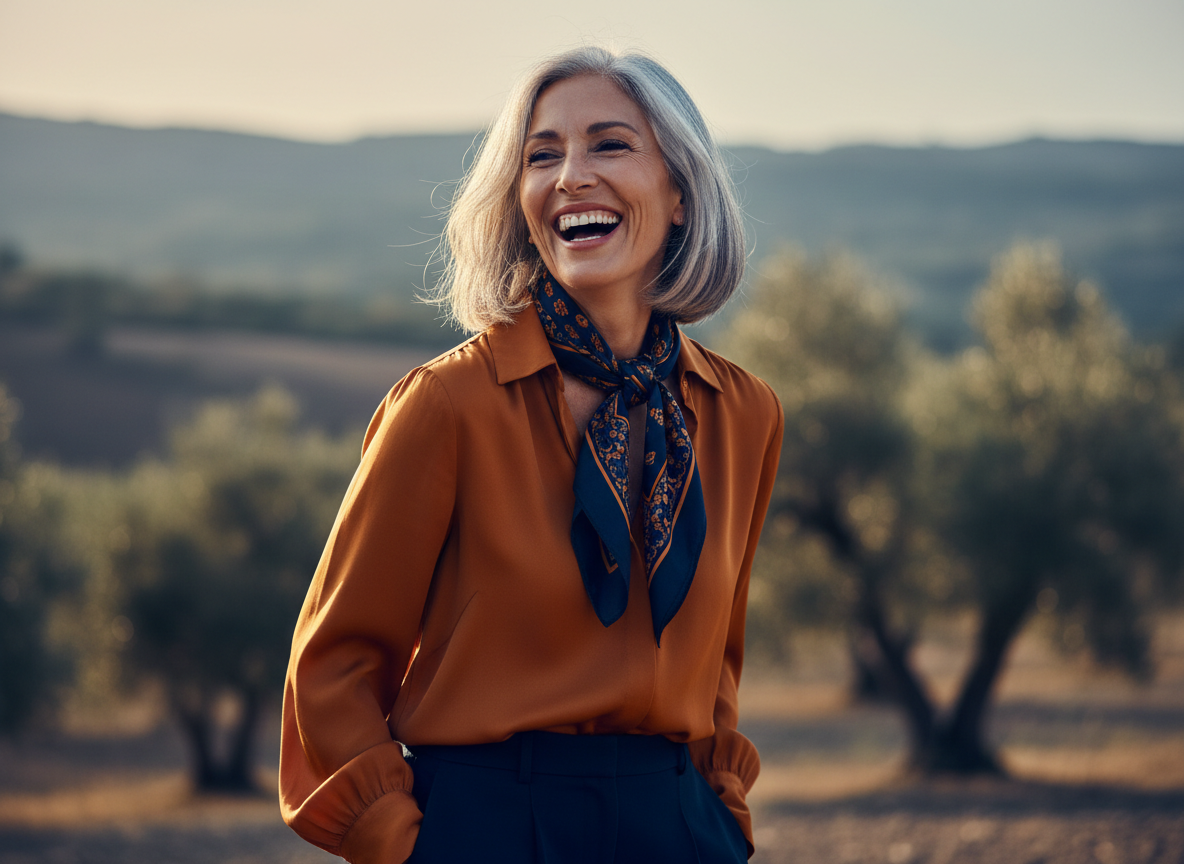
If you’ve had the same hair color for 20 or 30 years, you may eventually notice something strange. The color that once made your face look bright and healthy doesn’t always have the same effect anymore.
Your skin changes as you age. Your natural hair color changes. Gray appears. Hair can become finer or less dense. Even the amount of contrast between your hair and your face can change.
So the question is a good one: What color hair makes an older woman look younger?
The answer isn’t simply blonde, brunette, gray or red. The most flattering color is usually the one that adds some brightness and dimension without creating a harsh contrast with the face. And that can be different for every woman.
Why Hair Color Can Change the Way Your Face Looks
Hair surrounds your face, so it naturally affects how people see your complexion and facial features.
Research has found that hair color and skin color work together in perceptions of age and appearance. One study found that lighter hair was associated with younger age judgments in participants, particularly among women with lighter skin, and that the relationship between hair and skin color mattered.
Research on facial aging has also found that facial contrast tends to decrease with age. Changes in contrast can affect how young or old a face is perceived.
That may help explain why some women feel that their old hair color suddenly looks “too harsh” or that their face looks washed out. It isn’t necessarily that the color is bad. It may simply no longer be working with the way your coloring has changed.
So, What Hair Color Is Most Youthful?
For many women over 50, the answer is a softer version of the color they already have, with some dimension around the face.
- Soft blonde instead of very dark blonde
- Caramel or honey highlights in brown hair
- A softer brunette instead of almost-black brown
- Dimensional auburn instead of a flat red
- Blended silver instead of a dull, one-dimensional gray
- A mixture of gray, silver and lighter pieces instead of fighting every new gray hair
The goal isn’t necessarily to look younger. The goal is to make the face look brighter, healthier and more balanced. And sometimes that has a surprisingly youthful effect.
1. Soft Blonde Can Brighten the Face
Blonde can be particularly flattering when it isn’t too yellow, too gray or too stark. A softer blonde with some variation can reflect light around the face and keep the overall appearance from looking heavy.
AARP’s hair-color guidance for older women discusses using silvery or golden highlights to blend gray and add light around the face.
But going dramatically lighter isn’t automatically better. A very pale blonde can make some complexions look washed out. A good colorist can adjust the tone so the blonde works with the person’s natural coloring.
2. Caramel and Honey Can Make Brown Hair Look Softer
If you’re naturally brunette, you don’t have to become blonde to get a brighter appearance.
Adding subtle caramel, honey or mocha tones can give brown hair more dimension. This can be especially useful when an old dark brown color has started looking flat or severe.
Instead of coloring the entire head several shades lighter, a colorist can place lighter pieces around the face and throughout the hair. That creates movement without making the change look artificial.
3. Don’t Automatically Go Darker
This is one of the biggest mistakes women sometimes make when trying to cover gray. They go darker. Then darker again.
Eventually the hair may be a very deep brown or almost black. That can create a strong contrast against the face. For some women it looks fantastic. For others, it can make the complexion look tired and draw attention to facial lines.
That doesn’t mean dark hair makes every older woman look older. It means the amount of contrast matters.
4. Gray Hair Can Absolutely Look Beautiful
Gray isn’t automatically an “aging” hair color. A woman with beautiful silver or white hair can look incredibly striking.
Some women’s natural gray comes in bright silver, platinum or white, while others develop a more steely or ashy gray that can drain warmth from the complexion. Highlights can sometimes add life and brightness.
If you’re going gray, you don’t necessarily need to cover it. You may simply need to make the gray work better with your complexion.
- A shorter, more modern cut
- Silver-enhancing products
- Strategic highlights
- Better conditioning
- Removing yellow or dull tones
- Adding some dimension
What About Red or Auburn?
Red can be beautiful on an older woman, particularly when it works with her natural coloring. Softer shades such as auburn, cinnamon, copper and copper-brown can provide warmth without overwhelming the face.
The important word is dimension. Hair that has several related tones generally looks more natural than a flat block of one color.
The Hair Color Trick That May Matter More Than the Color
You don’t necessarily need to change your entire hair color. Sometimes the biggest difference comes from what happens around your face.
A few strategically placed lighter pieces can brighten the area around the eyes and cheeks. Fine highlights can create a softer, more natural transition than thick, obvious streaks.
You can tell your stylist: “I don’t want to completely change my color. I just want something that brightens my face and looks natural.”
What About Black Women and Women With Deeper Skin Tones?
The same basic principle applies, but the actual color choices can be very different. Hair color should work with the individual’s complexion rather than following a one-size-fits-all rule.
Deep brunette, espresso, warm brown, auburn, copper, honey highlights and even silver can all be beautiful depending on the person’s skin tone, natural hair and desired level of contrast.
A Simple Way to Choose Your Color
Before making a dramatic change, stand near a window in natural daylight and look at your current hair next to your face.
- Does this color brighten my complexion?
- Does it make my eyes stand out?
- Does it make my skin look dull or yellow?
- Does the color look harsh against my face?
- Does my hair look flat, or does it have dimension?
- Do I actually like it?
My Take
I don’t think women over 50 need to chase a magic “youthful” hair color.
What seems more useful is understanding how color interacts with your face. If your old color suddenly feels too harsh, try softening it. If your hair looks dull, try adding dimension. If gray is making your complexion look washed out, consider blending it rather than automatically covering everything.
And if you love your natural gray? Keep it.
There is no rule saying a woman has to look younger to look great. Sometimes the most flattering hair color isn’t the one that makes you look 10 years younger. It’s the one that makes you look bright, healthy, confident and completely comfortable in your own skin.
This article is for general information and personal experience, not professional hair-color or medical advice.
Leave a Reply