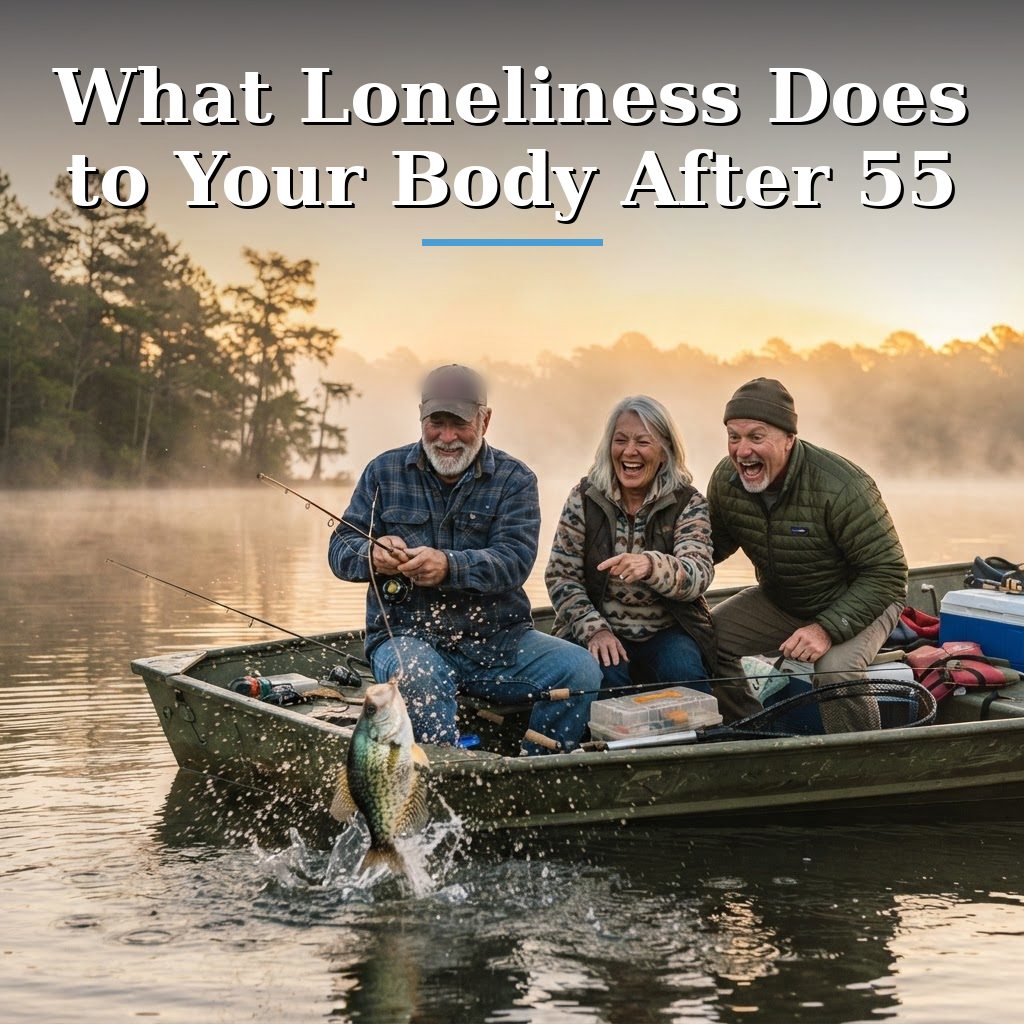
How does loneliness affect you physically after 55?
Short answer: When loneliness hangs on, your body stays in a low hum of stress. Over time that can push your blood pressure up, stir up inflammation, break up your sleep and make it harder to fight off viruses. It’s also tied to higher odds of heart disease, stroke and dementia. The good news is the fix doesn’t cost a dime, and your body starts settling down once you get back around people you enjoy.
Thanksgiving’s almost here, and for a lot of folks that means a full table and too much pie. For a lot of others it means a quiet house and the TV on for company. I’ve been reading up on what that second kind of holiday does to us, and I’ll be honest, it surprised me. Loneliness gets into your blood pressure, your blood work and even your sleep.
Stick with me, though, because this one ends on a hopeful note. The same research that shows how hard loneliness is on the body also shows how much good company helps. And men and women both have a better shot at it in these years than most people think.
How common is loneliness after 55?
More common than folks let on. AARP surveyed about 3,300 Americans 45 and older and found that 4 in 10 are lonely, up from about a third in 2010 and 2018. For the first time, men came out lonelier than women, 42% to 37%. Men were also more likely to say they don’t have a single close friend.
Now for the part I liked. In that same survey, loneliness was highest for folks in their late 40s and 50s, and it dropped after 60. AARP has seen that same pattern every time they’ve asked since 2010. So if you’re coming up on 60 or already past it, the odds are leaning your way.
What does loneliness do to your body?
Dr. Robert Waldinger explains it about as plain as anybody. He’s a Harvard psychiatrist who runs the Harvard Study of Adult Development, which has followed the same men and their families since 1938, and he co-wrote the bestseller The Good Life about what they learned.
When something upsets you, your body goes into fight-or-flight. Your heart speeds up and your blood pressure climbs, which is normal. Most of the time you go home, talk it over with somebody who listens, and your body calms back down. Waldinger told the Harvard Gazette that when you don’t have anybody like that, your body can stay stuck in a low level of fight-or-flight. More stress hormones and more inflammation keep running through you, and little by little they wear on your whole system.
The National Institute on Aging says it about the same way. The hurt of being lonely sets off the same stress response in your body that physical pain does. Let that go on long enough and it can lead to chronic inflammation and a weaker immune system.
Can loneliness raise your blood pressure?
It sure looks that way. The late John Cacioppo was a University of Chicago scientist who spent his whole career on loneliness and wrote a book on it called Loneliness. He and researcher Louise Hawkley followed 229 people ages 50 to 68 for five years. By year four, the loneliest folks had seen their top blood pressure number rise 14.4 points more than the people who were happiest with their social lives. That held up even after they accounted for age, weight, smoking and drinking.
Hawkley pointed out something worth remembering. You can have a whole lot of people around and still be lonely if those relationships leave you empty, and you can live a quiet life and be just fine if the few people in it really matter to you. So what really counts is how connected you feel inside.
Margaret Manning, who started Sixty and Me, one of the biggest sites for women over 60, draws that same line. She says there’s nothing wrong with being alone, and introverts need it to recharge their batteries. Loneliness is when you want real company and can’t find it. Gretchen Rubin, the bestselling author of The Happiness Project, goes a step further on her blog and lays out seven different kinds of loneliness, because she says you have to know why you feel lonely before you can fix it. The one that rang truest for me is what she calls quiet-presence loneliness. You’ve got friends and family, but you miss having somebody around the house to fix a cup of coffee with or sit beside on the sofa.
High blood pressure doesn’t usually hurt, which is why it sneaks up on so many of us. If yours has been creeping up, it’s worth mentioning to your doctor how much company you’ve been keeping lately, right along with the salt and the exercise.
Does loneliness weaken your immune system?
This was the part that got me. Cacioppo teamed up with Steve Cole at UCLA to look inside the immune cells of lonely people, including adults in their 50s and 60s. In the loneliest folks, the genes that turn up inflammation were working overtime, while the genes that help fight off viruses were turned down.
The researchers’ thinking makes a lot of sense to me. Way back, being cut off from your people meant real danger, so the body seems to treat loneliness like a threat and brace for the wrong kind of fight. That leaves lonely folks a little more open to the colds and bugs going around, which is no small thing heading into winter.
Can loneliness mess with your sleep?
It can. Cacioppo and Cole’s work found that lonely, isolated people wake up more during the night and spend less of their time in bed actually asleep. Anybody who’s laid there at 3 AM listening to a quiet house knows that feeling. Poor sleep then feeds right back into blood pressure, mood and your immune system, so it all piles on. If that 3 AM wake-up sounds familiar, I wrote a whole post on waking up at 3 AM.
How does loneliness affect your heart and brain?
The numbers get big when you look at the heart and brain. When Dr. Vivek Murthy was U.S. Surgeon General, he put out a national advisory on loneliness. It found that poor social connection is tied to a 29% higher risk of heart disease and a 32% higher risk of stroke. For older adults, it was tied to a 50% higher risk of developing dementia.
Murthy then went on to co-chair a World Health Organization commission on the same subject. Their 2025 report found that about 1 in 6 people worldwide are lonely, and that loneliness is linked to more than 871,000 deaths a year. That works out to about 100 every hour.
Now, in fairness, most of this research shows a strong link, and it can’t prove loneliness alone caused every one of those problems. Lonely folks also tend to move less, sleep worse and skip the doctor. But when study after study points the same direction, I’d rather pay attention than wait around for more proof.
Why do friendships thin out in retirement?
Arthur Brooks, the Harvard professor who writes the happiness column for The Atlantic, has a way of putting it that cleared it up for me. He says most of us have a lot of what he calls deal friends, the folks we’re friendly with because of work or because they’re handy to know. Then there are real friends, the ones you’d call with any silly thought. Deal friends are fine, but they tend to crowd out the real ones. And I reckon when the job ends, a lot of those deal friends go right along with it.
Longevity doctor Peter Attia talked this over with Brooks on his podcast and came away with some good advice. If you look around and can only name deal friends, don’t panic. That part of your life just needs some time and effort, and real friendships grow best when you spend your free time together on something you both enjoy.
Fellas, that’s exactly why so many retired guys are finding their way to Men’s Sheds, the community workshops I wrote about in Men’s Sheds: Where Retired Guys Go to Make Real Friends. Ladies, a lot of y’all already know this one by heart. The friend you walk with every Tuesday becomes the friend you call when the news is bad.
How do you turn loneliness around?
Start smaller than you think you need to. Waldinger told the Gazette that “our social life is a living system, and it needs maintenance too.” His advice is to sit and think about who you miss, or who you haven’t heard from in a while, and then send them a text or pick up the phone. He says people are amazed at how warmly folks answer back.
That one tiny step is where I’d start, today, before supper. After that, go looking for something that repeats. A standing breakfast with your old buddies, the same walking group every week, a volunteer shift, choir practice or a card night. Seeing the same faces over and over is how strangers turn into friends, and the National Institute on Aging suggests most of the same things.
For the lonely evenings when nobody’s around to call, Leo Babauta has some gentle advice. He writes Zen Habits, one of the best-known blogs on simple living, and he admits he gets lonely himself when his wife and kids are out of town. Instead of running from that feeling or covering it up with snacks and the TV remote, he suggests sitting with it a minute and getting curious about it. Then go find people at a class or a club and take a real interest in them. I like that, because it takes the shame out of feeling lonely in the first place.
One more thing that doesn’t get talked about enough. If your hearing has slipped, get it checked. The NIA notes that folks who can’t hear well often pull back from people because they’re embarrassed about missing what’s being said. A hearing aid might do more for your social life than any new hobby.
Does good company really help your health?
It does, and this is my favorite finding of the whole bunch. When the Harvard researchers looked back at their men in their 80s, they expected the best predictor of who aged well to be something like cholesterol or blood pressure at age 50. It wasn’t. Waldinger said the best predictor of a happy and healthy life was how satisfied they were with their relationships.
Think about that for a minute. The people you share a cup of coffee with may matter as much to your heart as anything your doctor prescribes. Like the old saying goes, if you want a friend, you’ve got to be one.
Common Questions
Can loneliness make you physically sick?
It can raise your risk. Long-lasting loneliness keeps the body’s stress response switched on, which is linked to inflammation, higher blood pressure, poorer sleep and a weaker defense against viruses.
Does loneliness raise blood pressure?
In a University of Chicago study of adults 50 to 68, the loneliest people saw their systolic blood pressure rise 14.4 points more over four years than the least lonely people.
Is being alone the same as being lonely?
No. Loneliness is feeling less connected than you want to be. Some people live alone and feel fine, while others are surrounded by people and still feel lonely.
Are men lonelier than women as they get older?
In AARP’s latest survey of adults 45 and older, 42% of men were lonely compared with 37% of women, and men were more likely to have no close friends.
How can I feel less lonely after 55?
Reach out to one person you miss today, then join something that meets on a regular schedule so you see the same faces often. Get your hearing checked if conversations have gotten hard to follow.
So who’s the one person you’ve been meaning to call? Tell me in the comments, then go call them. I’d love to hear how it went.
Tom
About Tom Green
Tom Green writes Well After 50. He was born in Pell City, Alabama, in 1962, and he’s a country boy and a true Southerner through and through. He’s a regular, laid-back 64-year-old who keeps things simple and passes along what he learns about getting older. Tom isn’t a doctor. He reads up on the research and shares what’s useful, plain and simple. Read more about Tom.
Health note: This article is for general education and isn’t medical advice. If loneliness or low moods have been hanging on for weeks, let your doctor know. It’s a real health concern, and help is out there.
Research & Sources
- AARP: Loneliness Is on the Rise, Affecting 4 in 10 Older Adults
- Harvard Gazette: Robert Waldinger on Relationships and Health
- National Institute on Aging: Loneliness and Social Isolation
- University of Chicago: Feeling Lonely Adds to Blood Pressure Increase in People 50 and Older
- University of Chicago: Loneliness Triggers Cellular Changes That Can Cause Illness
- Live Science: Why Loneliness Can Be Deadly
- NPR: The Surgeon General’s Advisory on Loneliness
- World Health Organization: Social Connection Linked to Better Health
- Gretchen Rubin: 7 Types of Loneliness (and Why It Matters)
- Sixty and Me: The Difference Between Being Alone and Being Lonely After 60 (Margaret Manning)
- Zen Habits: When You’re Lonely (Leo Babauta)
- The Atlantic: The Best Friends Can Do Nothing for You (Arthur Brooks)
- Peter Attia: Real Friends Over Deal Friends



What do you think? Have a tip, question, or personal experience to share? We’d love to hear from you. After 50, there’s always something new to discover—and your thoughts might help someone else, too!